
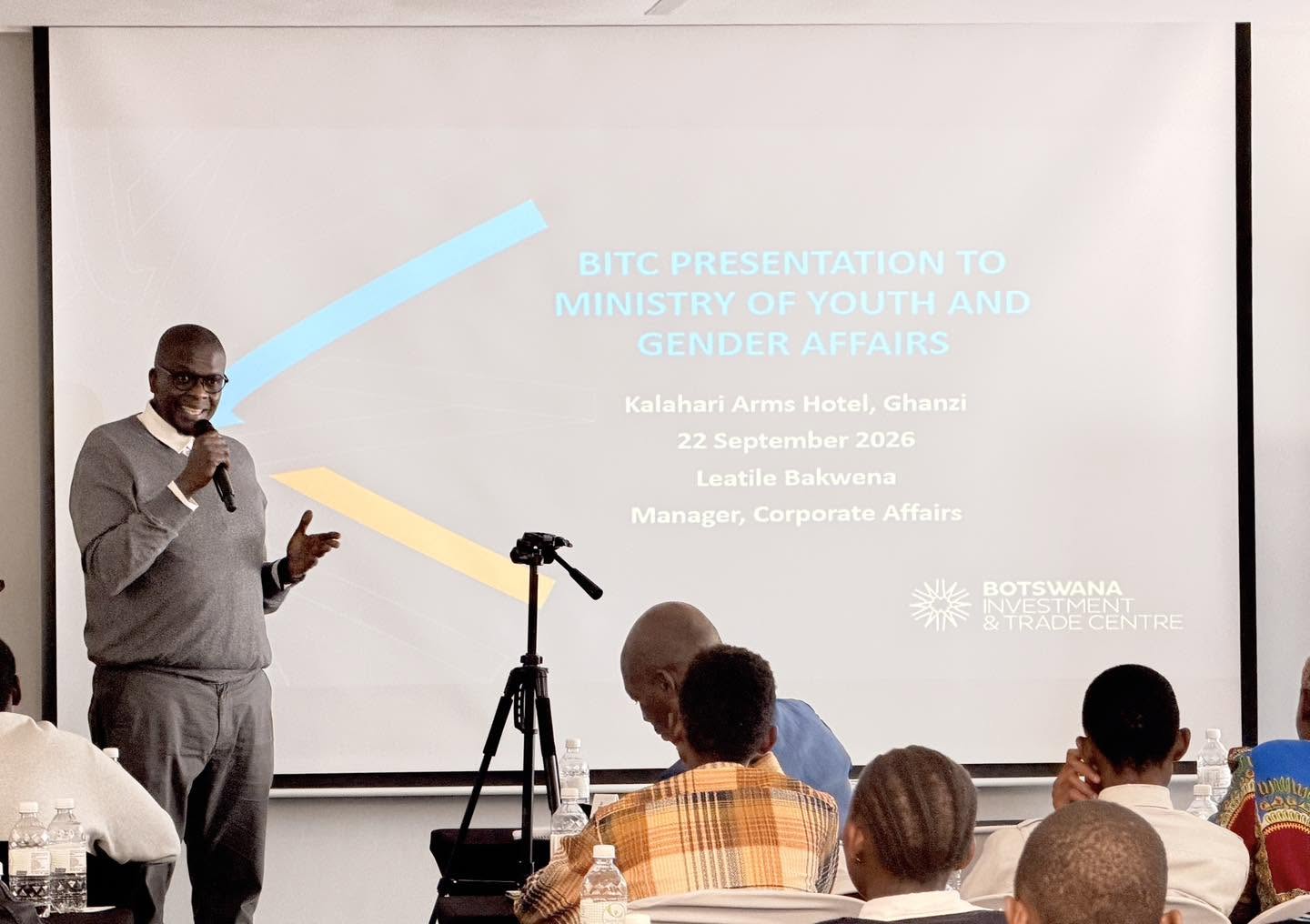
The Botswana Investment and Trade Centre (BITC) has encouraged young people in Ghanzi to turn their skills, ideas and entrepreneurial ambitions into businesses capable of serving markets beyond their local communities. The message came during the Ministry of Youth and Gender Affairs’ Youth Opportunities and Skills Engagement, held in collaboration with UNICEF Generation Unlimited (GenU). The engagement brought together young people and key stakeholders to discuss practical opportunities in entrepreneurship, skills development, investment, trade and business support. Held under the theme “Connecting Young People to Opportunities, Skills and Platforms for a Better Future,” the event focused on helping young people understand the opportunities available to them and how they can take practical steps toward economic participation. BITC’s participation highlighted the importance of connecting youth-owned businesses with information, markets, investment opportunities and platforms that can support their growth.
Representing BITC at the engagement, Corporate Communications Manager Leatile Bakwena explained the organisation’s role in supporting Botswana’s investment and trade ambitions. BITC works across areas that include investment promotion, export development, trade facilitation, market intelligence and nation branding. These functions are important for entrepreneurs who want to move from simply operating a business to developing products and services that can compete in wider markets. Access to reliable market information can help business owners understand customer needs, identify opportunities and make better decisions about their products. Trade platforms and export development support can also help businesses explore opportunities outside their immediate communities and potentially expand into markets across Botswana and beyond.
The engagement in Ghanzi placed particular attention on entrepreneurship and the role young people can play in Botswana’s economic development. For many aspiring entrepreneurs, starting a business can be challenging because they may have limited access to capital, market information, business networks or technical support. Opportunities to interact with institutions such as BITC can help young people understand where to seek information and what forms of support may be available. The engagement also created a platform for young people to learn more about the relationship between skills development and business creation. Having a useful skill is an important starting point, but understanding customers, pricing, competition, branding and market demand can help turn that skill into a sustainable business.
Bakwena also highlighted Brand Botswana, PrideMark and the Pusha BW campaign as initiatives that can support efforts to promote Botswana-made products and strengthen local brands. These initiatives place attention on the quality, identity and competitiveness of products associated with Botswana. For young entrepreneurs, building a recognisable brand can help distinguish their products from competitors and give customers a clearer reason to choose what they offer. Quality is equally important because a strong brand needs to be supported by products and services that consistently meet customer expectations. The message to young business owners was therefore not simply to start businesses, but to develop products that can earn customer trust and compete in increasingly competitive markets.
The focus on Botswana products is particularly relevant for entrepreneurs seeking to expand beyond their immediate communities. A product that succeeds in one location may still need improvements in packaging, pricing, quality, distribution or marketing before it can compete in another market. Understanding these differences requires research and a willingness to learn from customers. Entrepreneurs can use feedback to identify weaknesses, improve their products and respond to changing demand. This process can help businesses develop from small local operations into enterprises with the potential to serve customers across Botswana and eventually explore regional or international markets.
The advice shared during the engagement was straightforward: find the gap, conduct research and start small. Identifying a gap means looking closely at what customers need and determining whether an existing product or service meets that need effectively. Market research can help entrepreneurs understand who their customers are, what they are willing to pay and what competing businesses already provide. Starting small can allow a business owner to test an idea without taking on unnecessary costs before the product has demonstrated demand. As the business learns from customers and improves its offering, it can gradually build the confidence, experience and customer base needed for further growth.
The role of market intelligence is especially important in this process. Entrepreneurs need more than enthusiasm to make informed business decisions, particularly when they are considering expansion into new markets. Information about customer preferences, competitors, pricing, regulations and distribution channels can influence whether a product has a realistic opportunity to succeed. Access to useful market information can also help businesses identify potential customers and understand where their products may have a competitive advantage. BITC’s emphasis on market intelligence therefore connects directly with the practical challenges faced by entrepreneurs who want to grow their businesses.
Trade facilitation can also become increasingly important as Botswana businesses expand. Selling outside a local community can introduce new requirements related to transportation, documentation, standards, packaging and market access. Entrepreneurs who understand these processes can better prepare their businesses for expansion and avoid challenges that may arise when entering unfamiliar markets. Export development support can further help businesses understand how to position their products for customers outside Botswana. For young entrepreneurs, learning about these areas early can make it easier to consider regional and international opportunities as their businesses mature.
The participation of UNICEF Generation Unlimited in the engagement also reflects the broader focus on connecting young people with opportunities and skills. Young people need pathways that allow them to apply what they learn in practical settings. Entrepreneurship can provide one such pathway, particularly when young people receive access to information, mentorship, networks and platforms that can help them develop their ideas. Skills development can also strengthen employability and create opportunities for young people to contribute to existing businesses and industries. Bringing different stakeholders together can therefore help create stronger connections between young people’s abilities and the economic opportunities available to them.
The message delivered in Ghanzi also carries significance for rural entrepreneurship and local economic development. Businesses do not have to begin in major urban centres to have growth potential. An entrepreneur in Ghanzi can identify a local need, develop a product or service and gradually expand into other parts of Botswana if the business responds effectively to market demand. Digital platforms and broader trade networks can also create additional avenues for businesses to reach customers outside their immediate geographic areas. The central requirement is a willingness to understand the market, maintain quality and improve continuously as the business grows.
For Botswana’s young entrepreneurs, the engagement offered a practical reminder that business development is a process rather than a single event. An idea needs to be tested, refined and matched with a genuine customer need. Entrepreneurs must also learn how to build brands, manage their businesses, understand markets and identify opportunities for expansion. Institutions such as BITC can play a role by connecting businesses with investment promotion, export development, trade facilitation, market intelligence and nation branding opportunities. Young people, in turn, can use these platforms to gain information, develop their ideas and build businesses that contribute to Botswana’s economic activity.
The Youth Opportunities and Skills Engagement in Ghanzi ultimately reinforced a clear message about the potential of young people to participate in Botswana’s economic future. By encouraging entrepreneurship, skills development, investment and trade awareness, the engagement connected young people with areas that can support long-term business development. BITC’s message about finding market gaps, doing research and starting small provides a practical foundation for entrepreneurs who want to turn ideas into viable businesses. Brand Botswana, PrideMark and Pusha BW also highlight the importance of quality, identity and competitiveness when developing Botswana-made products. A business can begin in Ghanzi, grow across Botswana and potentially reach customers beyond the country, provided its owners understand their market, listen to customers, improve consistently and act on opportunities. Empower, create and take action captures the broader message: young people can contribute to Botswana’s economic growth by turning skills and ideas into products, services and businesses with the potential to compete in wider markets.