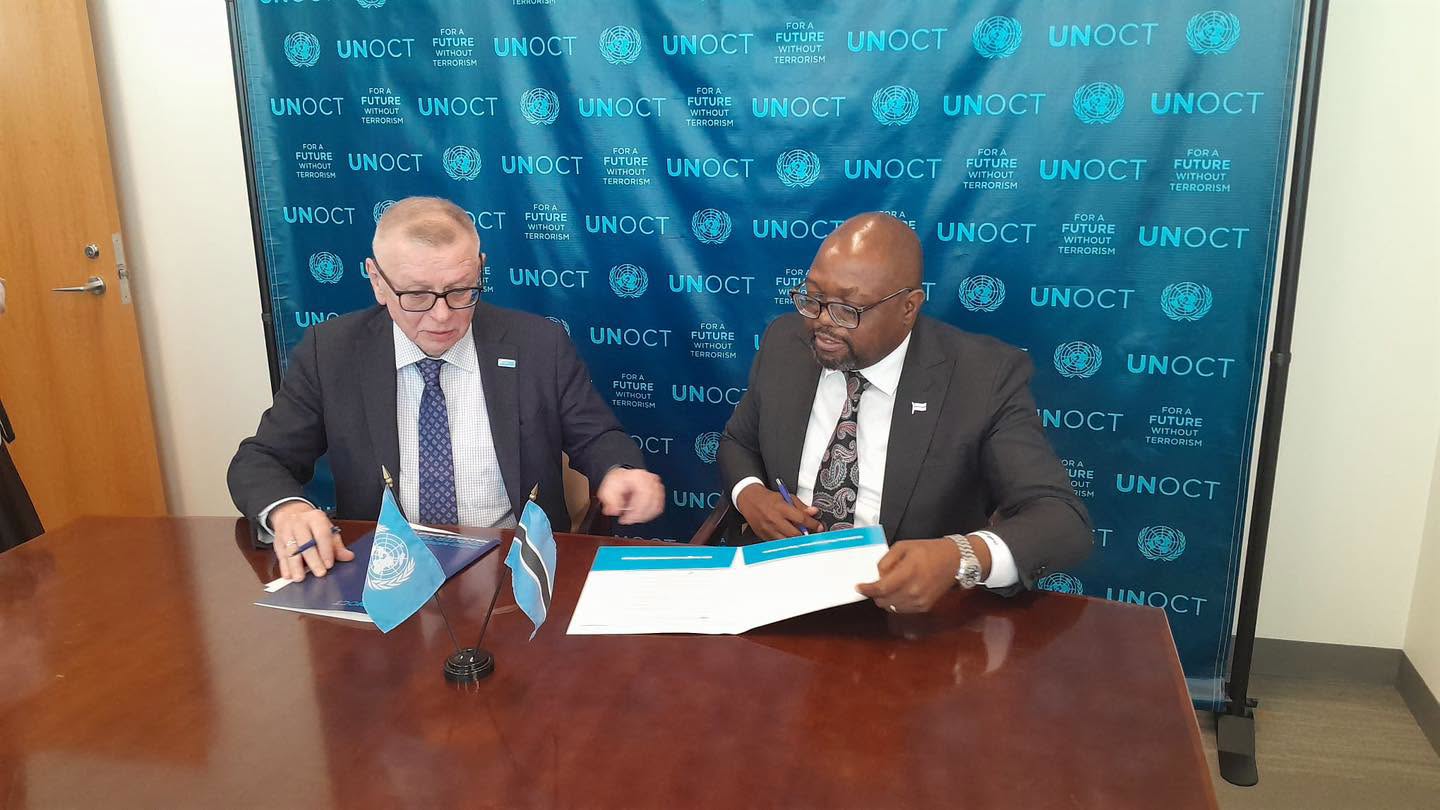
Botswana has strengthened its cooperation with the United Nations on counter-terrorism through a new Plan of Action covering the period from 2026 to 2028. On September 24, 2026, Botswana’s Minister of International Relations, Hon. Dr. Phenyo Butale, signed the agreement with Mr. Alexandre Zouev, Acting Under-Secretary-General of the United Nations Office of Counter-Terrorism. The signing took place in New York on the margins of the 81st Session of the United Nations General Assembly. The agreement establishes a framework for cooperation aimed at strengthening Botswana’s national capacity to prevent and counter terrorism while addressing related security challenges. It also places Botswana’s national efforts within a broader system of cooperation with the United Nations and international partners.
The 2026–2028 Plan of Action is designed to support Botswana as it strengthens the institutions and national mechanisms responsible for preventing and countering terrorism. Its focus is on capacity building, which can include strengthening institutional systems, improving capabilities and enhancing coordination among relevant authorities. The agreement does not simply represent a diplomatic commitment between Botswana and the United Nations, but provides a framework for practical cooperation over a defined three-year period. The objective is to help Botswana strengthen its ability to respond to terrorism-related risks in accordance with international law. The partnership also reflects the importance of international cooperation in addressing security challenges that can extend beyond national borders.
The signing took place during the 81st United Nations General Assembly, a setting that gave the agreement a wider multilateral context. Botswana has traditionally placed significant importance on international cooperation and participation in the United Nations system. Its approach to security therefore involves both national preparedness and engagement with international institutions. Working with the United Nations Office of Counter-Terrorism allows Botswana to connect its national priorities with international expertise and established multilateral mechanisms. The new Plan of Action provides a structured basis for that cooperation during the 2026 to 2028 period.
Counter-terrorism capacity building is important because preventing terrorism involves more than responding to an attack after it occurs. Effective national systems require institutions that can identify risks, coordinate information, strengthen prevention measures and respond appropriately when threats emerge. They also require clear national mechanisms that allow different government institutions and relevant partners to work together. The Plan of Action is intended to support Botswana’s efforts in these areas while respecting international law and the principles of the United Nations. Strengthening these capabilities can help a country improve its overall preparedness for security challenges while maintaining established legal and institutional safeguards.
For Botswana, the agreement also reinforces the importance of national institutions in addressing security threats. Terrorism prevention can involve several areas of government activity, meaning coordination is essential when different institutions have responsibilities that overlap. A national response may require cooperation among security agencies, government departments and other relevant institutions. International cooperation can complement those domestic efforts by providing opportunities to exchange expertise and strengthen institutional capacity. The 2026–2028 Plan of Action creates a framework through which Botswana and the United Nations Office of Counter-Terrorism can support these objectives over the coming years.
The role of the United Nations Office of Counter-Terrorism is particularly relevant to the agreement because UNOCT works with countries to strengthen international cooperation and national capacities related to preventing and countering terrorism. Its work is linked to the wider United Nations approach to addressing terrorism while promoting international law and human rights obligations. Cooperation with national governments can involve support for institutions, policies, training and mechanisms designed to improve prevention and response capabilities. Botswana’s new agreement places it within this broader international framework. The partnership therefore provides an avenue for Botswana to strengthen national capacity while participating in wider multilateral counter-terrorism efforts.
The signing also demonstrates the importance of cooperation between Botswana and international partners in addressing security challenges. Terrorism and related forms of organised violence can involve activities that cross national borders, making international coordination an important part of prevention. Countries may need to share expertise, improve institutional coordination and strengthen mechanisms for responding to emerging risks. International partnerships can also help countries learn from different experiences and adapt their national systems to changing security environments. Botswana’s cooperation with UNOCT is intended to support those broader objectives while remaining focused on the country’s own national capacity and institutional needs.
International law is a central part of Botswana’s stated approach to counter-terrorism cooperation. The Plan of Action is intended to support efforts that are consistent with international law and the principles of the United Nations. This matters because counter-terrorism measures operate within a wider legal framework that includes obligations concerning national security, human rights and the rule of law. Effective security policies therefore require both the capacity to address threats and systems that ensure those measures operate within applicable legal standards. Botswana’s commitment to international cooperation under the agreement is presented within that framework rather than as a separate approach outside established international principles.
The agreement also fits into Botswana’s broader engagement with multilateral institutions. The country has continued to use international platforms to advance cooperation on issues that affect national and regional security. Working with the United Nations allows Botswana to participate in collective efforts while also strengthening its own institutions. The counter-terrorism Plan of Action provides a practical example of how multilateral diplomacy can lead to specific cooperation between a country and a United Nations body. Its value will ultimately depend on how the framework is implemented and how effectively the planned cooperation strengthens national capabilities during the three-year period.
The 2026–2028 timeframe gives Botswana and UNOCT a defined period in which to develop and implement their cooperation. A multi-year framework can provide greater continuity than isolated activities because it allows institutions to plan capacity-building efforts over time. It can also create opportunities to assess needs, strengthen capabilities and improve coordination progressively. The agreement therefore provides a basis for sustained engagement rather than treating counter-terrorism cooperation as a one-time initiative. Its implementation will require continued coordination between Botswana and the United Nations as the country works to translate the framework into practical improvements.
For Botswana, stronger counter-terrorism institutions can also contribute to wider national security preparedness. Security risks can change over time as technology, communication systems, international travel and transnational criminal networks evolve. Governments therefore need institutions capable of adapting to new challenges rather than relying only on existing methods. Capacity building can help institutions strengthen their ability to identify and respond to risks as the security environment changes. The new cooperation framework gives Botswana an opportunity to develop those capabilities with support from a specialised United Nations office.
The agreement also carries significance for Botswana’s international partnerships because it demonstrates continued engagement with collective approaches to security. Rather than treating terrorism prevention solely as a domestic issue, the Plan of Action recognises the value of cooperation with international institutions and other partners. This approach allows Botswana to combine national responsibility with international support. It also reflects the understanding that security cooperation works most effectively when countries can coordinate their efforts through recognised international frameworks. The signing in New York therefore connects Botswana’s national security priorities with its wider role in the multilateral system.
The presence of Minister Phenyo Butale and Alexandre Zouev at the signing underlines the institutional nature of the agreement. The signing brought together Botswana’s Ministry of International Relations and the United Nations Office of Counter-Terrorism during one of the most important annual gatherings in international diplomacy. Holding the event alongside the United Nations General Assembly also provided an opportunity to reinforce the relationship at a senior diplomatic level. The agreement establishes a formal framework through which the two sides can pursue capacity-building cooperation from 2026 through 2028. Its implementation will determine how that commitment translates into stronger national institutions and practical counter-terrorism capabilities.
Botswana’s new Plan of Action with the United Nations Office of Counter-Terrorism represents a structured effort to strengthen the country’s ability to prevent and counter terrorism while addressing related security challenges. Signed on September 24, 2026, during the 81st United Nations General Assembly in New York, the agreement brings national capacity building and international cooperation together within a three-year framework. Its focus on institutions, capabilities, national mechanisms and coordination reflects the need for sustained preparation rather than short-term responses to security threats. The commitment to international law and United Nations principles also places Botswana’s counter-terrorism efforts within the broader multilateral system. As the 2026–2028 cooperation period progresses, the key measure of the partnership will be its ability to strengthen Botswana’s institutions, improve coordination and build lasting national capacity to respond to evolving security challenges.