
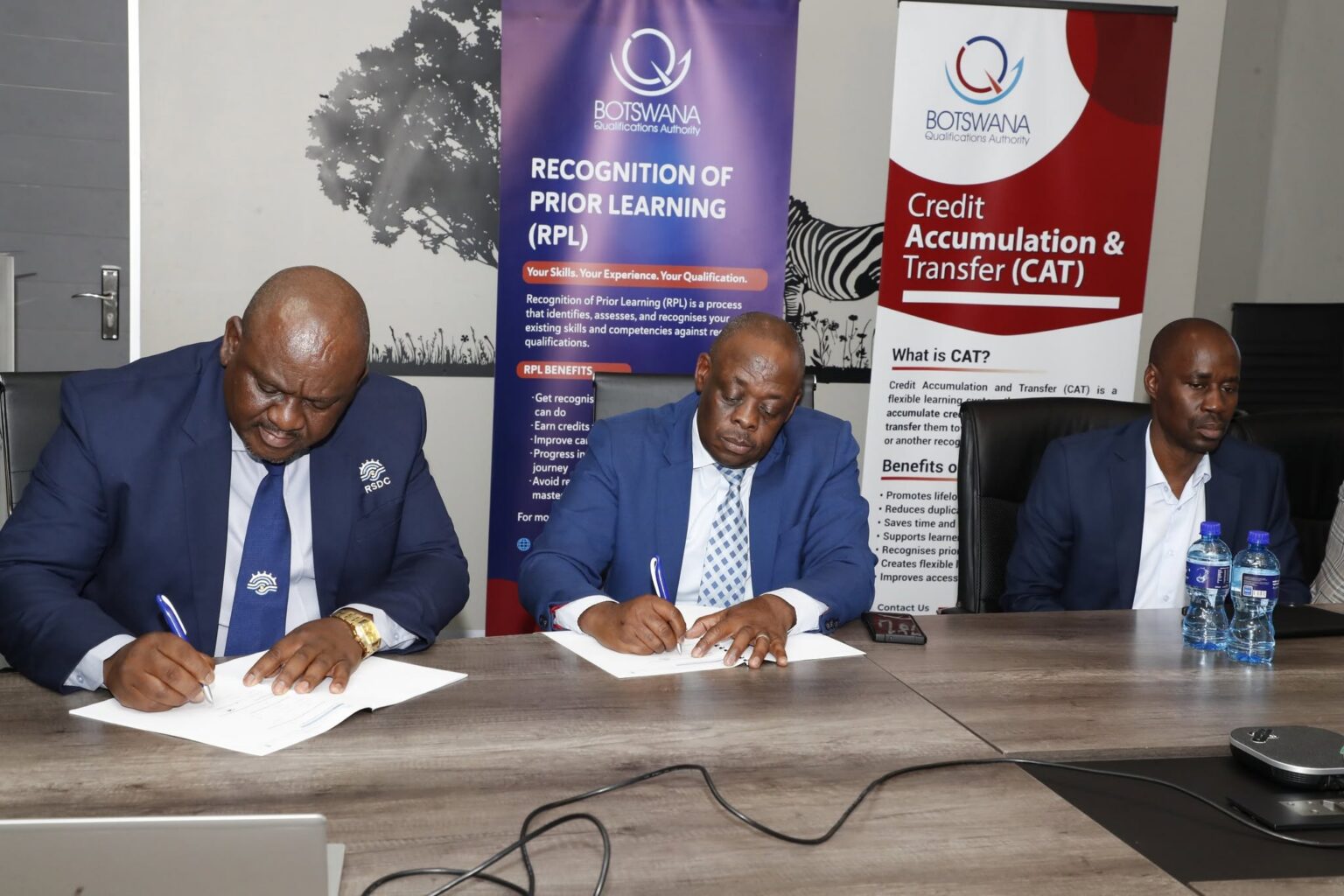
Botswana is taking an important step towards making its Recognition of Prior Learning (RPL) system more practical and accessible after the Botswana Qualifications Authority (BQA) and Rapid Skills Development Centre (RSDC) signed a Memorandum of Understanding (MoU). The partnership is aimed at moving the country’s RPL Policy and Framework from an established policy position into practical implementation. RPL has the potential to create new pathways for experienced workers, artisans and technicians whose knowledge and abilities may have been developed outside traditional education and training systems. The initiative also supports efforts to create a more inclusive, flexible and responsive education and training environment. By recognising learning gained through different experiences, Botswana can create stronger links between workplace skills, formal qualifications and opportunities for further development.
BQA Acting Chief Executive Officer Ofentse Disang said the signing of the MoU followed the recent launch of the RPL Policy and Framework. The launch represented an important milestone in Botswana’s efforts to strengthen the way learning and skills are recognised across different pathways. Disang explained that RPL should allow experienced workers, artisans and technicians to have the knowledge and skills they have acquired over time formally recognised. This can be particularly valuable for people who have developed strong occupational abilities through years of practical work but may not hold formal qualifications that reflect their competence. A properly implemented RPL system can help bridge this gap by assessing what individuals know and can do rather than focusing only on where or how they obtained their learning.
The implementation of RPL also requires lessons to be gathered from practical experience so that the system can continue to improve. Disang noted that lessons from the initiative would help strengthen implementation as Botswana moves from policy development to actual assessment and recognition processes. This learning approach can help identify challenges faced by candidates, assessors, institutions and employers during the early stages of implementation. It can also provide information that can be used to refine procedures and ensure that RPL remains credible and consistent. The RPL Policy and Framework, together with the Credit Accumulation and Transfer Policy and the African Continental Qualifications Framework (ACQF), provides additional quality assurance support for the process.
BQA board representative Professor Richie Moalosi stressed that RPL is based on the principle that learning can take place through many different pathways. These pathways include employment, apprenticeships, mentorship, workplace experience and informal learning. This approach recognises that people can acquire meaningful knowledge and skills without necessarily following a conventional classroom-based education route. However, Professor Moalosi made it clear that RPL does not mean automatically converting years of work experience into a qualification. Recognition must be based on credible evidence showing that the candidate has achieved the required learning outcomes or demonstrated the relevant competencies.
This distinction is important for maintaining confidence in the RPL system. A person may have many years of experience in an occupation, but experience alone does not automatically prove that the individual has achieved every competency required for a particular qualification or occupational standard. Candidates must therefore be assessed against clear requirements and provide appropriate evidence of their knowledge and skills. This ensures that qualifications awarded through RPL maintain the same credibility as those obtained through other recognised learning pathways. A strong assessment process can also protect employers, training institutions and candidates by ensuring that recognition reflects actual competence.
The partnership with RSDC provides an opportunity to put these principles into practice through structured implementation. RSDC Acting Executive Director Godiiramodimo Kalaote described the agreement as the beginning of a new chapter in formally and structurally recognising individual capabilities. He said the MoU was built on mutual respect and a shared vision between the two organisations. Combining the strengths of BQA and RSDC can support the development of practical mechanisms that allow candidates to demonstrate their existing knowledge and skills. The partnership also has the potential to generate benefits beyond individual candidates by helping employers and industries better understand and utilise existing skills within the workforce.
Kalaote’s comments highlight the broader value of recognising skills that already exist within the country. Workers often build expertise through years of performing tasks, solving problems and adapting to workplace demands. When these capabilities are formally assessed and recognised, individuals can have a clearer pathway towards qualifications, further education or improved employment opportunities. Employers can also benefit from a workforce whose competencies are more clearly documented and aligned with recognised occupational standards. This can contribute to a stronger connection between skills development and the needs of Botswana’s economy.
Dr Samuel Mosweu said the MoU represented a practical commitment to advancing RPL and creating credible opportunities for candidates. The immediate priorities include activating governance arrangements, finalising the pilot implementation plan, confirming relevant occupational areas and standards and mobilising and preparing candidates. These steps are important because successful RPL implementation requires more than an agreement between institutions. Clear governance structures are needed to establish responsibilities and ensure that implementation remains accountable. Occupational areas and standards must also be clearly defined so that candidates are assessed against appropriate and measurable requirements.
The planned pilot phase can provide an important test of how the RPL system operates in practice. Selecting relevant occupational areas will allow the participating institutions to focus resources and establish assessment processes suited to specific skills and competencies. Candidate mobilisation and preparation will also be essential because applicants need to understand what RPL involves, what evidence they must provide and how assessments will be conducted. Clear communication can reduce uncertainty and encourage qualified workers to participate. The information gathered during the pilot can then help inform broader implementation and strengthen the system before it reaches a wider group of candidates.
The MoU between BQA and RSDC therefore represents more than an institutional partnership. It provides a practical pathway for Botswana to begin translating its RPL policy into processes that can benefit workers and the wider skills development system. The success of the initiative will depend on credible assessment, clear occupational standards, strong governance and effective preparation of candidates and assessors. It will also require continued cooperation between regulators, training institutions, employers and industry stakeholders. If these elements are implemented effectively, RPL can provide experienced workers, artisans and technicians with meaningful opportunities to have their existing competencies formally recognised while strengthening Botswana’s broader education and training system.