
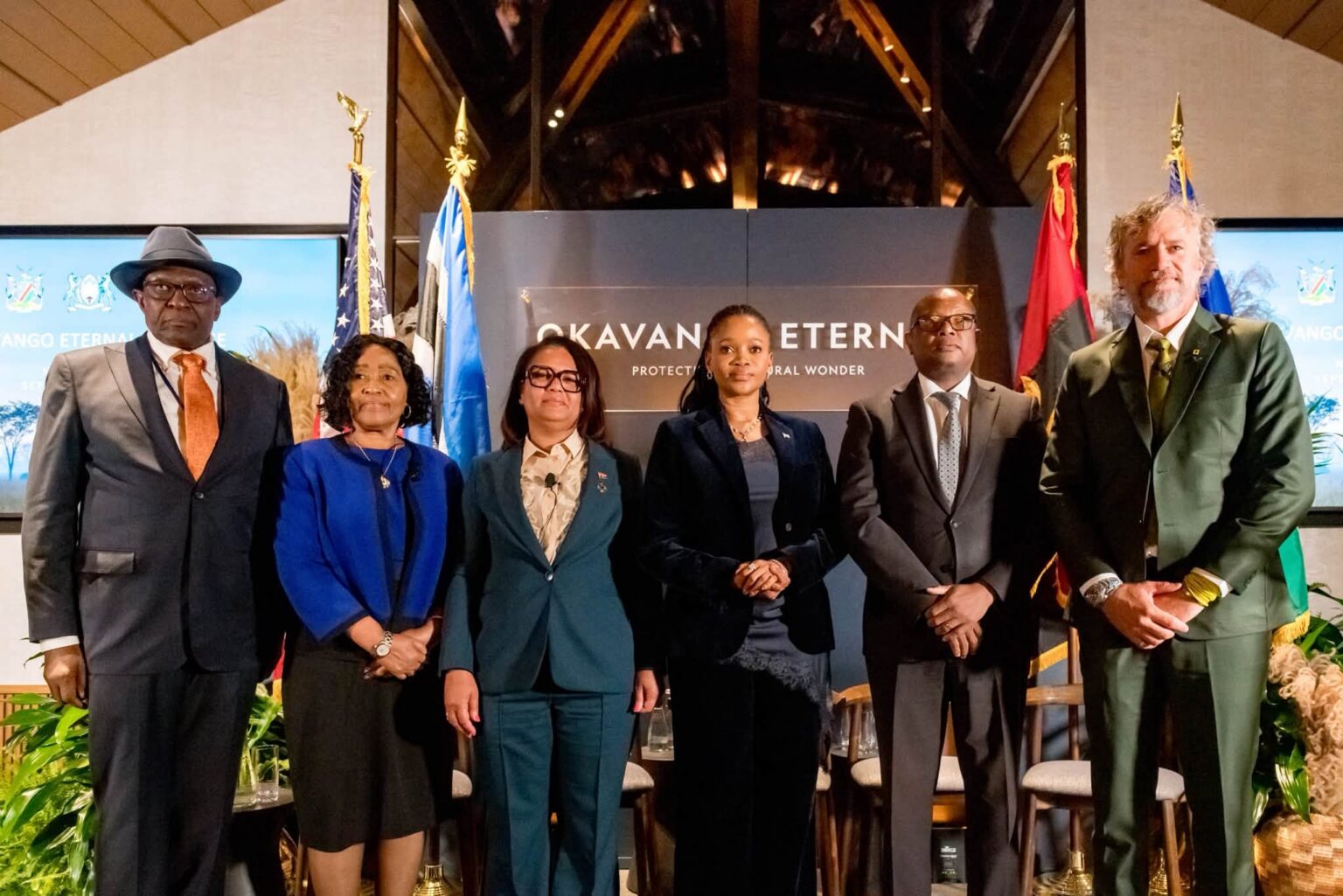
The National Geographic Society and De Beers Group have renewed their Okavango Eternal partnership for another five years, extending a major conservation effort focused on protecting the Okavango River Basin. The partnership brings renewed attention to one of Southern Africa’s most important interconnected ecosystems, which spans Angola, Namibia and Botswana. Its next phase will focus on protecting the Basin from its source in Angola while supporting communities whose livelihoods are connected to the natural environment. The initiative combines scientific research, traditional knowledge, conservation and sustainable economic opportunities as part of a long-term approach to protecting the region. The renewal also reflects the understanding that safeguarding the Okavango cannot depend on conservation efforts in one country alone because the Basin functions as one interconnected ecological system.
The Okavango River Basin is shared across Angola, Namibia and Botswana, making cooperation between the three countries central to its long-term protection. Water and ecological processes do not follow national borders, so activities taking place upstream can affect communities, wildlife and habitats further downstream. Protecting the Basin therefore requires attention to its entire connected landscape, from its source areas in Angola to the wetlands and surrounding ecosystems in Namibia and Botswana. The renewed Okavango Eternal partnership aims to strengthen this approach by supporting conservation across national boundaries. Greater cooperation can help the three countries address shared environmental challenges while recognising the different communities and landscapes that form part of the Basin.
One of the key goals of the renewed partnership is to help secure formal protection for approximately 5.4 million hectares at the Basin’s source in Angola. Protecting this area would create a stronger conservation framework around important landscapes that influence the wider Okavango system. The source region plays a critical role because water originating there ultimately contributes to the downstream ecosystems associated with the Okavango. Formal protection can provide a basis for managing these landscapes while supporting efforts to maintain their ecological functions. The proposed scale of protection also illustrates the geographic size of the conservation challenge facing the Basin.
Community participation remains an important part of the Okavango Eternal approach. Conservation efforts can have lasting value when communities living within and around protected landscapes have meaningful opportunities to benefit from sustainable activities. The partnership aims to expand conservation-linked livelihoods so that protecting natural resources can also support local economic opportunities. Since the initiative began in 2021, it has supported 2,118 conservation-linked livelihood opportunities. These efforts demonstrate an approach that connects environmental protection with the needs of people whose lives and livelihoods are linked to the Basin.
The partnership has also invested in developing local capacity for environmental monitoring. Eighty-two community members have been trained to monitor more than 20,000 square kilometres of forest, giving local participants a direct role in gathering information about their surrounding environment. Community-based monitoring can provide valuable observations from people who live close to the landscapes being studied. It can also strengthen local involvement in conservation by giving communities practical skills and responsibilities. Continued investment in this kind of participation will form part of the partnership’s wider effort to combine scientific knowledge with local and traditional understanding.
Another area of work has focused on the Basin’s peatlands, which can store significant amounts of carbon. Through the partnership, 230 carbon-storing peatland sites have been mapped, helping improve understanding of these important ecosystems. Mapping provides a foundation for identifying and monitoring areas that require conservation attention. Peatlands are also relevant to climate and environmental discussions because of their ability to hold carbon when they remain intact and function naturally. Better information about their location and condition can therefore support more informed conservation planning across the Okavango Basin.
The partnership has already contributed to conservation progress in Angola through support for the designation of Lisima Lya Mwono as the country’s first Ramsar Wetland of International Importance. Ramsar recognition highlights wetlands that have international importance and places additional attention on their conservation and wise use. The designation represents an important development for wetland protection in Angola and adds greater recognition to the environmental significance of the area. It also fits into the broader objective of protecting the Okavango from its source and maintaining the ecological connections that extend downstream. Such conservation measures can strengthen the foundation for long-term protection of the wider Basin.
The renewed five-year phase will place strong emphasis on science and traditional knowledge. Scientific research can provide detailed information about water systems, forests, wetlands, wildlife and other ecological processes, while traditional knowledge can offer generations of experience about local landscapes and natural resources. Bringing these forms of knowledge together can provide a broader understanding of the Basin and the pressures affecting it. The partnership intends to use this combined knowledge to support conservation decisions and strengthen understanding of the interconnected ecosystem. This approach also recognises the important role that local communities play in understanding and protecting the environments in which they live.
Conservation-linked livelihoods will remain another major priority during the renewed partnership. Protecting ecosystems can become more sustainable when communities have economic opportunities that are compatible with conservation objectives. The focus is therefore not only on protecting land and water but also on supporting activities that can provide income while maintaining the natural resources on which communities depend. Expanding these opportunities could help connect conservation goals with practical community needs across the three countries. The experience gained since 2021 provides a foundation for continuing and potentially expanding this work during the next five years.
Storytelling will also form part of the next phase of Okavango Eternal. Sharing the experiences of communities, conservation practitioners and researchers can help communicate why the Okavango Basin matters and why its protection requires cooperation. Stories can also bring attention to the people who live within the Basin and contribute directly to its conservation. Effective storytelling can make complex environmental issues easier for wider audiences to understand while highlighting the connections between people and ecosystems. By including storytelling alongside science, traditional knowledge and livelihoods, the partnership aims to broaden public understanding of the Okavango’s importance.
The renewed partnership also places greater emphasis on cooperation among the governments of Angola, Namibia and Botswana. Government involvement is essential because long-term protection of a transboundary ecosystem requires policies and conservation measures that work across national boundaries. The three countries have different responsibilities within the Basin, but their environmental interests are closely connected. Stronger coordination can help address challenges at the scale of the entire ecosystem rather than treating individual sections as separate environments. Protecting the Okavango River Basin as one interconnected system will therefore require continued cooperation between governments, communities, conservation organisations and other partners.
The progress made since 2021 provides a foundation for the partnership’s next stage. More than 2,000 conservation-linked livelihood opportunities have been supported, dozens of community members have received training in forest monitoring and hundreds of peatland sites have been mapped. These activities cover different aspects of conservation, from local participation and livelihoods to environmental research and carbon storage. The renewed partnership can build on this work while directing greater attention toward formal protection at the Basin’s source. Its success will depend on sustained cooperation and the ability to translate conservation plans into lasting benefits for ecosystems and communities.
The renewal of the Okavango Eternal partnership places the future of the Okavango River Basin at the centre of a five-year conservation effort involving Angola, Namibia and Botswana. Protecting approximately 5.4 million hectares at the Basin’s source, strengthening community-led conservation and expanding sustainable livelihoods are among the key objectives of the next phase. The work already completed since 2021, including support for 2,118 livelihood opportunities, community forest monitoring and peatland mapping, provides an important foundation for continued action. The partnership’s focus on science, traditional knowledge, storytelling and government cooperation reflects the complex nature of protecting a river basin that crosses national borders. By treating the Okavango as one connected ecosystem, the renewed initiative aims to strengthen conservation while supporting the communities whose lives remain closely connected to this remarkable landscape.