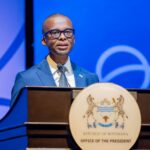

President Duma Boko has called on African leaders, international development partners and health experts to adopt bold and practical strategies to eliminate malaria in Botswana, across Africa and around the world. He made the call during a high-level dialogue on malaria elimination held in Gaborone, where he challenged delegates to move beyond discussions and commit to actions that can deliver measurable results. Boko stressed that malaria remained a serious public health threat that continued to cost lives, disrupt education and place considerable pressure on families and healthcare systems. He urged participants to address the challenges preventing effective malaria control and work towards solutions that could accelerate progress towards a malaria-free future. His remarks highlighted the urgent need for stronger political leadership, sustainable funding and closer cooperation between governments and international organisations.
Speaking at a cocktail reception for the 36th Roll Back Malaria (RBM) Partnership Board meeting in Gaborone, President Boko encouraged delegates to speak openly about the obstacles affecting malaria elimination programmes. He emphasised that meaningful progress would require honest discussions about funding shortages, implementation challenges and weaknesses in healthcare delivery. According to the President, the meeting presented an important opportunity for stakeholders to identify practical solutions and establish commitments that could be monitored and implemented. He warned against allowing diplomatic discussions to take priority over the urgent need to save lives. Boko made it clear that the fight against malaria required decisive action rather than promises that lacked clear targets and financial support.
“We cannot afford polite conversation when lives are at stake,” Boko said. “We must leave here with commitments that can be measured, funded and delivered.” His statement reflected the seriousness of the malaria challenge and the need for governments and development partners to translate political commitments into practical interventions. Measurable targets would allow countries to assess progress and identify areas where additional support was required. Adequate financing would also help ensure that malaria prevention, diagnosis and treatment programmes could operate effectively. The President’s message placed accountability and implementation at the centre of discussions about eliminating the disease.
Malaria remains one of Africa’s major public health challenges, with the disease continuing to affect vulnerable communities and place pressure on national health systems. The continent has historically carried the greatest burden of malaria, making its elimination an important priority for African governments and international health organisations. The disease is transmitted through the bites of infected female Anopheles mosquitoes and can cause serious illness or death if patients do not receive timely and appropriate treatment. Young children and pregnant women face particularly high risks of severe malaria and its complications. Beyond its impact on health, malaria can also affect household incomes, school attendance, productivity and economic development.
President Boko acknowledged that malaria continued to claim lives and prevent children from attending school. He also highlighted the financial pressure experienced by families who must deal with treatment costs and the consequences of illness. At a national level, malaria places additional demands on healthcare workers, medical supplies and public health budgets. These challenges demonstrate why malaria elimination should not be treated as a health-sector responsibility alone. Governments must recognise the wider social and economic consequences of the disease and integrate malaria control into broader development priorities.
Boko also reminded delegates that Botswana had a responsibility to contribute to Africa’s malaria elimination ambitions through its leadership of the African Leaders Malaria Alliance (ALMA). The country has positioned itself as an advocate for stronger political commitment and increased domestic investment in malaria control. Its leadership role provides an opportunity to encourage other African governments to strengthen national programmes and prioritise disease prevention. However, the President acknowledged that recent setbacks had made the elimination agenda more difficult. Funding cuts, climate-related shocks and growing resistance to medicines and insecticides have created additional challenges for malaria programmes across affected regions.
Funding shortages are particularly concerning because effective malaria control depends on consistent financial investment. Governments and their development partners need resources to support mosquito surveillance, distribute insecticide-treated mosquito nets, provide diagnostic testing and ensure access to effective medicines. When financial support declines, prevention and treatment programmes may struggle to reach the communities that need them most. This can weaken existing progress and increase the risk of renewed transmission. President Boko’s call for commitments that can be funded and delivered therefore highlighted the importance of protecting malaria programmes from financial uncertainty.
Climate change also presents a growing challenge to malaria prevention and elimination efforts. Changes in rainfall patterns, rising temperatures and extreme weather events can influence mosquito breeding conditions and alter the geographical distribution of malaria transmission. Flooding can create breeding sites for mosquitoes, while other environmental changes may affect the seasonal patterns of transmission. These developments make it increasingly important for health authorities to strengthen disease surveillance and prepare for changing malaria risks. Countries must also improve coordination between public health institutions, environmental agencies and local communities to respond effectively to climate-related threats.
Another major concern raised during the dialogue was resistance to antimalarial medicines and insecticides. Drug resistance can reduce the effectiveness of treatments, making it more difficult to manage infections and prevent complications. Insecticide resistance can also weaken mosquito control programmes, particularly where communities depend heavily on treated nets and indoor spraying. Addressing these problems requires continued research, effective monitoring and the responsible use of available medicines and insecticides. Health authorities must adapt their strategies as resistance patterns change and ensure that malaria interventions remain effective.
Joy Phumaphi, Chairperson of the RBM Partnership to End Malaria Board, also highlighted the importance of the meeting in strengthening global efforts to eliminate the disease. She said the board meeting in Gaborone would provide an opportunity to prepare for future challenges and reinforce programmes aimed at ending malaria. Her remarks placed particular emphasis on sustainable financing, stronger partnerships and country-led action. These priorities are essential to protecting the progress already achieved and ensuring that malaria elimination remains a realistic objective. Phumaphi’s comments also reinforced the need for African countries to take ownership of their national malaria programmes while maintaining cooperation with international partners.
Phumaphi praised Botswana for hosting the high-level meeting and recognised its leadership in promoting domestic resource mobilisation for malaria and neglected tropical diseases. Domestic resource mobilisation involves governments increasing the financial resources they allocate to public health priorities through national budgets and other sustainable funding mechanisms. This approach can help countries reduce excessive dependence on external assistance and maintain essential health programmes when international funding changes. Stronger domestic investment also allows governments to align public health spending with their national priorities and local disease patterns. Botswana’s advocacy in this area reflects the growing recognition that sustainable malaria elimination requires long-term financial planning and political commitment.
The RBM Partnership to End Malaria plays an important role in bringing together governments, development organisations, health institutions and other stakeholders to coordinate action against the disease. Its board provides a platform for discussing strategic priorities and strengthening collaboration among organisations working towards malaria elimination. The 36th board meeting in Gaborone offered an opportunity to examine the challenges affecting current programmes and consider how future interventions could deliver better results. By focusing on financing, partnerships and country-led action, the meeting aimed to strengthen the foundations needed to sustain progress. The participation of African leaders and international health experts also demonstrated the importance of collective action in addressing a disease that crosses national borders.
The dialogue comes as global health stakeholders continue working towards the ambition of achieving zero malaria by 2030. Reaching this target will require countries to strengthen prevention, improve access to diagnosis and treatment and invest in reliable health systems. Insecticide-treated mosquito nets, indoor residual spraying and effective malaria medicines remain important components of control programmes. Community education also plays a significant role because people need accurate information about prevention, symptoms and the importance of seeking medical attention early. Strong surveillance systems are equally important because they help health authorities identify outbreaks, monitor transmission patterns and direct resources towards communities facing the greatest risks.
African countries will need to maintain strong political leadership if the continent is to make substantial progress towards malaria elimination. National governments must ensure that malaria programmes receive sufficient funding and that public health institutions have the capacity to implement effective interventions. Regional cooperation can also help countries share information, coordinate cross-border responses and address challenges that cannot be managed by individual governments alone. Development partners and international organisations must support these efforts through technical expertise, research and sustainable financial assistance. However, external support should complement national leadership rather than replace government responsibility for protecting public health.
The involvement of communities will also remain essential to successful malaria elimination programmes. Public awareness campaigns can help households understand how to reduce mosquito breeding sites, use treated mosquito nets correctly and recognise malaria symptoms. Community health workers can improve access to testing and treatment, particularly in rural and underserved areas where healthcare facilities may be difficult to reach. Governments must also ensure that malaria services remain accessible to vulnerable populations, including young children and pregnant women. Without strong community participation, even well-funded national programmes may struggle to achieve lasting results.
President Boko’s remarks in Gaborone sent a clear message about the urgency of strengthening the fight against malaria. His call for honest discussions and measurable commitments highlighted the need to address financial, environmental and medical challenges before they undermine further progress. Joy Phumaphi’s emphasis on sustainable financing, stronger partnerships and country-led action provided an important framework for advancing these objectives. Botswana’s role in hosting the RBM Partnership Board meeting also offered an opportunity to reinforce its commitment to malaria elimination across Africa. The challenge now lies in turning the discussions into properly funded programmes and effective action at national and community levels.
Ending malaria will require more than ambitious targets and international declarations. It will depend on governments investing in healthcare systems, communities participating in prevention programmes and international partners maintaining meaningful support. African leadership will be particularly important because the continent continues to face the greatest burden of the disease. Botswana’s commitment, as highlighted by President Boko, demonstrates the importance of political accountability and cooperation in pursuing a malaria-free future. With sustained investment, stronger partnerships and practical strategies, the global ambition of achieving zero malaria by 2030 can remain within reach.