
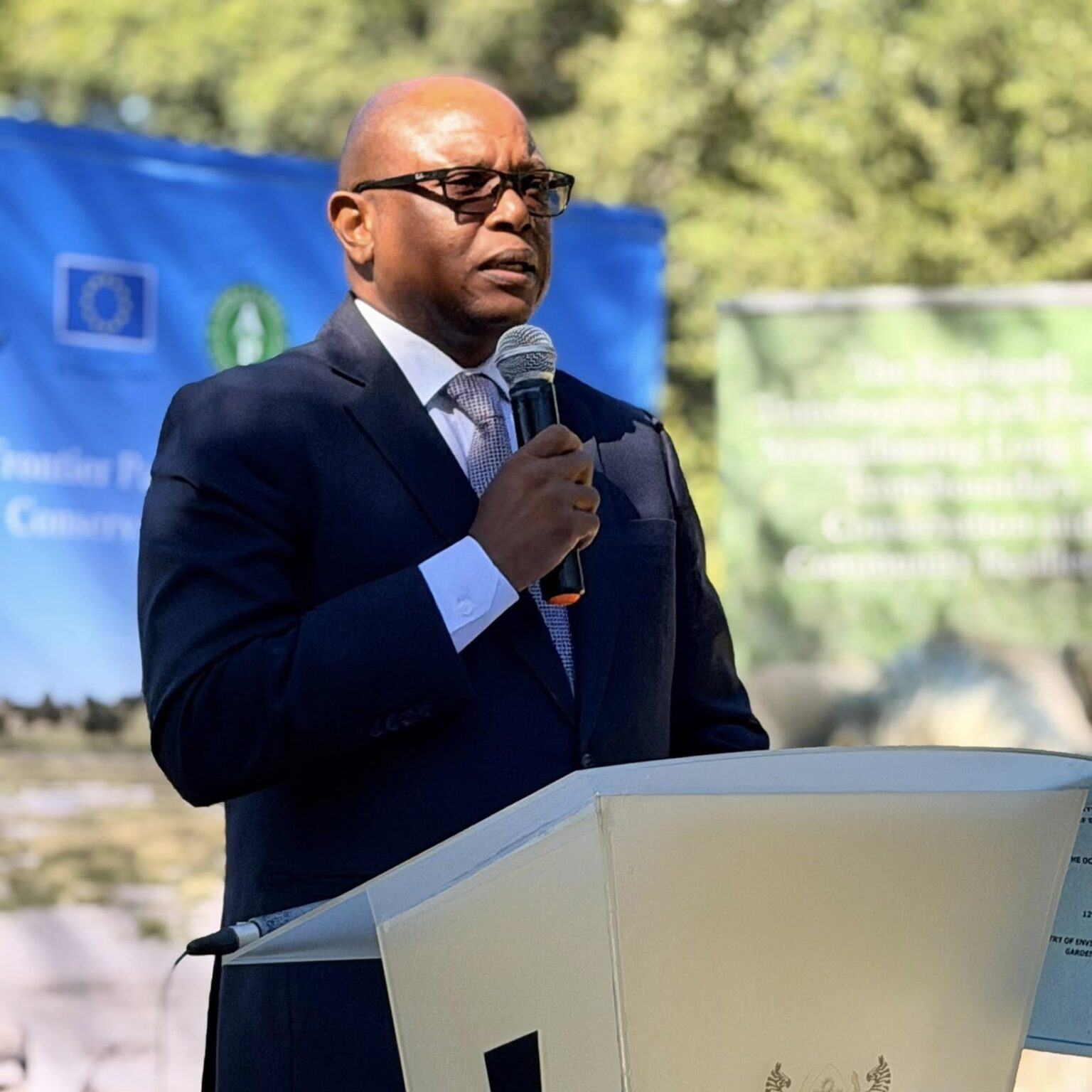
The Minister of Environment and Tourism, Honourable Wynter Boipuso Mmolotsi, yesterday officially launched a European Union-supported initiative aimed at strengthening the joint management of the Kalahari Transfrontier Park between Botswana and South Africa at the Ministry of Environment and Tourism Gardens in Gaborone. The launch marks a major step forward in regional conservation cooperation and sustainable tourism development across one of Southern Africa’s most important ecological landscapes. The initiative brings together international partners, government institutions and conservation organizations in a coordinated effort to improve how the shared ecosystem is managed and protected. It also reflects a growing commitment to cross border collaboration in addressing environmental challenges while supporting long term economic growth. The event underscored the importance of protecting biodiversity while ensuring that conservation efforts contribute directly to local and national development goals.
The project is supported through the European Union under the SADC Transfrontier Conservation Area Financing Facility and is executed by the International Union for Conservation of Nature International Union for Conservation of Nature in collaboration with African Parks through a Public Private Partnership model. This partnership approach is designed to strengthen governance systems and improve the effectiveness of conservation management across the Kalahari Transfrontier Park. By combining technical expertise, financial support and on the ground implementation capacity, the initiative aims to create a more coordinated and sustainable framework for managing shared natural resources. The involvement of multiple stakeholders also ensures that conservation strategies are aligned with both environmental protection and socio economic development priorities. This model represents a modern approach to conservation that integrates government leadership with private sector efficiency and international support.
Speaking during the launch, Minister Mmolotsi described the project as a significant milestone in advancing regional cooperation, biodiversity conservation, economic transformation and sustainable tourism development within the Kalahari landscape. He emphasized that the initiative demonstrates how transboundary collaboration can unlock long term benefits for both Botswana and South Africa. According to the Minister, the success of conservation efforts depends on strong partnerships that extend beyond national borders and involve multiple levels of governance. He highlighted that the Kalahari Transfrontier Park serves as a symbol of peace, cooperation and shared responsibility for natural heritage. The Minister also noted that the project will contribute to positioning the region as a leading destination for sustainable tourism and ecological preservation.
Honourable Mmolotsi further reminded stakeholders that the Kalahari Transfrontier Park holds a historic position as Southern Africa’s first Transfrontier Conservation Area, established in 2000 following a bilateral agreement signed by the late former President of Botswana, Dr Festus Gontebanye Mogae, and former President of South Africa, Mr Thabo Mbeki. This historical foundation has made the park a model for cross border conservation initiatives across the continent. The agreement laid the groundwork for joint management of wildlife, ecosystems and tourism activities across a vast shared landscape. Over the years, the park has become a key driver of biodiversity protection and eco tourism development. The Minister highlighted that the new initiative builds on this legacy while introducing modern tools and systems for improved management and sustainability.
Government expressed appreciation to the European Union for its continued support toward conservation and sustainable development efforts in the region, noting that the initiative reflects growing international confidence in Botswana and South Africa’s conservation leadership. The support also demonstrates recognition of the importance of the Kalahari ecosystem as a global environmental asset that requires coordinated protection efforts. By investing in this initiative, development partners are contributing to the long term stability of ecosystems that support wildlife, tourism and local livelihoods. The collaboration also strengthens diplomatic ties and reinforces shared commitments to environmental sustainability. This partnership highlights the role of international cooperation in addressing global environmental challenges.
The Minister also highlighted that the project aligns closely with the Botswana Economic Transformation Plan, which positions tourism as a priority sector for economic diversification and growth. He explained that the initiative is expected to unlock significant economic opportunities through sustainable tourism development, infrastructure improvement, local enterprise growth, employment creation and increased citizen participation in tourism value chains. The integration of conservation and economic development is seen as a key strategy for building resilient communities and expanding national income sources. By enhancing tourism potential within the Kalahari Transfrontier Park, the initiative aims to attract more visitors while preserving the natural environment. This balance between development and conservation is central to Botswana’s long term economic vision.
Community participation was also emphasized as a critical factor for the success of the project. The Minister stated that conservation efforts can only succeed when communities living adjacent to protected areas benefit meaningfully from such initiatives. He noted that local communities play a vital role in protecting wildlife, supporting tourism activities and ensuring the sustainability of conservation programs. The project therefore seeks to create opportunities for local employment, skills development and small business participation in the tourism and conservation sectors. Strengthening community involvement is expected to improve ownership of conservation efforts and reduce conflicts between human activities and wildlife management.
The initiative is also expected to strengthen biodiversity monitoring, ecosystem management, governance systems and long term sustainability of protected areas within the Kalahari ecosystem. Improved monitoring systems will support better decision making and allow for more effective protection of wildlife populations and habitats. Enhanced governance structures will help ensure transparency, accountability and coordination among stakeholders involved in park management. The project further aims to promote resilience in the face of climate change and other environmental pressures affecting the region. These improvements will contribute to safeguarding one of Southern Africa’s most important ecological landscapes for future generations.
The launch of the European Union supported Kalahari Transfrontier Park initiative represents a major step forward in regional cooperation, environmental protection and sustainable development. It demonstrates how strategic partnerships between governments, international organizations and private sector actors can deliver meaningful outcomes for both people and nature. The project strengthens Botswana and South Africa’s shared commitment to preserving biodiversity while promoting economic growth through sustainable tourism. As implementation progresses, the initiative is expected to deliver lasting benefits for communities, ecosystems and national economies. It stands as a strong example of how conservation and development can work together to create a more sustainable and inclusive future.