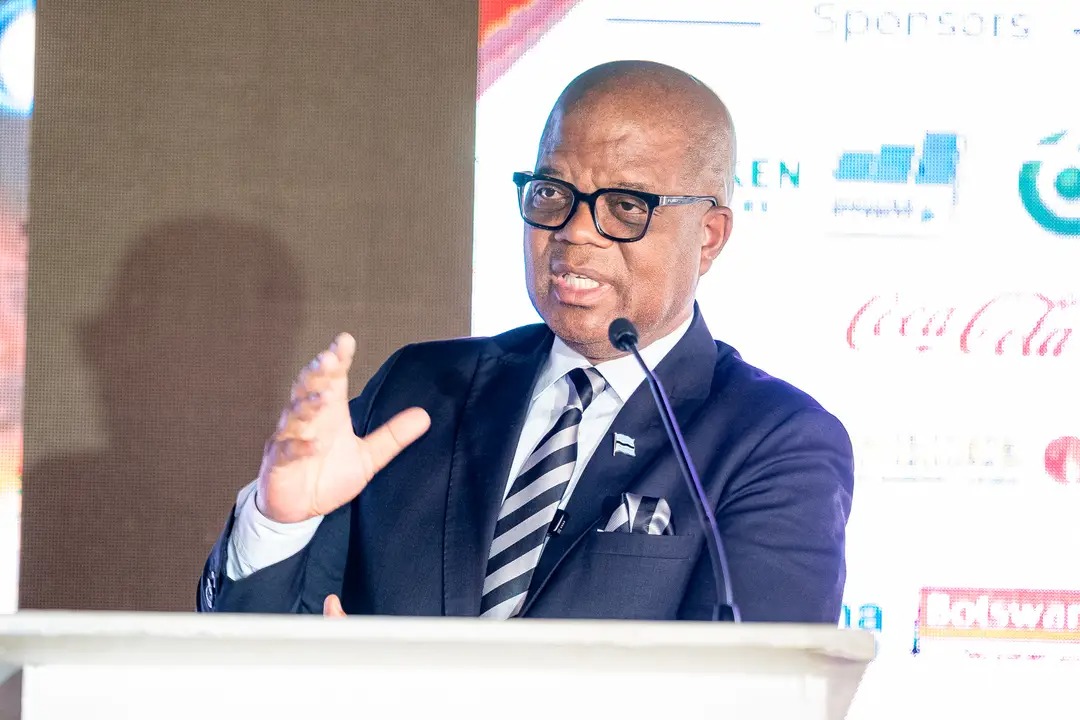
Botswana’s economy can no longer depend on extracting raw materials and exporting them without adding value locally, Minister for State President, Defence & Security, Moeti Mohwasa, told business leaders during the official opening of the 30th Northern Trade Fair on Thursday. Addressing delegates at the Business Botswana Northern Trade Fair, Mohwasa stressed that the country must urgently transform its economic model if it hopes to create sustainable growth, stronger industries, and long-term employment opportunities. His remarks reflected growing concern about the limitations of an economy heavily dependent on mineral extraction. While Botswana has enjoyed decades of macroeconomic stability from its mining sector, the minister warned that the current structure has insulated growth and slowed industrial diversification. He argued that Botswana now faces a critical moment where economic transformation is no longer optional but necessary.Mohwasa said the era of “simply digging up resources and shipping them away in raw form” must come to an end if Botswana wants to remain competitive in an increasingly industrialized global economy. He explained that exporting raw minerals without processing them locally denies the country opportunities for job creation, technology transfer, and industrial expansion. According to the minister, Botswana must move decisively toward high-value manufacturing, commercial agro-processing, and localized production systems that keep more wealth within the country. He noted that nations that process and manufacture goods locally tend to create more resilient economies because they generate wider economic participation across different sectors. This approach, he said, would help Botswana reduce overreliance on diamond mining and establish a more balanced economic foundation.The minister linked economic development directly to national stability and investor confidence. Mohwasa explained that peace should not only be understood as the absence of conflict but also as the existence of certainty for businesses and investors. He said entrepreneurs and companies need confidence that regulations are stable, institutions are reliable, and physical security is guaranteed before they commit significant capital to projects. According to Mohwasa, a stable environment encourages innovation, investment, and industrial growth because businesses are more willing to take long-term risks when they trust the system around them. He added that Botswana’s political stability and institutional framework remain among its strongest competitive advantages in attracting both domestic and foreign investment. These factors, he argued, should now be used strategically to accelerate industrialization and economic diversification.A major part of Mohwasa’s address focused on the Botswana Economic Transformation Programme, commonly referred to as BETP. The minister described the initiative as a decisive shift away from the traditional economic role played by government in the past. Instead of directly running commercial enterprises or serving as the main source of economic financing, government intends to position itself as a facilitator and regulator that creates the right conditions for private sector growth. Mohwasa said the new approach recognizes that long-term economic success depends on enabling businesses to innovate, compete, and expand independently. Under the BETP framework, government will focus on building infrastructure, strengthening regulation, improving institutional efficiency, and protecting the market environment so that businesses can operate effectively.Mohwasa emphasized that the private sector must become the driving force behind Botswana’s value chain revolution. He said government policies alone cannot transform the economy unless businesses actively invest in local production, manufacturing, and industrial expansion. The minister challenged companies to move beyond traditional business silos and develop partnerships between heavy industries, technology innovators, and small-scale enterprises. He argued that collaboration across sectors would allow Botswana to build stronger domestic supply chains capable of competing in regional and global markets. According to Mohwasa, industrial cooperation is essential if Botswana wants to convert local resources into finished products with higher export value and greater employment potential.The theme of this year’s Northern Trade Fair, “Value Chain Revolution: From Local Resources to Global Markets,” reflects the broader national conversation about economic transformation and industrial growth. The event brought together business leaders, entrepreneurs, policymakers, and investors to discuss strategies for expanding Botswana’s manufacturing capacity and increasing local participation in value chains. Mohwasa said the theme captures the urgency of transitioning from an extractive economy to one built on production, innovation, and global competitiveness. He explained that Botswana has significant potential in sectors such as agro-processing, renewable energy, logistics, and manufacturing if investment is directed toward local value addition. By processing raw materials locally instead of exporting them in unrefined form, Botswana could significantly increase export earnings while creating thousands of new jobs.The minister also called on businesses to embrace calculated risk-taking in pursuit of industrial growth and economic diversification. He assured the private sector that government remains committed to providing institutional protection, physical safety, and policy stability to support investment. Mohwasa said businesses must now respond by investing heavily in industries that create local value and support long-term economic resilience. He argued that Botswana’s future prosperity depends on the willingness of companies to expand production capacity, adopt modern technologies, and compete in international markets. This partnership between government and the private sector, he said, will determine whether Botswana succeeds in building a modern and employment-rich economy.Mohwasa’s message at the Northern Trade Fair highlighted a growing recognition that Botswana must evolve beyond dependence on raw mineral exports if it wants to achieve sustainable prosperity. His remarks reflected a broader continental trend where African countries are increasingly pushing for local beneficiation, manufacturing growth, and industrial self-reliance. Botswana’s challenge now lies in translating policy ambitions into measurable economic outcomes that improve livelihoods and create opportunities for citizens. The success of the Botswana Economic Transformation Programme will likely depend on effective cooperation between government institutions, investors, and local industries. If implemented successfully, the country’s shift toward value addition and industrialization could reshape Botswana’s economic future and position it as a stronger competitor in global markets.
Botswana Pushes for Economic Transformation Through Value Addition and Industrial Growth