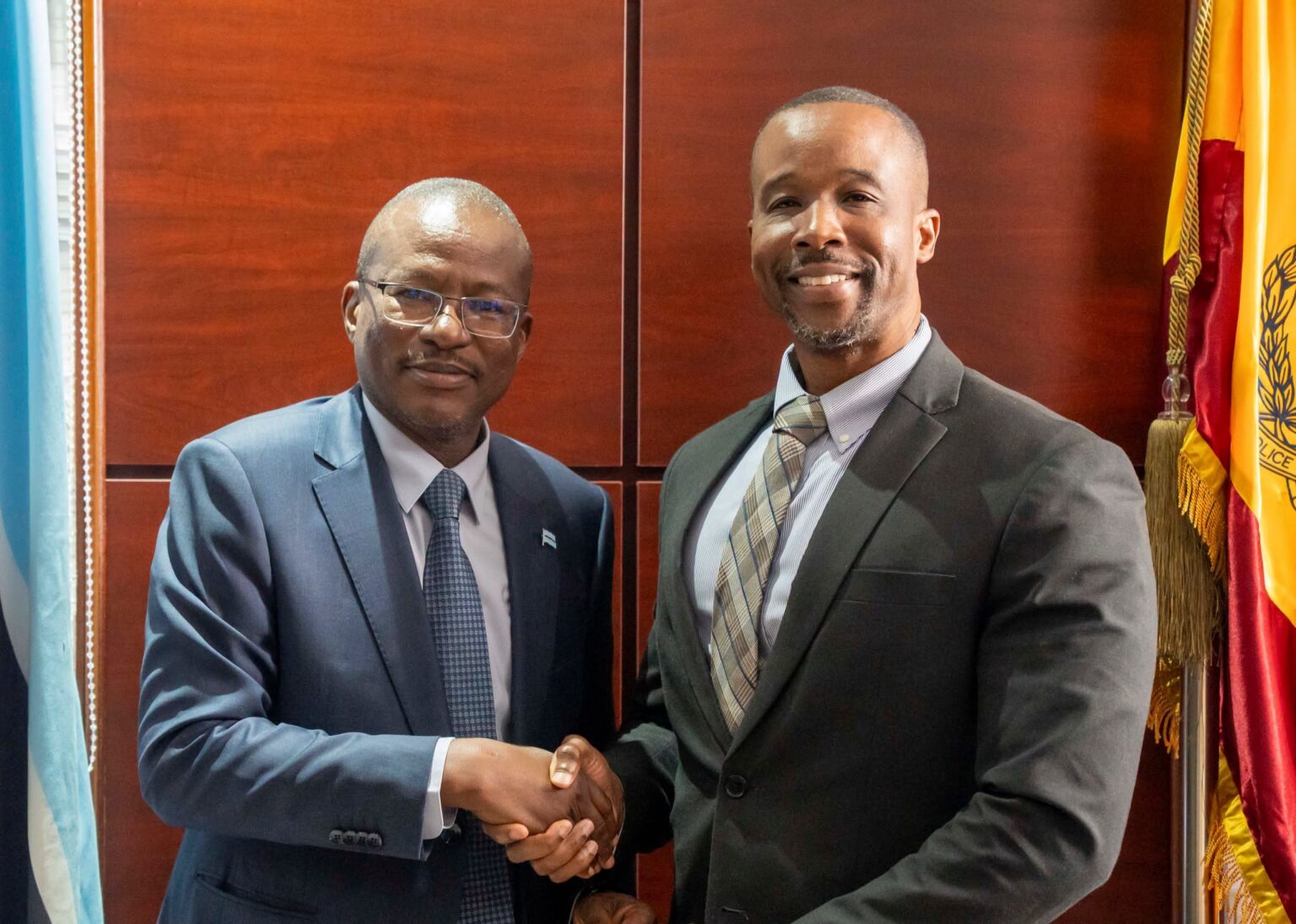
Botswana and the United States are looking to deepen security cooperation following a courtesy visit by newly appointed United States Embassy Regional Security Officer Mr Isaiah Roland II to Botswana Police Service Headquarters in Gaborone. Mr Roland paid the visit on August 13, 2026, in an engagement that highlighted the importance of stronger partnerships between law enforcement agencies in responding to increasingly complex security threats. The meeting provided an opportunity for the new Regional Security Officer to establish working relations with senior officials within the Botswana Police Service and discuss areas where cooperation can be expanded. Both sides recognised the value of continued collaboration in areas such as training, intelligence sharing, cyber security and criminal investigations. The engagement comes as law enforcement agencies worldwide face evolving threats that increasingly cross national borders and require coordinated responses.
Mr Roland was received by Deputy Commissioner of Police for Crime Investigations, Deputy Commissioner Busang Cornelius Lesola, who welcomed the continued support provided by the United States Government to the Botswana Police Service. Lesola specifically highlighted the value of training and capacity-building programmes that have supported police officers in developing specialised skills. Areas such as cyber security and criminal investigations have become increasingly important as criminals adopt new technologies and develop more sophisticated methods of operating. Continued investment in these areas can strengthen the ability of police officers to investigate complex cases and respond to threats that require specialised knowledge. The meeting therefore provided an opportunity to recognise existing cooperation while identifying areas where further engagement could benefit Botswana’s law enforcement capabilities.
The support provided through training and capacity-building can have a significant impact on the effectiveness of modern policing. Cybercrime, for example, can involve sophisticated techniques that require investigators to understand digital systems, electronic evidence and emerging forms of online criminal activity. Criminal investigations can also become more complex when cases involve multiple jurisdictions, digital communications or organised networks operating across borders. Strengthening the skills of police officers can help improve the collection and analysis of evidence while supporting more effective investigations. International cooperation can further enhance these capabilities by allowing law enforcement officials to share expertise and learn from experiences in other jurisdictions.
Mr Roland thanked the Botswana Police Service for the warm reception and reaffirmed the United States Embassy’s commitment to deepening cooperation with the Service. His remarks signalled an intention to build on existing relationships and develop stronger engagement between the two institutions. For cooperation to be effective, regular communication and sustained professional relationships between law enforcement agencies are important. Strong institutional links can make it easier for officials to identify areas of mutual concern and respond more quickly when security challenges emerge. The visit therefore represents an important starting point for further discussions and practical cooperation during Mr Roland’s tenure in Botswana.
One of the key areas identified during the engagement was intelligence sharing. Effective intelligence cooperation can help law enforcement agencies identify potential threats, understand criminal networks and respond to emerging security risks. Information exchanged through appropriate channels can also assist investigators when criminal activities involve individuals, organisations or transactions connected to more than one country. Intelligence sharing must operate within relevant laws, procedures and safeguards to ensure that information is handled responsibly. When properly managed, stronger intelligence cooperation can improve the ability of both countries to anticipate threats and support investigations into serious criminal activity.
Cyber security is expected to remain an important part of the partnership as digital technology becomes increasingly integrated into everyday life. Criminals can use digital platforms to facilitate fraud, identity theft, cyberattacks, illegal financial activities and other forms of criminal conduct. These threats can affect individuals, businesses, government institutions and critical infrastructure, making cyber security an important national security concern. Strengthening investigative capabilities can help Botswana respond to incidents more effectively and develop stronger systems for identifying those responsible. Cooperation with international partners can also provide access to specialised knowledge and training that can complement domestic efforts to combat cybercrime.
Transnational crime presents another challenge that requires cooperation beyond national borders. Organised criminal groups can operate across several countries, making it difficult for a single law enforcement agency to address their activities independently. Criminal networks involved in activities such as trafficking, financial crimes, cybercrime and other serious offences can use international connections to evade detection and move resources between jurisdictions. Stronger relationships between Botswana and United States law enforcement institutions can support information exchange and coordinated approaches where appropriate. Such cooperation can strengthen the ability of authorities to identify connections between cases and respond to criminal activity that extends beyond Botswana’s borders.
The partnership also reflects the changing nature of security threats facing countries around the world. Traditional policing remains essential, but law enforcement agencies increasingly need expertise in technology, intelligence analysis, financial investigations and international cooperation. Criminal organisations can adapt quickly to new technologies and exploit gaps between jurisdictions. This creates a need for police services to continually update their skills and strengthen relationships with international counterparts. Botswana’s engagement with the United States demonstrates the importance of developing these capabilities as part of a broader strategy to protect communities and maintain national security.
The role of international partnerships extends beyond individual training programmes because sustained cooperation can contribute to institutional development. When law enforcement agencies exchange knowledge and experience, officers can gain exposure to different investigative approaches and emerging practices. Training can also help institutions identify areas where systems, procedures or technical capabilities can be improved. Continued engagement allows these relationships to develop over time rather than relying on isolated exchanges. This can provide a stronger foundation for cooperation when both countries face emerging security challenges that require coordinated action.
The courtesy call by Mr Roland also provides an opportunity for the United States Embassy and Botswana Police Service to strengthen communication at a senior level. Regular engagement can help both institutions understand each other’s priorities and identify practical areas for collaboration. It can also support the development of professional networks that become valuable when urgent security matters arise. Building trust between institutions is particularly important when cooperation involves sensitive areas such as intelligence and criminal investigations. The continued commitment expressed by both sides suggests that the relationship is expected to remain an important part of broader security cooperation between Botswana and the United States.
The meeting between the newly appointed Regional Security Officer and Botswana Police Service leadership ultimately highlights the growing importance of international cooperation in addressing modern security threats. Cybercrime, transnational crime and organised criminality can evolve quickly and often require expertise, information and resources that extend beyond a single jurisdiction. Botswana’s continued cooperation with the United States can help strengthen police capacity through training, intelligence sharing and professional engagement. The commitment to deeper cooperation also creates opportunities for both sides to develop stronger responses to emerging challenges while supporting the safety and security of their communities. As the partnership develops, sustained collaboration and practical implementation will be essential to ensuring that the relationship produces lasting improvements in Botswana’s ability to respond to increasingly complex forms of crime.