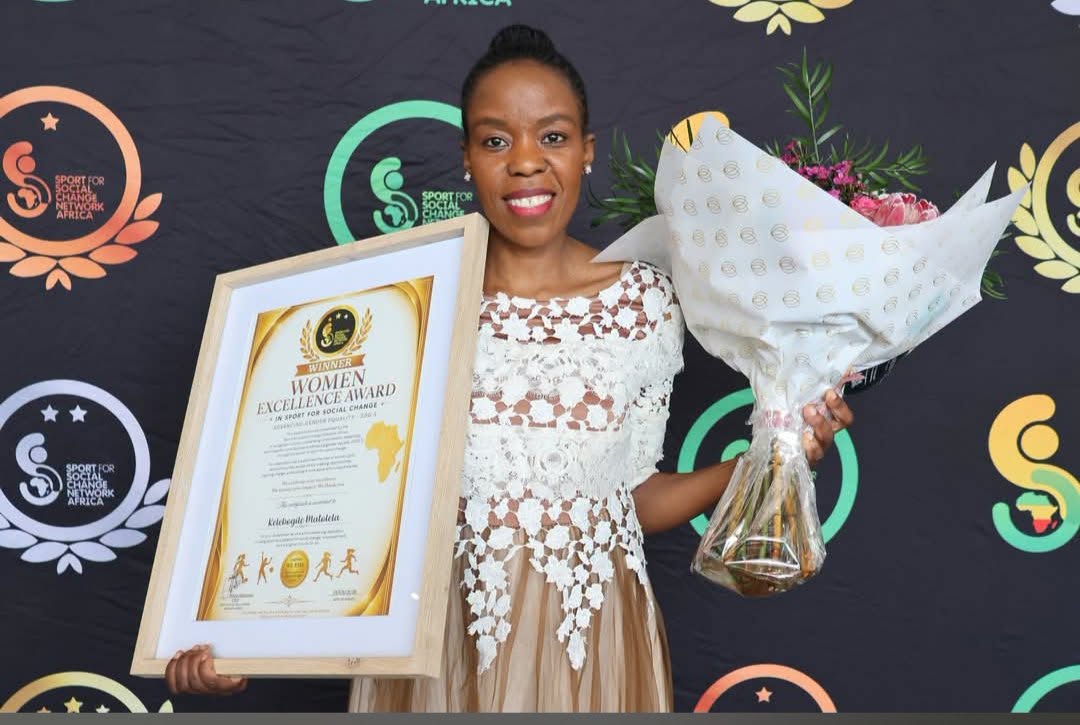
Botswana’s Kelebogile Matolela has been named the first-place winner of the 2026 Women Excellence in Sport for Peace and Development Award, marking a significant achievement for Botswana and highlighting the growing role of women in using sport to drive positive social change. Matolela received the prestigious recognition during the fifth Arise Women of Africa Symposium, held on 21 August 2026 at the Artscape Theatre Centre in Cape Town, South Africa. Her award recognises work that connects sport with gender equality, peace, environmental sustainability, education, technology and community development. The achievement also places a spotlight on the different ways women can contribute to the wider sport ecosystem beyond competing as athletes. For young Batswana women and girls, Matolela’s recognition provides an example of how sport can become a platform for leadership, advocacy, innovation and social empowerment.
The Arise Women of Africa Symposium is one of the flagship initiatives of the Sport for Social Change Network Africa, also known as SSCN Africa. The platform was established to accelerate progress towards Sustainable Development Goal 5, which focuses on achieving gender equality and empowering women and girls. Sport provides a powerful setting for this work because it can bring people together while creating opportunities for education, leadership, participation and community engagement. Each year, the symposium brings together policymakers, researchers, practitioners, thought leaders and experts to examine challenges affecting women and girls. Participants also share evidence and develop practical recommendations aimed at advancing gender equality in and through sport.
The 2026 gathering represented the fifth edition of the Arise Women of Africa Symposium and was held under the theme “Together We Rise.” The theme reflected the importance of collective action in addressing barriers that continue to affect women and girls across African communities. Discussions around women in sport increasingly extend beyond participation and competition to include leadership, economic empowerment, safety, education, sustainability and decision-making. Platforms such as the symposium provide an opportunity to examine these issues while highlighting individuals who are already creating solutions in their communities. Matolela’s first-place award therefore fits closely with the wider purpose of the event, which seeks to demonstrate how sport can contribute to broader social and developmental goals.
A major part of Matolela’s work has involved advocating for the use of Olympic values as a tool to address gender-based violence. Her efforts have included engagement with relevant government stakeholders and initiatives involving shelters that support survivors of gender-based violence. Using sport values such as respect, fairness, solidarity and inclusion can help create conversations about violence and encourage communities to challenge harmful attitudes and behaviours. Her approach demonstrates that sport can serve a purpose beyond physical activity by becoming a platform for awareness, education and social responsibility. By connecting Olympic values with efforts to address gender-based violence, Matolela has highlighted the potential of sport to contribute to safer and more inclusive communities.
Her work also extends into environmental sustainability, showing how sport can be connected to efforts to protect communities and the natural environment. Matolela has been involved in environmental initiatives that include tree planting and environmental education in schools. She has also contributed to research and sustainability activities associated with major sporting events. These initiatives highlight the relationship between sport and environmental responsibility, particularly as sporting events can influence public awareness and encourage large numbers of people to participate in sustainability activities. Her environmental work adds another dimension to her contribution and demonstrates how sport-based leadership can support practical action on issues affecting future generations.
Matolela has also worked to preserve and advance indigenous and traditional sports and games, an area that carries significant cultural importance across Africa. Her advocacy focuses on indigenous knowledge, intergenerational learning, inclusion and the recognition of traditional sport as part of Africa’s cultural and developmental assets. Traditional games can provide opportunities for communities to preserve knowledge and pass cultural practices from older generations to younger ones. They can also support physical activity, social connection and community participation while helping young people develop a stronger understanding of their cultural heritage. By promoting indigenous sport, Matolela is contributing to efforts to ensure that traditional forms of recreation and competition remain relevant within modern education, community development and sporting environments.
The recognition also reflects Matolela’s broader approach to using sport as a tool for development across several areas. Her work demonstrates that sport can contribute to gender equality while also supporting environmental sustainability, peacebuilding, education and community development. Technology and innovation can further expand the reach of sport-based initiatives by creating new opportunities for communication, learning, research and participation. Women’s involvement in these areas is particularly important because leadership opportunities within the broader sports ecosystem extend well beyond the field of play. Matolela’s achievement shows that women can build influential careers in advocacy, research, sustainability, technology, education, governance and community development through their connection to sport.
The final results of the 2026 Women Excellence in Sport for Peace and Development Award placed Matolela in first position for her work using sport, technology and environmental stewardship to drive social change. Helen Herbert finished in second place after being recognised for more than three decades of leadership in lifesaving, water safety and sport governance. Michelle Abdeziet took third place for her work using grassroots football, youth counselling and sport leadership to support healing, empowerment and opportunities within communities. The three award recipients represent different approaches to using sport as a vehicle for social impact. Their recognition demonstrates the breadth of work being undertaken by women who use sporting platforms to address community challenges and create opportunities for others.
For Botswana, Matolela’s achievement provides an important opportunity to highlight the contribution of women to the country’s sporting and development landscape. Her work demonstrates that sport can be used to address issues that extend well beyond competition and physical fitness. It can provide a platform for young people to learn, communities to connect, organisations to collaborate and leaders to promote social change. Her recognition also offers young Batswana women and girls a practical example of the career possibilities available within the wider sport sector. These pathways can include sport management, environmental sustainability, technology, research, advocacy, education, governance and community development.
Matolela’s first-place award at the 2026 Women Excellence in Sport for Peace and Development Award is therefore more than an individual achievement. It is recognition of an approach that places sport at the centre of efforts to build more inclusive, sustainable and empowered communities. Her work across gender-based violence prevention, environmental sustainability, indigenous sport, education and social development demonstrates the broad potential of sport when it is connected to wider development objectives. The award also strengthens the visibility of Botswana on a regional platform focused on women, sport, peace and development. As the country continues to encourage greater participation and leadership by women, Matolela’s achievement provides a strong example of how determination, innovation and community-focused action can create meaningful impact and inspire the next generation of Batswana women and girls.