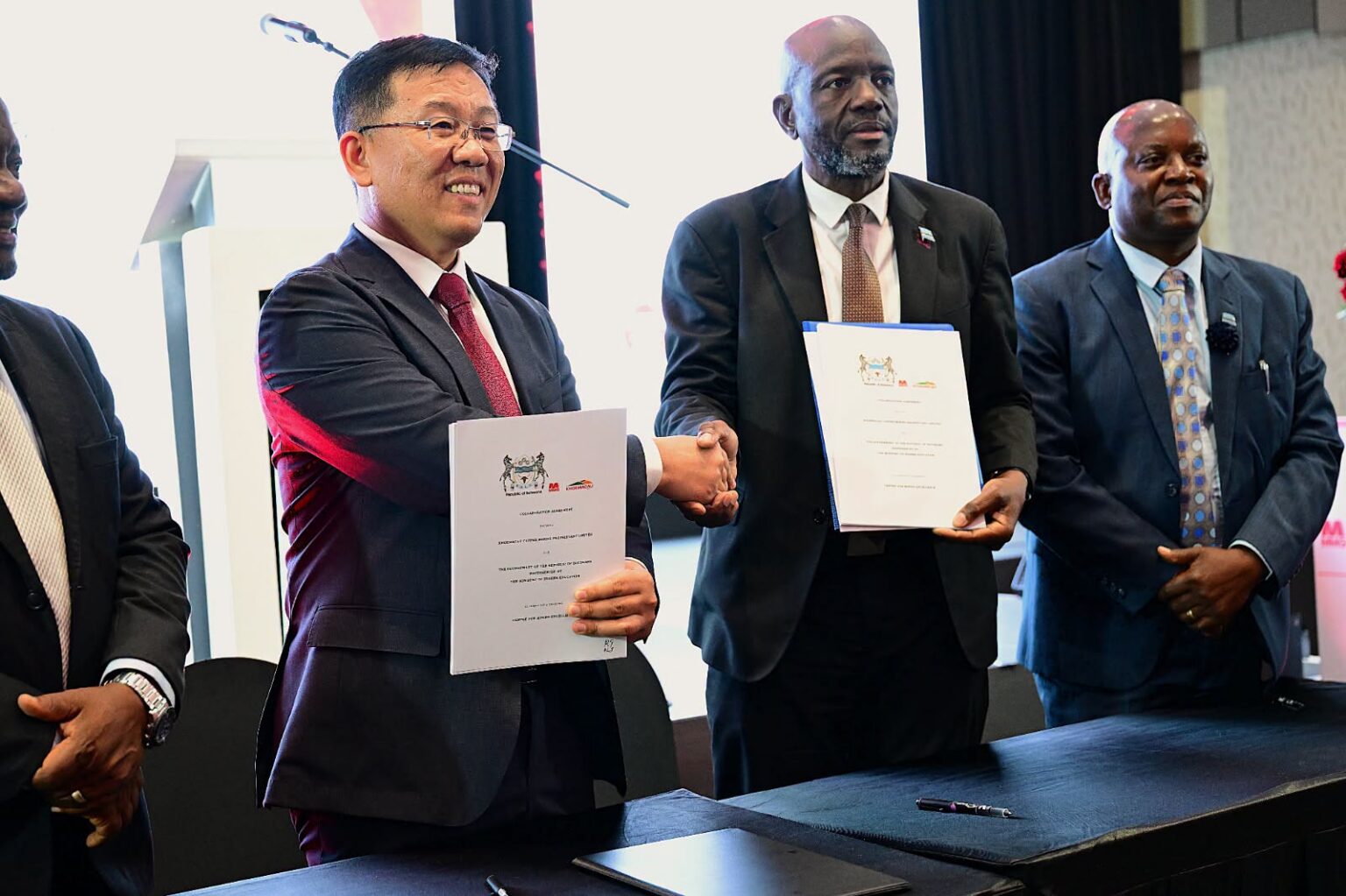
Botswana’s Ministry of Higher Education and MMG Khoemacau have signed a Memorandum of Agreement (MoA) aimed at advancing skills development, youth empowerment and industry-led education across the country. The agreement is being viewed as an important step in strengthening Botswana’s technical and vocational education and training (TVET) system while creating stronger links between education and the needs of the mining industry. By bringing Government and the private sector together, the partnership seeks to create practical opportunities for young people to gain relevant skills and improve their chances of entering the workforce. The initiative also highlights the importance of using the country’s mineral wealth to support long-term human capital development. The signing marks a move towards a more coordinated approach in which education, industry and economic development work together to prepare Botswana’s young people for future employment and entrepreneurship opportunities.
The signing ceremony was attended by senior Government officials, Members of Parliament and industry leaders, reflecting the importance placed on the partnership and its potential contribution to national development. Higher Education Minister Prince Maele hosted the event and described the agreement as a shared commitment to transforming Botswana’s education landscape. He emphasised the need for Government, industry and educational institutions to work together to create tangible opportunities for young people. The Minister’s remarks highlighted the growing need for education programmes to respond directly to the skills required by employers and industries. Stronger collaboration between training institutions and companies can help ensure that students gain qualifications and practical experience that prepare them for real workplace conditions.
Maele stressed that technical and vocational education should be repositioned as a strategic driver of economic transformation in Botswana. He noted that although the mining sector extracts valuable minerals from the country, education has an equally important role in developing the people who will shape Botswana’s future. The Minister argued that the true return from mining should not be measured only through mineral production and exports, but also through the number of young people who gain skills and build successful careers. He highlighted the potential for young people to become engineers, innovators, technicians, entrepreneurs and leaders through access to quality technical education. This approach places human capital development at the centre of discussions about the long-term value that mining can create for Botswana.
The MoA is expected to provide young people with access to practical training, modern technologies, mentorship, scholarships and career guidance. These opportunities can give students a better understanding of how the knowledge they acquire in classrooms applies to real workplaces. Exposure to modern mining technologies can also help trainees develop skills that are relevant to an industry that continues to evolve through digitalisation, automation and advanced technical systems. Mentorship programmes can connect students with experienced professionals who can provide guidance on workplace expectations, career choices and professional development. Scholarships and other forms of support can further help talented young people access specialised training that may otherwise be financially difficult to obtain.
The agreement also aims to create clearer pathways between education and employment, addressing one of the key challenges facing young people who complete their studies without sufficient workplace experience. Industry participation can help training providers understand the specific technical competencies employers require when recruiting new workers. Students can then receive training that is more closely aligned with available career opportunities and the changing needs of the economy. Practical exposure can also help young people build confidence and develop workplace skills before they enter full-time employment. By strengthening the connection between training and industry, the partnership could contribute to a more skilled workforce while helping employers access locally trained talent.
The Minister also urged society to change the way it views technical and vocational education, stressing that choosing TVET does not mean choosing less. Instead, he presented vocational training as a pathway towards possibility, dignity and meaningful professional development. This message is important as countries increasingly require workers with practical, technical and specialised skills across a wide range of industries. Careers in engineering, electrical work, mechanical services, mining technology, construction, information technology and other technical fields can provide valuable employment opportunities. Promoting TVET as a respected and strategic career pathway could encourage more young people to consider technical education based on their talents, interests and career ambitions.
The wide range of officials present at the ceremony demonstrated the cross-sectoral importance of the agreement. Labour and Home Affairs Minister Pius Mokgware, Assistant Education Minister Justin Hunyepa, International Relations Minister Dr Phenyo Butale and Minerals and Energy Minister Bogolo Kenewendo attended the event. MP Tshenolo Bogatsu and the Chinese Ambassador were also among those present, alongside representatives from Government and industry. Their participation highlighted the close relationship between skills development, employment, mining, education and international cooperation. It also showed that developing a skilled workforce requires coordinated action across different parts of the economy rather than relying on education institutions alone.
Chen Dexing, Chairman of China Minmetals Corporation (CMC), described the Centre of Mining Excellence as an investment in people and communities. His comments reinforced the importance of ensuring that mining activities generate benefits that extend beyond the extraction and export of minerals. Dexing reaffirmed CMC’s commitment to supporting broader social benefits from mining and highlighted the long-standing friendship between Botswana and China. He also pledged deeper cooperation, which could support the exchange of knowledge, technical expertise and industry experience. Such cooperation has the potential to strengthen the capacity of Botswana’s education and training institutions while providing young people with greater exposure to international standards and practices.
The Centre of Mining Excellence is expected to form an important part of efforts to strengthen mining-related skills and improve industry-led training. A specialised centre can provide opportunities for practical learning while exposing trainees to equipment, technologies and technical processes used in modern mining operations. It can also create a platform for stronger relationships between employers, educators and students. For the mining industry, investing in local skills can help develop a stronger pool of qualified workers who understand both technical requirements and workplace standards. For Botswana, the development of specialised expertise can help increase the local value generated from mining while supporting the growth of a more skilled national workforce.
The partnership also has significance for Botswana’s broader efforts to empower young people and support economic development. Youth skills development can help reduce barriers to employment by giving young people qualifications, practical experience and professional networks that can improve their prospects. Industry involvement can make training more responsive to economic opportunities while helping companies contribute directly to the development of future workers. The approach can also support economic diversification by giving young people technical skills that can be applied beyond the mining sector. When education and industry work together effectively, training can become a stronger link between young people seeking opportunities and businesses seeking qualified talent.
The agreement represents a shift from aspiration to action by establishing a framework for practical cooperation between the Ministry of Higher Education and MMG Khoemacau. Its long-term success will depend on how effectively the commitments are implemented and whether young people receive sustained access to training, mentorship, scholarships, technology and employment pathways. Measuring outcomes such as the number of students trained, qualifications achieved, workplace placements secured and employment opportunities created will be important in assessing the impact of the partnership. If the initiative delivers on its objectives, it could provide a valuable example of how Government and industry can work together to strengthen TVET and develop human capital. Botswana’s mineral resources can generate lasting value when investment in mining is matched by investment in the skills, knowledge and opportunities that enable its young people to contribute to the country’s future.