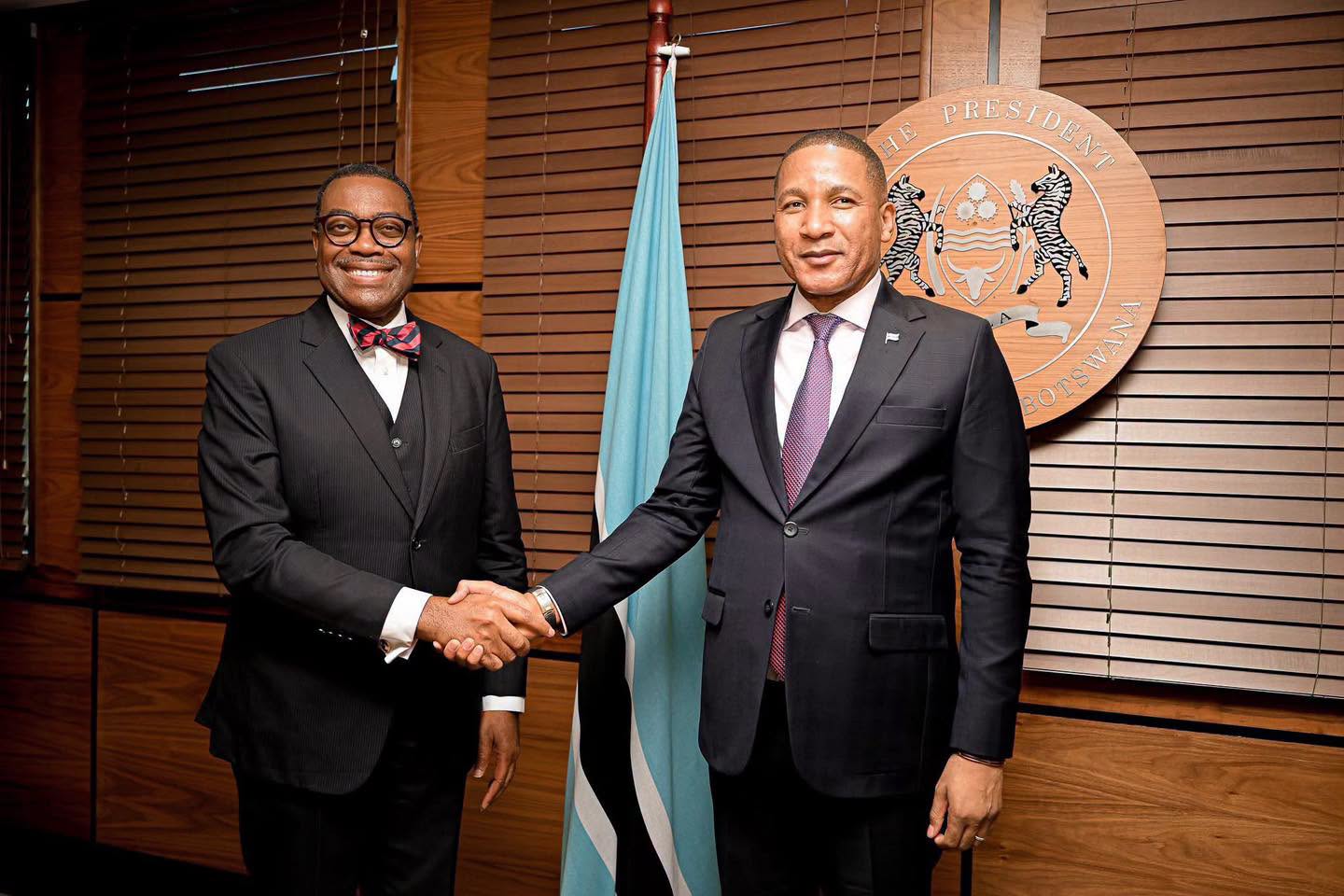
President Duma Boko has received Dr Akinwumi Adesina, Chair of the Board of the Diamonds for Development Fund, for a courtesy call focused on accelerating Botswana’s development agenda through strategic investment and structural economic reform. The meeting comes as Botswana continues to pursue broader economic diversification and reduce its dependence on traditional sources of economic activity. Discussions around investment, private-sector development and long-term economic transformation are expected to play an important role in shaping new opportunities for the country. The engagement also highlights the growing focus on building an economy that can generate sustainable opportunities for businesses and young people. President Boko welcomed the initiative and emphasised the need for swift action, noting that Botswana has significant development work to complete within a limited timeframe.
The Diamonds for Development Fund is a strategic economic initiative established by De Beers Group in consultation with the Government of Botswana. Its purpose is to support the country’s long-term economic diversification while contributing to the development of a knowledge-based economy. The initiative is expected to use investment and other forms of financial support to stimulate sectors beyond traditional economic activities. This approach comes at a time when Botswana is seeking to expand the role of the private sector and create new sources of sustainable economic growth. By directing capital towards areas with development potential, the Fund aims to contribute to structural changes that can strengthen the economy over the long term.
President Boko welcomed Dr Adesina and expressed appreciation for the Fund’s efforts to move quickly in establishing its development agenda. The President stressed the urgency of the task ahead, highlighting the need for practical action to translate national development objectives into measurable economic opportunities. His remarks reflected the importance of ensuring that investment initiatives respond to Botswana’s immediate needs while also supporting longer-term national priorities. The engagement between the President and the Fund’s leadership therefore provides an opportunity to align investment decisions with the country’s broader development objectives. The emphasis on speed also points to the need for institutions involved in economic transformation to move from planning towards implementation.
Dr Adesina highlighted the experience and capabilities of the Fund’s ten-member Board, describing its members as highly capable business leaders who are aligned with Botswana’s national vision. He also emphasised the importance of kgotla dialogue and the spirit of Therisanyo in guiding the Fund’s work. These principles place consultation, participation and collective discussion at the centre of the development process. Such engagement can provide communities and other stakeholders with opportunities to contribute to discussions about economic priorities and investment needs. Dr Adesina also stated that poverty should not define Botswana’s future and outlined the Fund’s ambition to support major structural growth across the economy.
A major component of the Fund’s strategy will involve developing investment portfolios focused on youth, infrastructure and agriculture. These sectors have the potential to support employment, strengthen productive capacity and create opportunities for businesses across different parts of the country. Investment in youth can support the development of skills and enterprises, while infrastructure can improve the conditions needed for economic activity and private investment. Agriculture also remains an important area for diversification because stronger production and value chains can create opportunities beyond traditional industries. By targeting several areas at the same time, the Fund intends to support a broader base of economic activity.
The Fund will also deploy risk capital and repayable grants to support viable small and medium-sized enterprises and private-sector growth. Access to appropriate financing remains important for businesses seeking to expand operations, invest in equipment, develop new products or enter new markets. Risk capital can provide funding for ventures where conventional financing may not be suitable, while repayable grants can support businesses while maintaining a mechanism for capital to be recycled into future development initiatives. The focus on viable SMEs indicates an intention to direct resources towards enterprises with the potential to contribute to economic activity and employment. Stronger private-sector participation could also help create a more diverse economic base and expand opportunities for entrepreneurs.
The focus on agriculture, infrastructure, youth and SMEs also reflects the interconnected nature of economic development. Young people need skills, access to capital and opportunities to participate meaningfully in the economy. Businesses require reliable infrastructure, suitable financing and markets in which they can grow. Agricultural producers need investment that can improve production, processing, distribution and access to markets. Addressing these areas together can help create stronger links between different parts of the economy and support the development of new value chains.
The meeting between President Boko and Dr Adesina therefore places the Diamonds for Development Fund within a wider conversation about Botswana’s economic future. The initiative is expected to work alongside national development priorities while using investment to support diversification and structural transformation. Its success will depend on how effectively planned investments are implemented, how opportunities reach businesses and communities and how partnerships between government and the private sector develop. Continued consultation through kgotla dialogue and Therisanyo will also be important as the Fund establishes its programmes and investment priorities. With the Board seeking to position Botswana for accelerated growth, the coming period will be important in determining how these plans translate into practical economic opportunities for the country.
The engagement signals a focus on using strategic investment to build a more diversified and knowledge-based Botswana economy. The Diamonds for Development Fund’s proposed support for youth, infrastructure, agriculture and SMEs provides several potential areas for expanding economic participation and private-sector activity. President Boko’s call for urgency and Dr Adesina’s emphasis on structural growth point to a shared focus on moving development plans into implementation. As the Fund begins its work, its ability to mobilise capital, support viable enterprises and align investment with national priorities will be central to its contribution. The initiative now faces the task of turning its stated ambitions into sustainable economic opportunities that can support Botswana’s development over the long term.