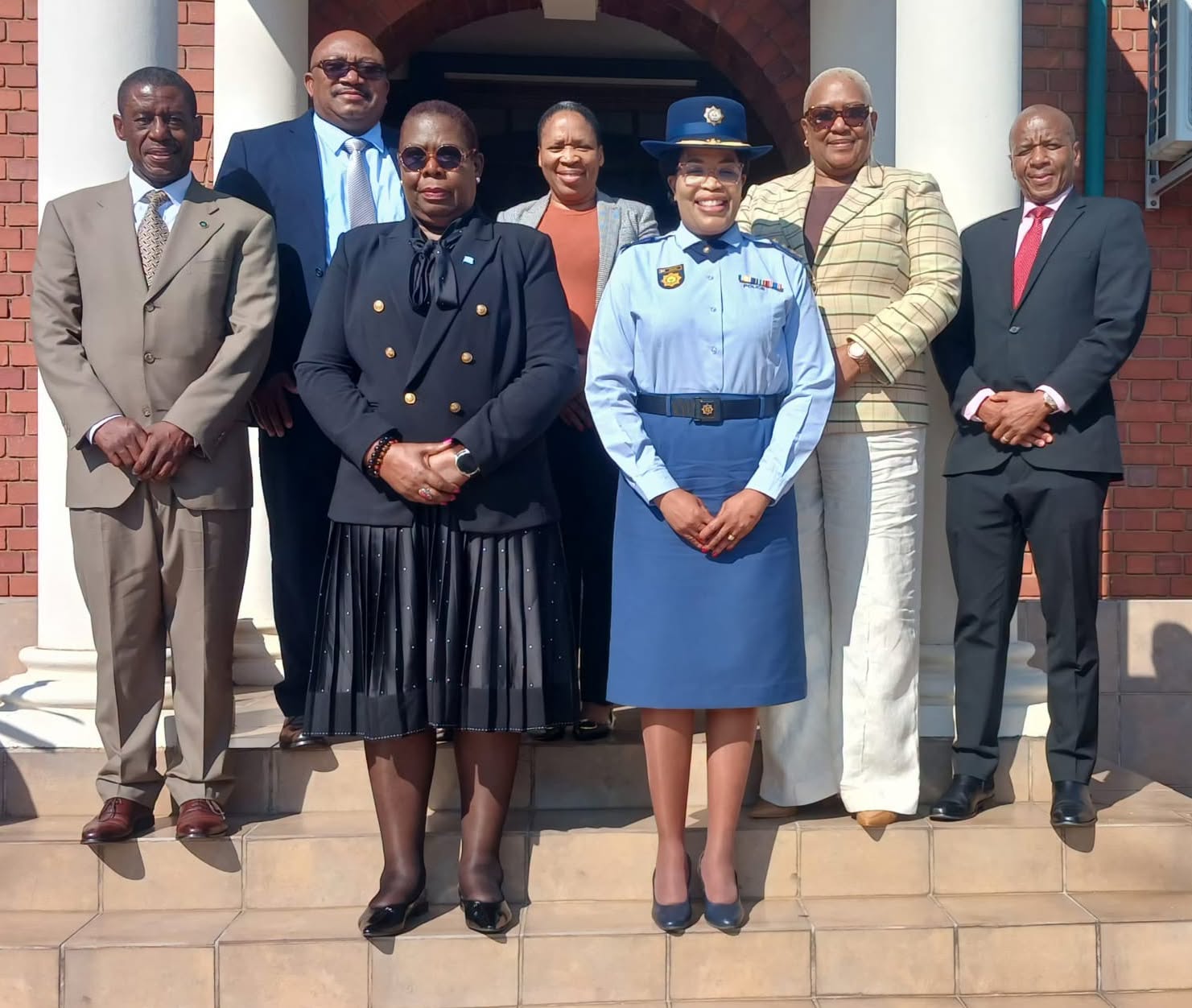
The Botswana Police Service and the South African Police Service are strengthening cooperation as criminal networks continue to operate across national borders. Botswana Police Service Commissioner Dinah Marathe paid a courtesy call on the Acting National Commissioner of the South African Police Service, Lieutenant General Puleng Dimpane, in Pretoria on 16 September 2026. The meeting reaffirmed the longstanding relationship between the two neighbouring police services and highlighted the importance of working together to address transnational organised crime. Both sides recognised that criminals can exploit the close links and shared border between Botswana and South Africa to facilitate illegal activities. Enhanced intelligence sharing, joint investigations and coordinated law enforcement operations were identified as important tools in responding to these challenges.
Commissioner Marathe acknowledged the deep historical, social, cultural and economic ties between Botswana and South Africa. The close relationship between the two countries results in significant movement of people, goods and services across their shared border. While these connections support legitimate economic and social activity, they can also create opportunities for criminal networks to operate across jurisdictions. Criminals may use border areas to move stolen property, people, drugs and other illicit goods while attempting to avoid detection by law enforcement agencies. The Commissioner therefore stressed the need for both Police Services to maintain strong cooperation to prevent criminals from exploiting the border.
Several forms of cross border crime were identified as requiring a coordinated response from Botswana and South Africa. These include stock theft, motor vehicle theft, human trafficking, drug trafficking, illegal migration, financial crimes, cyber-enabled offences and the smuggling of illicit goods. Many of these crimes can involve activities that begin in one country and extend into another, making cooperation between law enforcement agencies essential. Effective investigations can require police officers to exchange information quickly and work across jurisdictions to identify suspects, trace stolen property and disrupt criminal networks. Commissioner Marathe emphasised that timely intelligence sharing and operational collaboration are therefore central to addressing these increasingly complex crimes.
Cross border stock theft remains a particular concern for Botswana, according to Commissioner Marathe. She revealed that between 2023 and 2026, a total of 3,441 livestock, predominantly small stock, were reported stolen in Botswana and taken across the border into South Africa. Of those animals, only 480 were recovered during the period. The figures highlight the scale of the challenge facing livestock owners and law enforcement agencies in communities affected by stock theft. Recovering stolen livestock can also require cooperation between police authorities on both sides of the border, particularly when animals are moved from the country where the crime occurred into another jurisdiction.
Commissioner Marathe further warned about the changing methods used by organised criminal syndicates. She pointed to the reported use of drone technology by organised criminals as an example of how criminal groups can adopt new tools to support their activities. The use of technology can create additional challenges for law enforcement agencies that must monitor large and difficult-to-secure border areas. This changing environment makes it important for police services to develop their technological capabilities and improve the speed at which they share operational intelligence. Stronger joint operations can also help authorities respond more effectively when criminal networks operate across both countries.
Lieutenant General Dimpane reaffirmed the South African Police Service’s commitment to strengthening bilateral policing relations with Botswana. She stressed that criminals should not be able to use international borders to evade justice. This requires police services to maintain continuous information exchange and ensure that relevant intelligence reaches the appropriate authorities in a timely manner. Intelligence-led policing can help investigators identify patterns, connections and individuals linked to organised criminal activity. Joint investigations and coordinated operations can then provide mechanisms for police authorities to act on that intelligence across national jurisdictions.
The two Police Chiefs also discussed the evolving nature of crime, with particular attention given to cyber-enabled offences and the growing influence of organised criminal groups. Cyber-enabled crime can cross borders without requiring offenders to be physically present in the country where victims or businesses are located. Organised criminal groups can also combine traditional criminal activities with technology, financial networks and other methods to conceal their operations. These developments require law enforcement agencies to continually adapt their investigative approaches and strengthen their ability to share information. The discussions between the Botswana Police Service and SAPS highlighted prevention, proactive intelligence sharing and collaborative policing as important elements of this response.
Cooperation between Botswana and South Africa also has implications for communities living along the shared border. Effective policing can help protect livestock owners, businesses, travellers and other members of the public who depend on secure movement between the two countries. Stronger coordination can also assist authorities in responding to crimes that affect communities on both sides of the border rather than treating them as isolated incidents. The relationship between the two Police Services provides an established platform for addressing these shared security concerns. Maintaining regular engagement can help ensure that operational cooperation develops alongside changes in criminal activity.
The meeting in Pretoria demonstrated the importance of regional cooperation in addressing organised crime and other cross border offences. Commissioner Marathe’s engagement with Lieutenant General Dimpane focused on practical areas including intelligence sharing, joint investigations and coordinated operations. The discussion also recognised that criminal networks continue to adapt their methods, creating a need for police services to strengthen their ability to prevent and respond to emerging threats. Botswana and South Africa have longstanding institutional and social ties that provide a basis for continued law enforcement cooperation. Their shared border makes this cooperation particularly relevant to efforts aimed at protecting communities and disrupting criminal activity.
The Botswana Police Service has reaffirmed its commitment to working closely with SAPS and other regional partners to strengthen border security and public safety. The objective is to ensure that the Botswana-South Africa border supports legitimate movement and economic activity while limiting opportunities for criminal networks. Addressing stock theft, trafficking, smuggling, cyber-enabled offences and other forms of organised crime will require sustained cooperation rather than isolated enforcement actions. The figures on stolen livestock and the emergence of technologies such as drones demonstrate why law enforcement agencies must continue adapting their approaches. Through stronger intelligence sharing, joint investigations and coordinated operations, Botswana and South Africa are working to make their shared border a stronger line of defence against cross border crime.