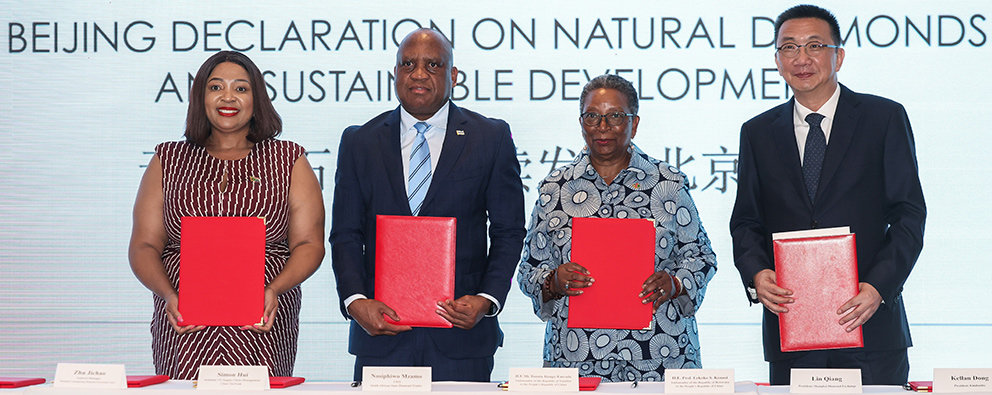
The Shanghai Diamond Exchange (SDE), together with government representatives from Botswana, Namibia and South Africa and members of the Chinese and international diamond industry, convened in Beijing on September 15 to sign the Beijing Declaration on Natural Diamonds and Sustainable Development. The declaration sets out a shared vision for strengthening cooperation across the natural diamond value chain while highlighting the socioeconomic contribution of diamond production in Africa. The signing brought together representatives from diamond-producing countries, Chinese jewellery businesses and major international industry organisations. Discussions focused on the changing Chinese diamond market, the contribution of natural diamonds to African economies and opportunities for stronger cooperation between China and Africa. The declaration also seeks to improve consumer understanding of the connection between natural diamonds, sustainable development and the communities that benefit from the industry.
The Beijing Declaration recognises the global nature of the diamond industry and the connection between diamond-producing countries and consumers in international markets. For African producers, the natural diamond industry can contribute to economic growth, employment, skills development and government revenue. For Chinese consumers, diamonds can carry personal and cultural significance, particularly when they are purchased to mark marriage, family milestones and other important occasions. The declaration seeks to make the relationship between these two sides of the industry more visible by improving understanding of where natural diamonds originate and how their economic impact reaches producing countries. It also reflects growing consumer interest in authenticity, traceable provenance, cultural meaning and the enduring value associated with natural diamonds.
The signing ceremony was hosted by the Shanghai Diamond Exchange and brought together government representatives from Botswana, Namibia and South Africa alongside senior figures from China’s jewellery industry and the international natural diamond sector. The gathering took place in the spirit of the Forum on China-Africa Cooperation, providing an opportunity for participants to discuss the current state of the global natural diamond industry. Discussions included consumer and retail trends in China as well as the socioeconomic contribution of diamonds across African producing countries. Participants also considered priorities for future cooperation between the African diamond industry and Chinese businesses and consumers. The meeting provided a platform for stakeholders from different parts of the value chain to identify areas where greater cooperation could support sustainable industry development.
Natural diamonds were central to the discussions because of their geological origin, rarity and long-standing cultural significance. In diamond-producing African countries, revenues associated with the industry have supported economic activity, jobs, livelihoods and skills development while also contributing to conservation and biodiversity initiatives. The declaration acknowledges these contributions and calls for them to be better understood by Chinese consumers. This focus on the wider impact of diamonds places greater attention on the communities and economies connected to the production process rather than viewing diamonds only as luxury products. The approach also creates an opportunity for producing countries and industry participants to communicate more clearly about the economic, social and environmental dimensions of natural diamonds.
The Beijing Declaration is rooted in the long-standing relationship between China and African countries and seeks to build on existing cooperation mechanisms. Its shared vision is aligned with the United Nations Sustainable Development Goals and the African Union’s Agenda 2063. The declaration proposes deeper cooperation across the natural diamond value chain, with particular attention to increasing local value creation in African producing countries. It also identifies skills training and economic diversification as important areas where cooperation can contribute to long-term development. By connecting diamond industry cooperation with wider development goals, the declaration aims to create a framework that extends beyond trade and supports broader economic and social priorities.
One of the key areas identified in the declaration is support for African diamond-producing countries to strengthen their local value creation capacity. This includes expanding skills development and supporting greater participation in activities connected to the diamond value chain. Increasing local capabilities in areas such as diamond processing, manufacturing and related services can help producing countries retain more economic value from their natural resources. The declaration also proposes stronger market connections between African producers and Chinese consumers. Such links could create opportunities for businesses across both markets while improving consumer access to information about the origin and socioeconomic impact of natural diamonds.
Consumer communication was another important part of the declaration. Stakeholders proposed greater transparency and objective communication about the origin of natural diamonds and the socioeconomic benefits associated with the industry. This includes consumer-facing education programmes designed to provide clearer information about natural diamonds and their journey through the global supply chain. As Chinese consumers increasingly consider factors such as authenticity and provenance, accessible information could play a greater role in purchasing decisions. The proposed approach aims to give consumers a more complete understanding of the product while strengthening connections between producing countries and the Chinese jewellery market.
The Shanghai Diamond Exchange occupies an important position within China’s natural diamond market and the wider international diamond industry. As a State Council-approved national diamond trading platform, SDE connects elements of the global natural diamond supply chain with the Chinese market. It provides integrated services involving customs, taxation and certification while maintaining links with international diamond industry organisations. SDE is also a permanent member of the Executive Committee of the World Federation of Diamond Bourses. Its role gives the exchange a platform from which it can facilitate communication and cooperation between international diamond businesses and Chinese consumers.
The declaration was supported by several key figures from the participating countries and industry organisations. Mr Lin Qiang, President of the Shanghai Diamond Exchange, was among the principal advocates alongside Botswana’s Ambassador to China, H.E. Prof. Lekoko S. Kenosi, South African State Diamond Trader Chief Executive Officer Ms Nosiphiwo Mzamo and Namibia’s Ambassador to China, H.E. Ms Tonata Itenge-Emvula. The signing was witnessed by international industry representatives including De Beers Group CEO Al Cook, Natural Diamond Council CEO Amber Pepper and Ms Emma Wade-Smith on behalf of the World Diamond Council. Major Chinese jewellery retailers also attended, including Chow Tai Fook, Lao Feng Xiang, Chow Sang Sang, Lukfook Jewellery, CHJ Jewelry, Chow Tai Seng, Sino Gem and Kimberlite. Their participation brought together stakeholders representing government, diamond production, trading, manufacturing and retail.
Lin Qiang said the signing represented an important step towards closer cooperation between China and African diamond-producing countries. He highlighted the socioeconomic benefits associated with natural diamonds and the role of China as an important participant in the global diamond industry. Qiang also described the Shanghai Diamond Exchange as a platform and bridge between different parts of the industry. He said stronger connections and greater mutual understanding could create opportunities for mutually beneficial cooperation. The exchange’s role in connecting the supply chain with Chinese consumers could therefore become increasingly important as the market develops.
De Beers Group CEO Al Cook also welcomed the declaration and linked it to the company’s approach to its operations in Africa. He said the company’s “Building Forever” approach focuses on creating positive impacts for people and the environment in diamond-producing regions. Cook said the Beijing Declaration provides a framework for strengthening connections between African producing countries and Chinese consumers. He also highlighted the importance of cooperation across the global diamond industry to support jobs, livelihoods and environmental protection. His comments reflected the broader focus of the declaration on connecting natural diamond consumption with socioeconomic and environmental considerations in producing countries.
Botswana’s Ambassador to China, H.E. Prof. Lekoko S. Kenosi, highlighted the significance of diamonds to Botswana’s national development. He noted that diamond resources have supported areas including education, healthcare, infrastructure and livelihood opportunities for generations of Batswana. Botswana has also developed local capabilities in areas such as diamond sorting, cutting and polishing while seeking to increase the amount of technology, expertise and economic value retained within the country. The ambassador also pointed to conservation initiatives as part of Botswana’s wider approach to balancing resource development with protection of its natural heritage. His remarks emphasised the connection between Botswana’s diamond industry, national development and its long-term economic diversification ambitions.
H.E. Ms Dipuo Bertha Letsatsi-Duba, Ambassador of South Africa to China, described the declaration as a framework for dialogue, cooperation and mutual understanding between the participating countries and industry stakeholders. She highlighted the role of natural diamonds in economic growth, employment and sustainable development. Letsatsi-Duba also emphasised the importance of consumer confidence, particularly because natural diamonds often carry significant emotional value for buyers. She expressed the hope that the declaration would strengthen interaction between China and African diamond-producing countries. Her remarks further reinforced the focus on cooperation across national and industry boundaries.
The participating governments and industry representatives are expected to continue exchanges following the signing as they work towards turning the declaration’s shared vision into practical initiatives. Proposed areas of future cooperation include industry market data sharing and consumer education on the origin and socioeconomic impact of natural diamonds. Stakeholders also plan to explore cross-border exchanges on industry best practices and additional opportunities through established China-Africa sustainable development cooperation mechanisms. These areas could provide a foundation for more structured engagement between producing countries, Chinese businesses and international industry participants. Continued cooperation will be important for ensuring that the principles outlined in the declaration translate into practical activities across the natural diamond value chain.
The Beijing Declaration marks a new stage in cooperation between African diamond-producing countries, China and international participants in the natural diamond industry. By focusing on local value creation, skills development, economic diversification, consumer education and stronger market connections, the declaration places sustainable development at the centre of future industry cooperation. Botswana, Namibia and South Africa bring significant experience as diamond-producing countries, while China’s large jewellery market provides an important connection to consumers. The continued involvement of industry organisations and businesses could help turn the commitments made in Beijing into practical partnerships and programmes. As the natural diamond industry responds to changing consumer expectations and evolving global markets, the declaration provides a framework for deeper China-Africa cooperation and for strengthening awareness of the socioeconomic value linked to natural diamonds.