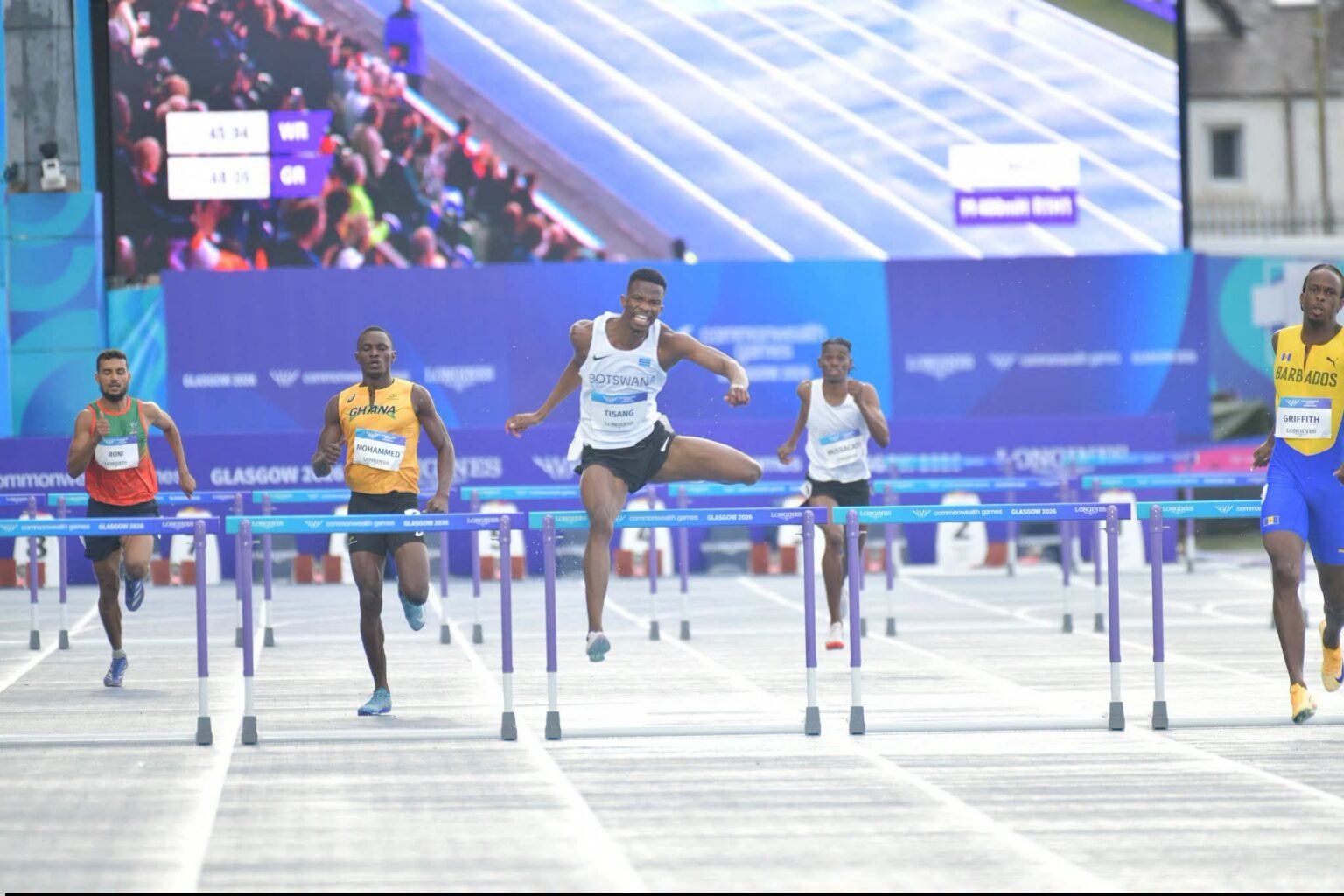
Botswana’s campaign in the men’s 400-metre hurdles at the Glasgow 2026 Commonwealth Games came to an end after Kemorena Tisang narrowly missed out on a place in the final. The talented hurdler delivered a determined performance in Heat 1 but was unable to secure one of the automatic qualifying positions needed to advance. Although the result was disappointing for both the athlete and Botswana’s athletics supporters, Tisang demonstrated resilience by fighting back after an early setback during the race. His performance reflected the determination and competitive spirit that have become hallmarks of Botswana’s growing athletics programme. While he will not contest the final, his effort remains a valuable experience on one of the biggest stages in Commonwealth sport.
Tisang finished fourth in Heat 1 after recording a time of 50.05 seconds. Only the top two athletes in each heat earned automatic qualification to the final, leaving the Botswana athlete just outside the required positions. The result meant his Commonwealth Games campaign concluded in the heats despite a strong effort over the remainder of the race. The narrow margin highlights the highly competitive nature of international athletics, where even small mistakes can determine whether an athlete progresses or is eliminated. Every fraction of a second matters in the 400-metre hurdles, making consistency and flawless execution essential for success.
The race took a difficult turn almost immediately when Tisang stumbled at the first hurdle. Losing momentum so early in a race can have a significant impact because the 400-metre hurdles requires athletes to maintain rhythm, speed and precise stride patterns throughout the event. The stumble disrupted his race plan and forced him to recover while competing against athletes who had already established their rhythm. Such an early mistake often requires additional energy to regain lost ground, placing athletes at a disadvantage during the demanding one-lap race. Despite the setback, Tisang remained composed and continued to push forward with determination.
After recovering from the early stumble, Tisang produced an encouraging response as he accelerated down the back straight. He managed to regain valuable ground and remained competitive against the rest of the field despite the difficult start. His ability to recover demonstrated both physical conditioning and mental strength, qualities that are essential for elite athletes competing at major international championships. Throughout the second half of the race, he continued to challenge strongly, refusing to allow the early mistake to define his entire performance. Unfortunately, the time and momentum lost at the opening hurdle ultimately proved too difficult to recover completely.
The 400-metre hurdles is widely regarded as one of the most demanding events in track and field because it combines sprinting speed, endurance and technical precision. Athletes must clear ten evenly spaced hurdles while maintaining a consistent rhythm and carefully managing their energy over the full lap of the track. Even a slight disruption in stride pattern or balance can affect an athlete’s overall performance and finishing time. This makes the event particularly unforgiving, as competitors have very little opportunity to recover from mistakes made during the race. Tisang’s experience in Glasgow serves as a reminder of how technically challenging the discipline can be at the highest level.
Representing Botswana at the Commonwealth Games remains an important achievement in itself. Competing against some of the strongest athletes from across the Commonwealth provides valuable international experience that contributes to an athlete’s long-term development. Exposure to high-level competition helps athletes identify areas for improvement while building confidence for future continental and global championships. Every major competition presents opportunities to learn, adapt and gain experience that can strengthen future performances. For Tisang, racing on such a prestigious stage adds another important chapter to his athletic career.
Botswana has continued to build a strong reputation in international athletics over recent years, producing athletes capable of competing at world-class events across multiple disciplines. The country’s growing investment in athletics development has resulted in increasing success on regional, continental and global stages. Athletes like Tisang play an important role in inspiring the next generation of Botswana’s sports talent by demonstrating dedication, discipline and perseverance. While medals and finals are important goals, participation at elite competitions also contributes to the continued growth of Botswana’s athletics programme. Experiences gained through international competition help strengthen the country’s future prospects in major championships.
Although Kemorena Tisang will not compete in the Glasgow 2026 Commonwealth Games final, his determination to recover after an unfortunate start highlighted his resilience and commitment to representing Botswana with pride. His fourth-place finish in Heat 1 and time of 50.05 seconds may not have been enough to secure qualification, but the performance provided valuable lessons that can support future success. The experience gained from competing against top international athletes will serve as an important foundation for upcoming competitions. Botswana’s athletics community will undoubtedly continue to support Tisang as he works toward future championships and opportunities to improve on this performance. His perseverance under challenging circumstances reflects the qualities that continue to drive Botswana’s growing presence in international athletics.