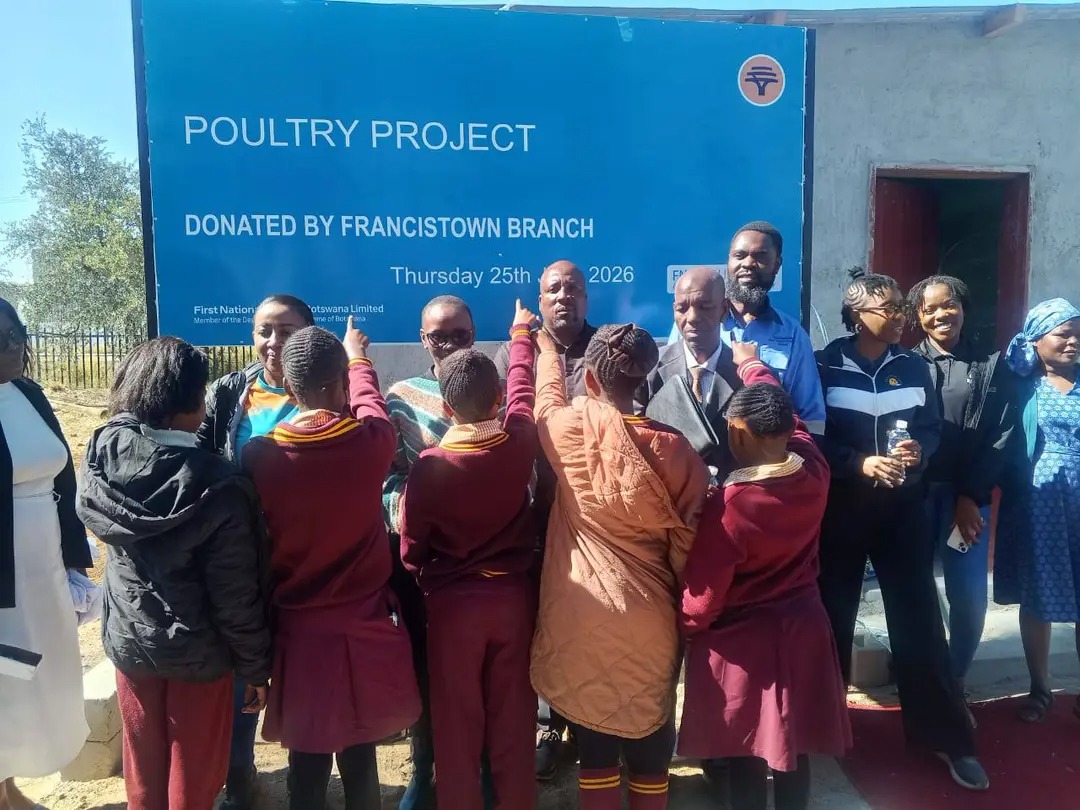
Nyangabgwe Primary School in Francistown has received a poultry project from the First National Bank of Botswana Foundation in a development aimed at strengthening practical learning among learners. The initiative focuses on moving education beyond theory and into real-world application where learners actively participate in managing agricultural activities. supported the project as part of its broader commitment to community development and youth empowerment. The donation includes a fully equipped poultry setup that will be used for hands-on learning within the school environment. The project is valued at P85 000 and includes a poultry house, 100 layers and chicken feed, giving learners a complete working model of a small-scale poultry enterprise.
The initiative is designed to help learners build practical life skills that go beyond the classroom curriculum. Students will learn how to manage livestock in a structured and responsible way, which includes feeding routines, hygiene practices and basic animal care. They will also gain experience in keeping financial records, tracking expenses and calculating profits from poultry production. These activities introduce learners to core business principles at an early stage, helping them understand how small enterprises operate in real life. The approach encourages self-reliance, innovation and problem-solving skills that can support future careers in agriculture and entrepreneurship.
Speaking at the handover ceremony, the Chief Education Officer responsible for the Francistown Sub Region in the North East Region, Ms Kedisaletse Tshukudu, explained that education has traditionally been focused on textbooks and theory. She noted that the current education direction places stronger emphasis on practical learning where learners gain knowledge through direct experience. She highlighted that this shift is important in preparing learners for a rapidly changing world that demands adaptable skills. Ms Tshukudu also pointed out that practical learning helps learners better understand how classroom concepts apply in everyday life. Her remarks reflected a broader push to modernise education delivery in Botswana through hands-on engagement.
Ms Tshukudu further explained that the poultry project supports the government’s efforts to strengthen Science, Technology, Engineering, Arts and Mathematics education. She said that learners will naturally develop critical thinking and analytical skills as they collect and analyse production data from the poultry unit. They will also learn how to solve practical challenges such as feed management, production efficiency and basic business planning. By managing the poultry enterprise, learners will be exposed to real decision-making processes that build confidence and responsibility. She emphasised that this form of learning connects academic subjects with real economic activities in a meaningful way.
She also stated that Science, Technology, Engineering, Arts and Mathematics education should not remain abstract concepts disconnected from daily life. She explained that when learners participate in projects like poultry farming, they begin to see how science and mathematics directly influence production outcomes. This understanding helps learners appreciate the relevance of their studies and motivates them to perform better academically. She added that the project will also promote entrepreneurship by creating opportunities for income generation within the school environment. This practical exposure teaches learners how to manage resources efficiently and sustainably.
According to Ms Tshukudu, the poultry project will leave a lasting impact on learners by equipping them with practical skills and an entrepreneurial mindset. She said learners will gain confidence as they take responsibility for managing a real production system from start to finish. The experience will also teach discipline, teamwork and accountability, which are essential skills in both education and employment. She highlighted that such initiatives prepare learners to become future innovators and job creators rather than job seekers. The long-term goal is to build a generation that can contribute actively to economic development.
The donation at Nyangabgwe Primary School reflects a growing recognition of the importance of practical education in Botswana’s schools. By integrating agricultural projects into the learning environment, schools can provide learners with early exposure to business and technical skills. The poultry project stands as an example of how partnerships between the private sector and education institutions can deliver meaningful impact. It also demonstrates how targeted investments in schools can enhance learning outcomes while addressing real community needs. The initiative is expected to benefit learners for years to come by giving them skills that extend beyond the classroom.