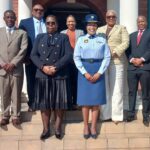

The Botswana Police Service and the United Nations Children’s Fund, UNICEF, have reaffirmed their shared commitment to protecting children and strengthening child-friendly justice systems across Botswana. This commitment was highlighted during a courtesy call by the Acting UNICEF Country Representative to SADC and Botswana, His Excellency Kimanzi Muthengi, on Commissioner of Police Dinah Marathe at the Botswana Police Service Headquarters on 4 August 2026. The meeting underscored the importance of collaboration between law enforcement and international partners in addressing the growing challenges affecting children and young people. Both leaders agreed that protecting children requires coordinated action from government institutions, communities, families and development partners. Their discussions reflected a shared vision of creating a safer environment where every child can grow, learn and thrive free from violence and exploitation.
Commissioner Dinah Marathe welcomed His Excellency Muthengi and reaffirmed the Botswana Police Service’s unwavering commitment to strengthening child protection services throughout the country. She acknowledged that children today face increasingly complex threats that demand innovative and coordinated responses. According to the Commissioner, the vulnerability of young people is driven by several interconnected factors, including weakened family structures, increasing digital risks, substance abuse and the gradual decline of community guardianship. These challenges have changed the landscape of child protection and require institutions to adapt their approaches. She stressed that the Botswana Police Service remains committed to working with partners to ensure that children receive the protection and support they deserve.
Commissioner Marathe explained that emerging social and technological changes have introduced new threats that require a comprehensive and multi-layered response. She highlighted concerns such as school violence, bullying and online exploitation, noting that these issues continue to affect children in different parts of the country. While Botswana has legislation designed to protect children from abuse and violence, she emphasized that legal frameworks alone cannot eliminate these problems. Laws provide an important foundation, but prevention, education and community involvement are equally essential. This balanced approach recognizes that child protection extends beyond policing and requires active participation from every sector of society.
To address these evolving challenges, Commissioner Marathe outlined the Botswana Police Service’s renewed strategic direction under its Corporate Development Strategy 2026 to 2030. She explained that the strategy places greater emphasis on community-led prevention rather than relying solely on reactive law enforcement measures. Guided by the philosophy that raising children is a shared responsibility, the strategy encourages citizens, families, schools and communities to play an active role in safeguarding children before they become victims of abuse or exploitation. This preventative model seeks to strengthen community partnerships while empowering families to create safer environments for children. By focusing on prevention alongside enforcement, the Botswana Police Service aims to reduce risks before they escalate into criminal cases.
The Commissioner also praised the long-standing partnership between the Botswana Police Service and UNICEF, describing it as an important pillar of the country’s child protection efforts. She commended UNICEF for its support in establishing child-friendly centres that provide safe and appropriate spaces for children who come into contact with the justice system. These centres help reduce trauma by ensuring that children are interviewed and assisted in environments designed to meet their emotional and developmental needs. Commissioner Marathe noted that such facilities represent significant progress toward creating a justice system that respects the rights and dignity of every child. The continued partnership demonstrates the value of combining international expertise with national leadership to improve services for vulnerable children.
Another major achievement highlighted during the meeting was Botswana’s growing role in combating online child exploitation. Commissioner Marathe revealed that the Botswana Police Service has made the fight against Online Child Sexual Exploitation and Abuse a strategic priority. She announced that Botswana has become the first Southern African Development Community country to connect to the INTERPOL International Child Sexual Exploitation Database. This milestone strengthens Botswana’s ability to cooperate with international law enforcement agencies in identifying victims, tracking offenders and disrupting child sexual abuse networks that often operate across national borders. It also positions Botswana as an important regional contributor to global efforts aimed at protecting children from online abuse and exploitation.
In his response, His Excellency Kimanzi Muthengi reaffirmed UNICEF’s commitment to supporting the Botswana Police Service in building a justice and protection system that places children’s safety, dignity and best interests at the center of every intervention. He praised the Botswana Police Service for establishing child-friendly centres and recognized the positive impact these facilities have had on children who encounter the justice system. He also commended the organization for investing in the training of police officers on child-friendly policing approaches. These specialized training initiatives have contributed to improved reporting, more sensitive investigations and better handling of cases involving children. His remarks reflected UNICEF’s confidence in Botswana’s progress while encouraging continued investment in child-centered policing practices.
His Excellency Muthengi further emphasized the importance of expanding child-friendly and survivor-centered policing across the country. He called for stronger collaboration between law enforcement agencies and stakeholders in the telecommunications sector to create safer digital spaces for children. He also stressed the need to increase public awareness about online dangers, particularly as children spend more time using digital technologies for education, communication and entertainment. Improved coordination among government departments, civil society organizations and private sector partners, he said, will be essential in responding effectively to emerging threats. By strengthening these partnerships, Botswana can continue building a comprehensive child protection system that responds to both traditional and modern forms of abuse.
The meeting between UNICEF and the Botswana Police Service reflects a shared commitment to ensuring that every child in Botswana is protected from violence, exploitation and neglect. The discussions highlighted significant progress already achieved through child-friendly centres, improved policing approaches and international cooperation against online child exploitation. At the same time, both parties acknowledged that lasting success depends on sustained collaboration between government institutions, communities, families and development partners. Their commitment to prevention, education and child-centered justice provides a strong foundation for future progress. As Botswana continues strengthening its child protection systems, the partnership between UNICEF and the Botswana Police Service will remain vital in creating a safer, more supportive environment where every child can enjoy their rights, dignity and opportunity to reach their full potential.