
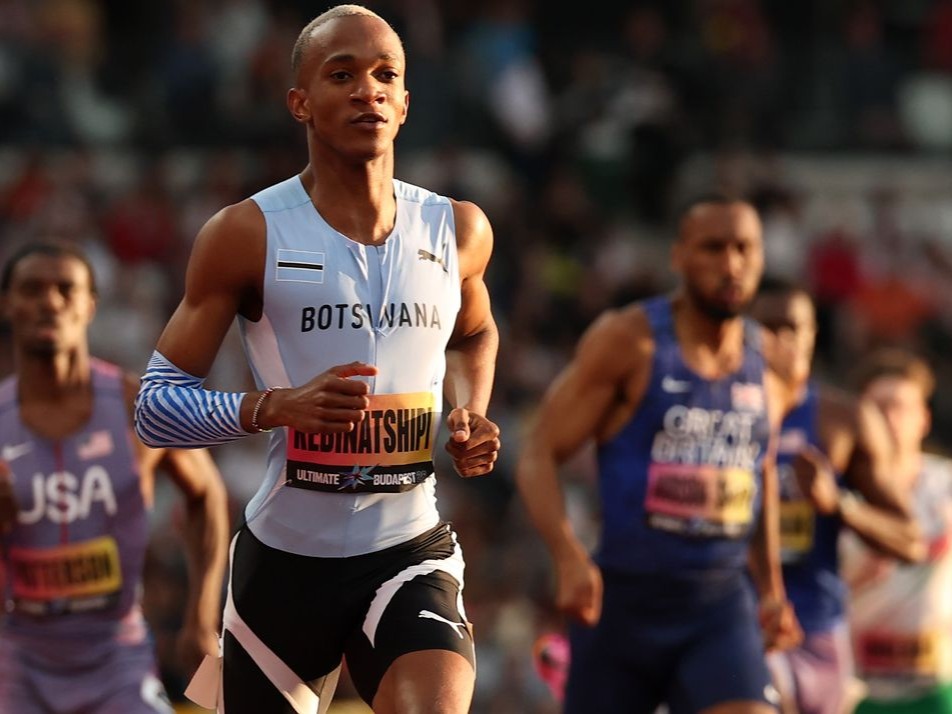
Collen Kebinatshipi has delivered a season of remarkable performances, strengthening his position among the leading 400m athletes in the world and declaring that his rise is only beginning. The 22-year-old Motswana has combined speed, consistency and confidence throughout the season, producing major victories on the international stage and repeatedly lowering his own national record. His latest triumph came at the World Athletics Ultimate Championship in Budapest, where he won the men’s 400m title in 43.39 seconds and earned $150,000 in prize money. The performance followed a season in which he remained unbeaten at six Diamond League meetings and established a national record of 43.40 at the Diamond League Final in Brussels. After another dominant campaign, Kebinatshipi believes he has entered an era that he intends to control for many years.
“Trust me,” Kebinatshipi said. “This was just the start of an era of Collen. My plan is just to dominate for the longest period possible.” His confidence reflects the progress he has made since emerging as one of Botswana’s most promising young athletes. The foundation for his breakthrough was laid several years ago, but his performances in the current season have taken his career to another level. His consistency has been particularly notable because he has repeatedly delivered at major meetings rather than relying on one standout performance. His results have also demonstrated that he can adapt his race strategy when circumstances require a different approach.
Kebinatshipi arrived in Budapest as the overwhelming favourite for the men’s 400m after an extraordinary run of form. He had won all six of his Diamond League races and had already improved the Botswana national record to 43.40 seconds in Brussels. Rather than relying on his usual approach of conserving energy before producing a strong finish, he decided to attack the race from the beginning. “I just decided I should go all out and see where it would end,” he explained. The decision produced one of the fastest performances of his career and showed how much confidence he had developed in his ability to sustain a demanding pace over one lap.
His opening section of the Budapest race demonstrated the scale of his ambition. Kebinatshipi covered the first 100 metres in 10.61 seconds before reaching 200 metres in 20.67 seconds. He then passed the 300-metre mark in a remarkable 31.37 seconds, creating a substantial gap between himself and a field that included leading global medallists. The final 100 metres tested his ability to maintain that pace under extreme physical pressure. He crossed the finish line in 43.39 seconds, setting another Botswana national record and securing the Ultimate Championship trophy.
The performance also demonstrated the physical demands of the 400m when raced at such intensity. Kebinatshipi blacked out shortly after finishing and spent several minutes recovering in a wheelchair. He described the reaction as normal for him when he pushes his body to its limits. His intention had been to leave everything on the track in his final race of the season, and his performance showed that he followed that plan. The result came at the cost of significant exhaustion, but it also completed a season in which he consistently operated at an exceptional level.
His achievements throughout the year extend well beyond the Budapest victory. Earlier in the season, Kebinatshipi recorded two 9.89-second performances in the 100m on home soil in Gaborone. He also set three national records in the 400m, demonstrating the breadth of his improvement across the season. His contribution to Botswana’s men’s 4x400m relay team was equally significant, as the team won at the World Athletics Relays in Gaborone while recording an African record of 2:54.47. These performances established a pattern of success across individual and relay events. They also showed that his influence extends beyond the individual 400m to Botswana’s wider ambitions in international athletics.
Kebinatshipi’s development has been gradual, despite the speed of his recent rise. He first took up athletics while attending primary school, initially treating the sport as something he did for fun. In 2019, he met his current coach, Chilume “Chippa” Ntshwarang, at a competition, and the two began working together. Their partnership has since become a major part of his development as an elite athlete. He trains alongside Lee Eppie, a 44.40-second 400m athlete who was also part of Botswana’s team that won the men’s 4x400m world title in Tokyo.
The decision to focus more seriously on the 400m came in 2020. Kebinatshipi has acknowledged that he was initially afraid of the event, but his coach apparently recognised potential in him that he had not yet seen himself. That change in focus began producing clear results within a few years. In 2022, at just 18, he improved his personal best to 45.40 seconds and reached the World U20 400m final. In 2023, he won gold at the African U20 Championships in 44.91 seconds and reached the World Championships semi-final in Budapest.
The following year brought another major step when Kebinatshipi became an Olympian in Paris. He narrowly missed qualification for the individual 400m final but contributed to Botswana’s Olympic silver medal in the 4x400m relay. The experience gave him exposure to the highest level of international competition and added another major achievement to his developing career. His breakthrough as an individual global champion came in 2025 at the World Championships in Tokyo. Although his campaign began with a difficult heat in which he finished fourth in 44.48 seconds, he responded with a national record of 43.61 seconds in the semi-final before winning the final in 43.53 seconds.
The Tokyo victory changed the trajectory of Kebinatshipi’s career. Winning a world title at 22 placed his name among the leading athletes in the 400m and gave him a platform from which to build further success. He has said that the victory opened many doors, but he did not view it as the completion of his ambitions. Instead, he regarded the following season as an opportunity to establish himself further and demonstrate the full extent of his ability. His performances have since supported that ambition, with repeated national records and victories at major meetings. The Budapest performance provided a fitting end to a season that had consistently reinforced his status as one of Botswana’s leading athletes.
Kebinatshipi’s race strategy in Budapest was different from what he had used in many races during the season. He had often managed his energy during the early stages of the 400m before producing a powerful second half. In Budapest, he and his coach chose to test a more aggressive approach. The plan was to attack from the start and determine how far he could carry that pace. The result was a national record and a victory by 0.76 seconds over runner-up Rai Benjamin, one of the world’s leading 400m athletes. Kebinatshipi’s willingness to experiment with his strategy could become an important part of his continued development as he seeks faster times.
Despite producing 43.39 seconds, Kebinatshipi was not focused on breaking the world record in Budapest. Wayde van Niekerk’s 43.03-second world record remains the benchmark in the men’s 400m, and Kebinatshipi openly acknowledges that the mark is part of his long-term thinking. He has discussed the possibility of pursuing a sub-43-second performance and believes that his training calculations suggest such a time could eventually be within reach. At the same time, he has stressed that he does not want to place unnecessary pressure on himself. He has suggested that the world record could become a more immediate target around the 2028 Olympic Games in Los Angeles.
His ambitions do not end with the 400m. Kebinatshipi believes he could have another decade or more of competition ahead of him and has kept open the possibility of moving between different events. If he achieves his goals in the 400m, he has considered testing himself over the 200m and potentially even the 800m. Such plans remain part of his long-term thinking rather than confirmed changes to his specialist events. For now, the 400m remains the event in which he has established himself as a global champion and one of the world’s most consistent performers. His immediate priority is to remain healthy and prepare properly for the next major championship cycle.
After completing his season, Kebinatshipi plans to return home to Botswana for an extended break and recovery period. Away from athletics, he breeds Boerboel dogs on a 10-acre farm and currently has eight dogs. He has joked that he has missed them since May and intends to spend his prize money on them after returning home. His comments provide a glimpse into the life of an athlete whose public identity is increasingly defined by international success but who remains connected to interests and activities away from the track. The planned break will also give him an opportunity to recover physically after a season in which he repeatedly pushed his body to exceptional levels.
Kebinatshipi’s rise has become an important story in Botswana athletics because his achievements combine individual excellence with contributions to the national relay team. His 400m performances have placed him among the world’s fastest athletes over the distance, while his relay performances have contributed to Botswana’s success in international competition. His development also demonstrates the value of long-term athlete development, coaching relationships and competitive experience. From running for fun in primary school to becoming a world champion, Olympic medallist and national record holder, his career has progressed through several significant stages. At only 22, he now enters the next phase of his career with major achievements already secured and further ambitions clearly defined.
The next chapter of Collen Kebinatshipi’s career will be shaped by how he manages health, training, competition and the expectations that come with becoming a global champion. His 43.39-second performance in Budapest ended an unbeaten season at the Diamond League level and added another national record to an already remarkable year. His comments about future world record attempts and possible moves to other events show that he is thinking beyond his current achievements. For now, his priority is recovery and staying healthy ahead of future World Championships competition. If his development continues on its current trajectory, the “era of Collen” he described could become one of the defining stories of Botswana athletics in the years ahead.