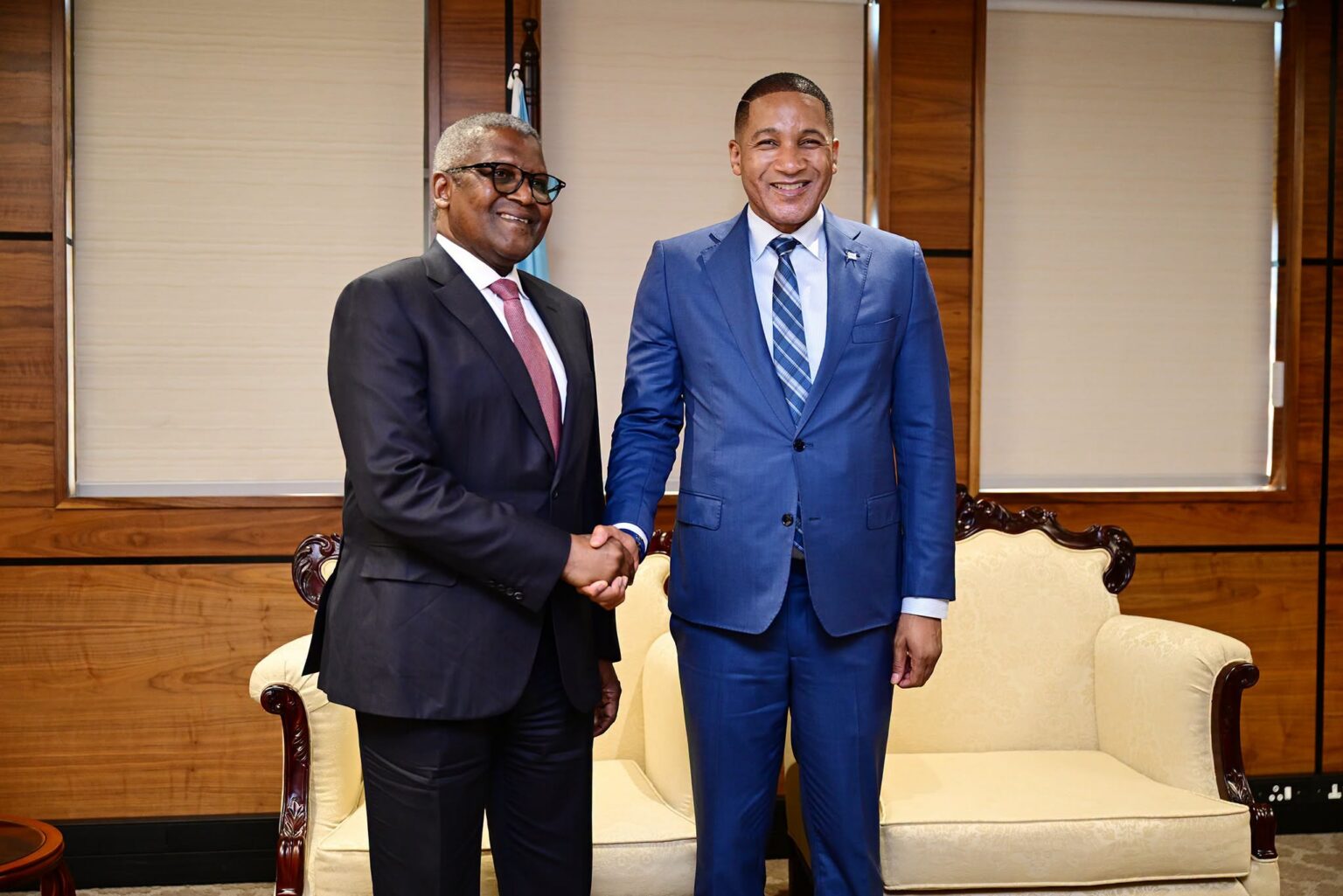
President Duma Boko has called for stronger African-led investment and partnerships to accelerate economic development across the continent, following a meeting with Nigerian billionaire and business leader Aliko Dangote yesterday. The meeting brought together political and private-sector leadership around a shared message that African countries must take greater responsibility for building their economies. President Boko said the continent has the intellectual capacity, entrepreneurs and resources needed to develop itself, but stressed that ideas must be translated into practical projects. He also highlighted Botswana’s efforts to advance regional infrastructure through discussions with Namibia on the proposed Trans-Kalahari rail line. The engagement reflects growing calls for African governments, businesses and investors to work together to unlock opportunities, create jobs and strengthen economic growth.
President Boko said Africa already has many of the thinkers, innovators and entrepreneurs required to solve its development challenges. However, he warned that having strong ideas is not enough if governments and businesses fail to move those ideas into implementation. His comments placed execution at the centre of Africa’s development agenda, particularly as countries seek to improve infrastructure, expand trade and attract investment. The President revealed that Botswana is in discussions with Namibia over the Trans-Kalahari rail line and said he wants the project to move forward soon. He also indicated that pension funds could participate in financing the infrastructure initiative, potentially creating a mechanism for African capital to support major regional development projects.
The proposed Trans-Kalahari rail line represents the type of infrastructure that could support stronger economic links between countries in the region. Improved rail connectivity has the potential to make the movement of goods more efficient, strengthen trade corridors and support businesses that depend on reliable transport networks. For Botswana and Namibia, infrastructure cooperation could also create opportunities to connect producers and markets while supporting broader regional economic integration. President Boko’s call to involve pension funds is significant because institutional investors control substantial pools of long-term capital that can potentially support infrastructure projects when suitable investment structures are available. His position that Botswana is ready to drive the African agenda also signals an intention to place practical regional cooperation at the centre of the country’s economic strategy.
Aliko Dangote reinforced the President’s message by urging Africans to stop waiting for foreign investors to develop the continent. Dangote, one of Africa’s most prominent industrialists, argued that governments and private companies need to partner, interact and work together more aggressively to create sustainable development. He said African countries must challenge the perception that the continent is not investable by demonstrating that viable businesses and major projects can succeed through African participation. His remarks point to the importance of building confidence among investors while strengthening cooperation between governments, local companies and African-owned capital. Such partnerships could help keep more investment value within the continent while giving African businesses greater opportunities to participate in large-scale economic activity.
The call for African-led investment comes at a time when countries across the continent are looking for ways to accelerate industrialisation, improve infrastructure and expand employment opportunities. Governments cannot create sustainable economic growth through public spending alone, while private companies often require supportive policies, infrastructure and predictable regulatory environments to invest with confidence. Stronger public-private partnerships can help bridge this gap by combining government’s ability to develop policy and infrastructure with the private sector’s capital, expertise and operational capacity. African pension funds, development finance institutions and other long-term investors could also play an important role in funding projects that have clear commercial and economic benefits. The challenge will be to ensure that these investments have sound governance, transparent procurement processes and realistic financial models that protect investors while delivering measurable public benefits.
Vice President Ndaba Gaolathe also echoed the emphasis on execution and partnership, highlighting the need for economic initiatives to translate into job creation and stronger growth. His comments reinforce the view that investment should ultimately produce tangible benefits for households, businesses and communities. Large infrastructure projects can create employment during construction while also supporting longer-term economic activity once they become operational. However, job creation depends on more than announcing projects, as governments and businesses must ensure that local companies and workers have meaningful opportunities to participate. Building skills, supporting small and medium-sized enterprises and developing supply chains around major investments can help ensure that economic growth reaches a wider section of society.
The meeting between President Boko and Dangote therefore carries a broader message about the role of African leadership in the continent’s economic future. Africa’s development requires more than attracting capital from outside the continent, as it also depends on mobilising domestic savings, strengthening African businesses and improving cooperation between neighbouring countries. Initiatives such as the Trans-Kalahari rail project demonstrate how regional infrastructure can become a platform for trade, investment and economic integration when governments work together. At the same time, Dangote’s emphasis on changing perceptions about Africa’s investment potential highlights the need for successful projects to demonstrate that African markets can support competitive and sustainable businesses. Greater collaboration between political leaders and entrepreneurs could help turn these ambitions into projects that generate lasting economic value.
For Botswana, the engagement also presents an opportunity to position the country as an active participant in regional investment and infrastructure development. Advancing the Trans-Kalahari rail discussions with Namibia could strengthen Botswana’s role in regional transport and trade while creating opportunities for investors and businesses. Inviting pension funds to participate could also demonstrate how domestic institutional capital can contribute to strategic infrastructure rather than relying exclusively on external financing. Any such approach would require careful assessment of project feasibility, financial returns, risk allocation and long-term maintenance requirements. If these issues receive adequate attention, African investment institutions could become important partners in financing infrastructure that supports economic development for decades.
The message from President Duma Boko, Aliko Dangote and Vice President Ndaba Gaolathe is ultimately focused on turning Africa’s economic potential into measurable results. The continent has entrepreneurs, investors, skilled professionals and natural resources that can support significant development, but these assets need effective coordination and practical execution. Governments must create conditions that encourage investment, while businesses must be prepared to invest, innovate and form partnerships that extend beyond national borders. Projects such as the Trans-Kalahari rail line could provide an example of how regional cooperation and African capital can work together to address infrastructure needs while supporting trade and employment. If the commitment to execution matches the ambition expressed at the meeting, stronger African-led partnerships could play an important role in building more integrated, productive and resilient economies across the continent.