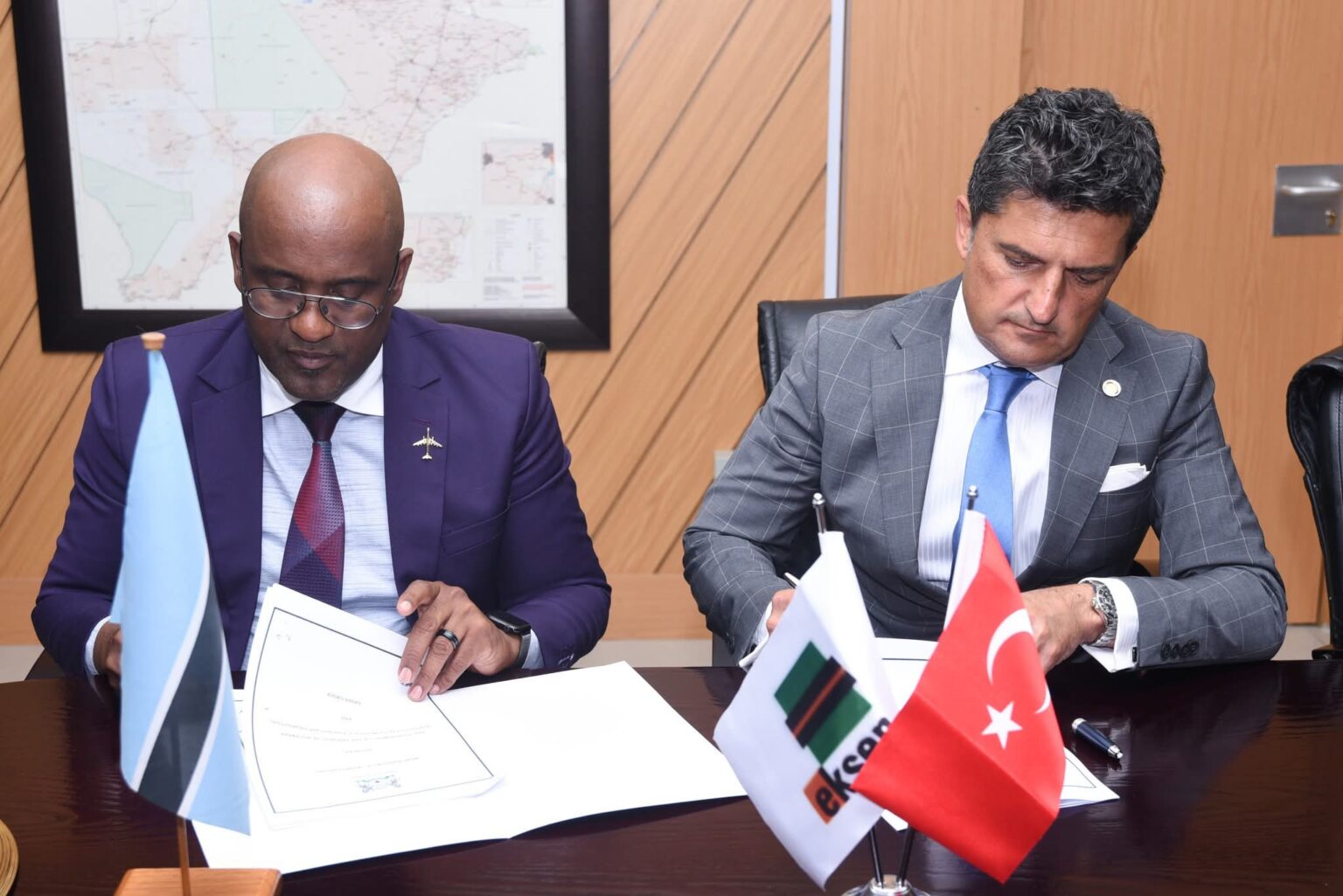
In a significant step towards strengthening international investment and modernising infrastructure, Botswana’s Minister of Transport and Infrastructure, Hon. Noah Salakae, has signed a Memorandum of Understanding (MoU) with Turkish construction and engineering giant, Eksen Group. The agreement, signed on behalf of the Government of Botswana, forms part of President Duma Boko’s broader agenda to attract foreign investment and accelerate national development through strategic partnerships.
The MoU centres on the ambitious Mosetse–Kazungula–Livingstone (MKL) rail project, a transformative transport corridor that will link central Botswana to the Kazungula Bridge and onward to Livingstone, Zambia. Once complete, the MKL rail line is expected to boost trade efficiency, reduce logistics costs, and enhance Botswana’s role as a regional transport and logistics hub in Southern Africa. The proposed project will also play a vital role in enhancing regional connectivity among member states of the Southern African Development Community (SADC), streamlining access to ports, and supporting cross-border economic activity.
By engaging Eksen Group through a Public-Private Partnership (PPP) framework, Botswana’s government is showcasing its dedication to leveraging international expertise and private capital for the timely delivery of critical infrastructure. The PPP approach not only reduces the financial burden on public coffers but also ensures that projects are executed with efficiency, innovation, and accountability.
Minister Salakae noted that the agreement with Eksen Group aligns with President Boko’s vision of creating a conducive environment for foreign direct investment (FDI) while addressing long-standing infrastructural gaps. “This MoU is a bold step forward. It demonstrates our resolve to forge ahead with meaningful partnerships that will deliver results, create jobs, and unlock new economic potential,” he said.
Beyond improving trade and transport, the MKL rail project is poised to deliver broad socio-economic benefits. One of the government’s top priorities under this initiative is job creation, particularly for Botswana’s youthful population. The construction and eventual operation of the rail line is expected to create thousands of direct and indirect employment opportunities, from engineering and construction to logistics and supply chain management. The project also offers opportunities for skills transfer and capacity building, enabling local professionals and young graduates to participate in and benefit from large-scale infrastructure development.
The signing of the MoU with Eksen Group marks the beginning of a collaborative journey toward realising one of Botswana’s most important infrastructure undertakings in recent years. As feasibility studies and detailed project planning get underway, both parties have reaffirmed their commitment to transparency, sustainability, and long-term economic impact. As Botswana continues to position itself as a gateway for trade and investment in Southern Africa, initiatives like the MKL rail project are not just about transport — they are about transformation.