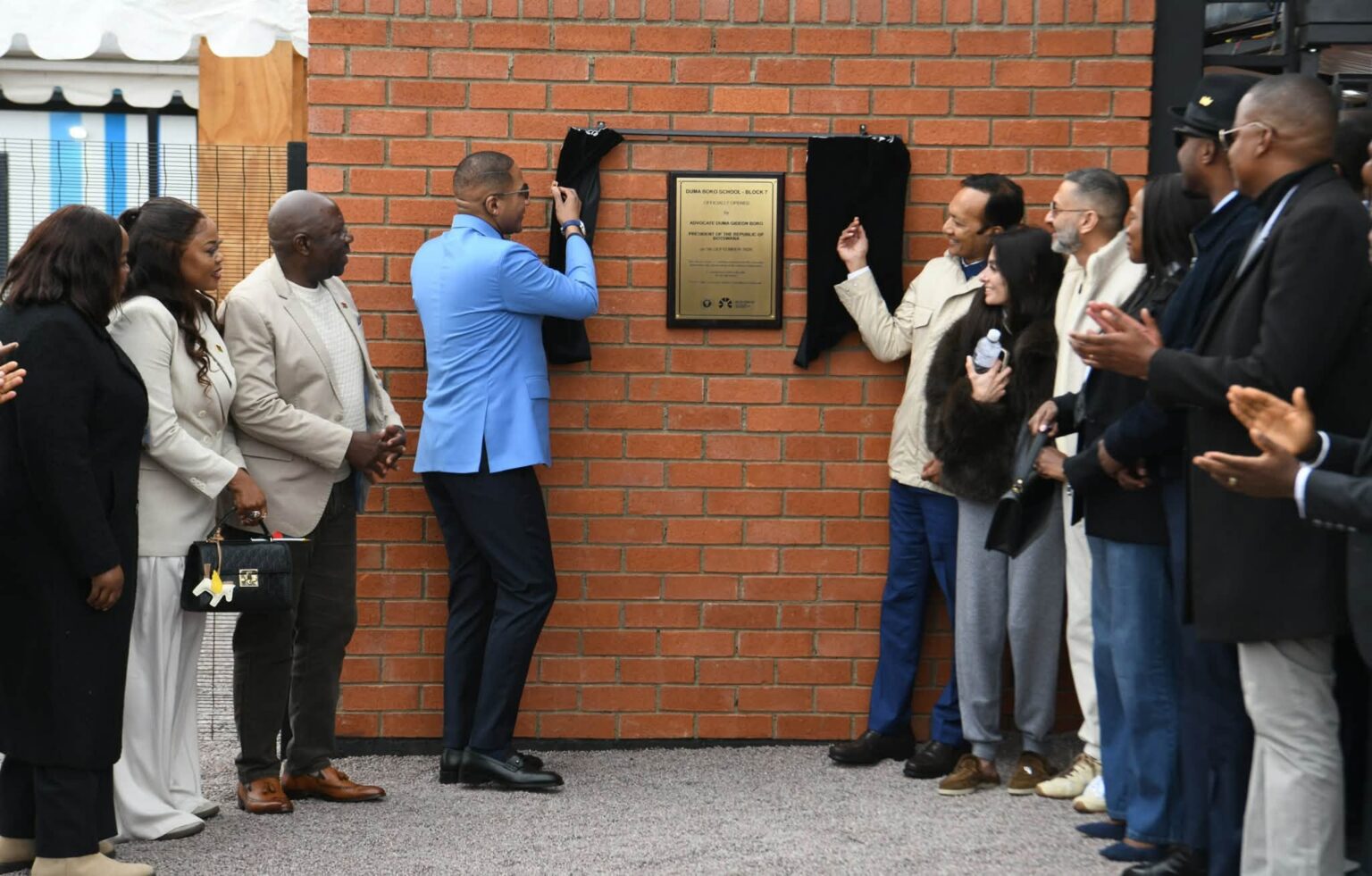
President Advocate Duma Gideon Boko on Saturday officially launched the Duma Boko School in Block 7, Gaborone, marking the start of an ambitious initiative aimed at delivering 100 schools and clinics across Botswana. The Block 7 project is being presented as more than the construction of another public facility, as it introduces a different approach to delivering essential social infrastructure. The model brings together private capital, faster construction technology, local manufacturing and government facilitation in an effort to accelerate the delivery of schools and clinics. The pilot project includes both a school and a clinic developed through a partnership between government and the private sector. President Boko described the initiative as an opportunity to demonstrate what can be achieved when government and private companies work together to address the country’s infrastructure needs.
During the launch, President Boko placed particular emphasis on the children who will use the new school and the importance of protecting childhood from adult concerns. He urged people to remember that children should be allowed to learn, play and grow in safe environments without being burdened by disputes and controversies that concern adults. “Let the children be children. Leave the difficult things to the adults,” he said, highlighting the need to keep the interests of children at the centre of discussions about the project. The President noted that childhood is a luxury not experienced by children who are forced to grow up too soon because of difficult circumstances. By providing classrooms, play spaces and an environment designed around children’s needs, the school is intended to offer learners a place where they can focus on education and enjoy the experiences that should form part of childhood.
The President also addressed the controversy and questions surrounding the project, including concerns about its funding, construction speed and naming. He acknowledged that these issues may be important to adults who are examining the project from political, administrative or financial perspectives. However, he argued that the children who attend the school and the patients who receive treatment at the clinic are more concerned with the services and opportunities the facilities provide. The Block 7 development includes classrooms and play areas as well as a clinic with a children’s welfare section, giving the project an important social services component. The facilities were delivered by African Hero in partnership with Aga Isago Trust, Navin Jindal and other stakeholders, demonstrating the role private and philanthropic partners can play in supporting public infrastructure.
President Boko described the Block 7 school and clinic as a proof of concept for people who remain doubtful about the possibilities offered by the new construction model. He thanked Mr Zunaid Moti for pushing the project forward and said the African Hero team engaged stakeholders while also injecting its own capital into the initiative. The President said the project demonstrates how alternative approaches to infrastructure delivery can challenge traditional expectations about how long construction should take and how much it should cost. He also spoke about resistance encountered from some public servants and from Gaborone City Council regarding the swimming pool he had demanded as part of the school development. Despite these challenges, the completion of the pilot has given government and its partners a physical example that can be assessed as Botswana considers expanding the model.
The President linked the project to wider efforts to improve the efficiency of infrastructure spending in Botswana. He referred to the Education Infrastructure Management Company and said the organisation has the potential to refurbish 40 schools with money that would traditionally have been sufficient for only six. He used the example of a boiler at Molefhi Secondary School that was repaired cheaply by local artisans to illustrate the value of using local skills and practical solutions. His comments suggest that government wants to examine not only how new infrastructure is built but also how existing facilities can be maintained and refurbished more efficiently. If local artisans and businesses can increasingly take part in infrastructure maintenance, Botswana could retain more economic value within the country while also creating opportunities for skilled workers.
Another significant aspect of the initiative is the limited financial role government played in constructing the Block 7 facilities. President Boko said government provided land that had already been zoned for a school for more than 20 years but did not spend money on the construction itself. The government will now take responsibility for operating the school and clinic by deploying teachers, nurses and medicines needed to provide services to the public. This arrangement illustrates the intended division of responsibilities between government and private partners under the model. Private capital can support construction while government provides the land, facilitates the project and ultimately ensures that essential public services are delivered through the completed facilities.
President Boko also announced plans to establish Botswana as a manufacturing hub for the infrastructure model. He said a factory is being established in Gabane using South Korean equipment capable of producing about one clinic per hour. The manufacturing component could significantly expand the economic impact of the initiative if the planned production capacity translates into actual projects and sustained demand. Rather than importing completed facilities, Botswana could develop domestic manufacturing capacity that supports construction projects within the country and potentially serves markets elsewhere in Africa. The President said Malawi has already requested 400 schools to be made in Botswana, creating the possibility that the initiative could develop into an export-oriented industry.
The manufacturing plans also place employment and skills development at the centre of the initiative. President Boko said he insisted that the factory employ and train at least 200 people, with a minimum wage of P4,000. This requirement could help ensure that the expansion of infrastructure production creates opportunities for Batswana rather than simply increasing the country’s capacity to import technology and equipment. Training workers in modern construction and manufacturing processes could also create a pool of people with technical skills that can be used across future infrastructure projects. If these workers gain experience in manufacturing, installation, maintenance and quality control, the benefits could extend beyond the initial 100 schools and clinics.
Cost reduction is another major argument behind the new construction approach. President Boko said the Block 7 school cost less than half the price of a traditional brick-and-mortar school, presenting the model as a potential way to stretch public infrastructure resources further. Lower construction costs could allow more facilities to be delivered within available resources if the same standards of quality, safety and durability are maintained. The President also explained that the project’s budget was not tabled in Parliament because government did not provide financial resources for its construction. His comments were aimed at addressing concerns about public expenditure and clarifying the financial structure behind the pilot.
President Boko has called on private capital and companies to participate in the expansion of the programme by financing additional schools and clinics. He said companies that contribute to the construction of facilities can name them as they wish, creating an additional incentive for private sector participation. This approach could open the door for businesses, trusts and other private organisations to contribute directly to infrastructure development while supporting projects that benefit communities. For government, increased private sector involvement could help accelerate infrastructure delivery without requiring the state to carry the entire construction cost. The success of this model will depend on whether private partners can be attracted at sufficient scale while maintaining transparency, quality and a clear focus on public benefit.
The President ultimately urged Batswana to focus on what the project can deliver rather than allowing criticism to overshadow its potential benefits. He encouraged people to consider participation, school enrolment, healthcare access and employment as important measures of the initiative’s success. The Duma Boko School in Block 7 therefore represents the first practical demonstration of a broader plan to deliver 100 schools and clinics using new construction methods and partnerships with private capital. If the model performs as intended, it could change how Botswana approaches social infrastructure while supporting local manufacturing, skills development and job creation. The success of the initiative will ultimately be judged by whether it can deliver quality facilities faster, create meaningful opportunities for Batswana and establish a sustainable infrastructure industry capable of serving Botswana and potentially other African countries.