
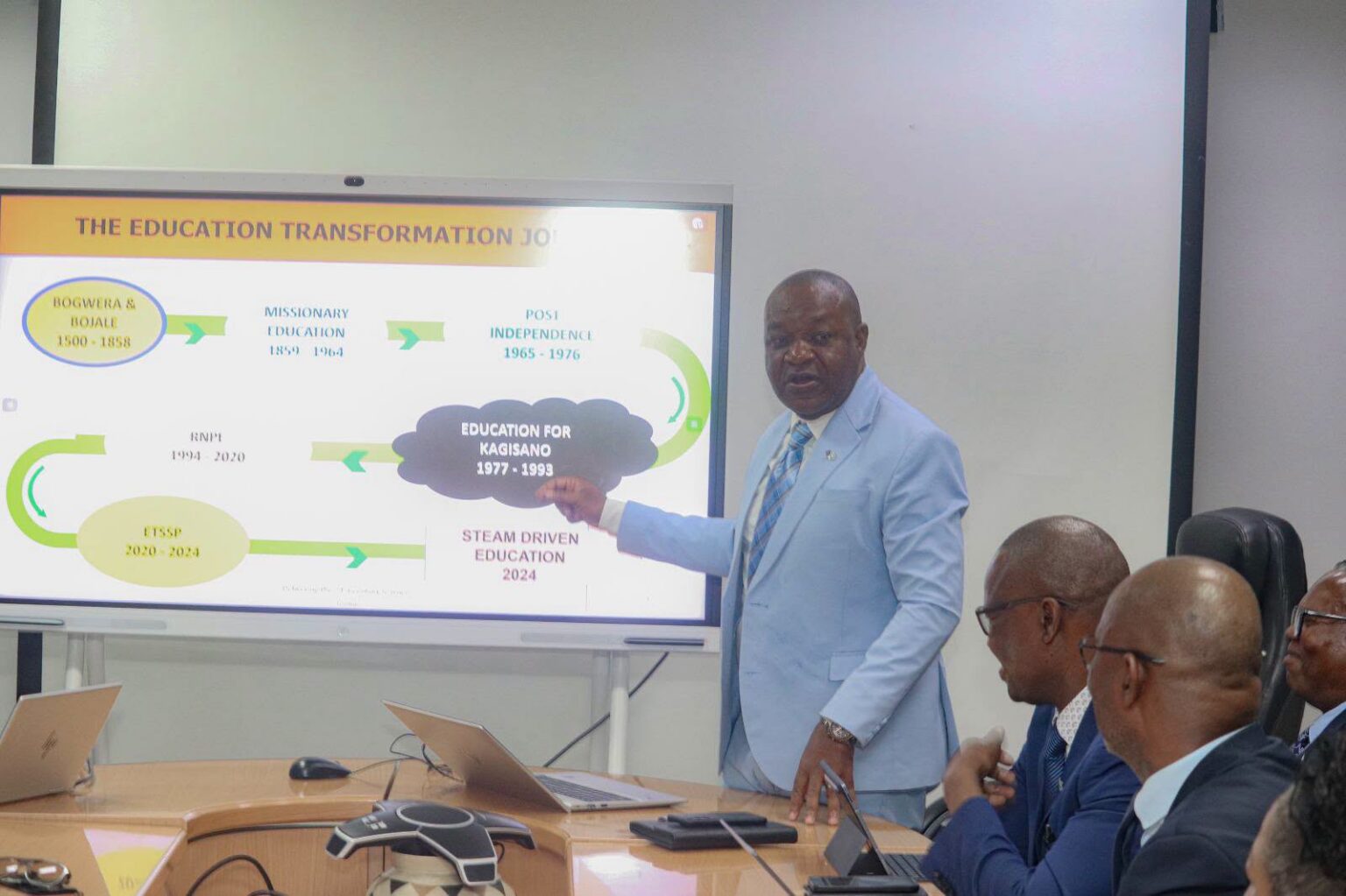
Botswana is making progress towards transforming its education system through the transition to a STEAM-based approach designed to prepare learners for the demands of a changing world. Yesterday morning, the Ministry of Education held a progress review to assess key milestones achieved so far and determine the next steps towards implementation. The review provided an opportunity to examine developments in curriculum reform while identifying areas that require further attention before the new approach is fully implemented. New curricula for Early Childhood Development, Pre-Primary and Special Education have now been completed and are ready for rollout. The development marks an important stage in Botswana’s efforts to create a modern education system that equips learners with relevant knowledge, practical skills and the ability to respond to future challenges.
The transition to STEAM-based education reflects a broader focus on Science, Technology, Engineering, Arts and Mathematics within the learning process. Rather than focusing only on traditional academic knowledge, a STEAM approach encourages learners to apply knowledge, solve problems, think creatively and connect concepts across different areas of learning. This approach can help children develop skills that are increasingly important in further education, employment, entrepreneurship and everyday life. The inclusion of the arts alongside science, technology, engineering and mathematics also supports creativity, communication and innovation. For Botswana, the move towards STEAM-based education represents an opportunity to align learning more closely with the skills required in a modern and increasingly technology-driven economy.
The Ministry’s progress review comes as curriculum development reaches several important milestones. The completion of the new curricula for Early Childhood Development, Pre-Primary and Special Education means that these areas are moving closer to practical implementation in schools and learning environments. Curriculum development is a detailed process that requires consideration of learning outcomes, teaching methods, assessment approaches and the needs of different groups of learners. The completed curricula will therefore provide teachers with a structured framework for delivering education under the new STEAM-based approach. Their rollout will also provide an important opportunity to assess how effectively the revised curriculum works in practice and where additional support may be required.
Early Childhood Development and Pre-Primary education are particularly important within the reform because they establish the foundation for future learning. Young children need opportunities to explore, ask questions, communicate ideas and develop basic problem-solving skills from an early age. A STEAM-informed curriculum can introduce these skills through age-appropriate activities that encourage curiosity, creativity and practical learning. Early exposure to these approaches can help children develop confidence in exploring different subjects and understanding how knowledge can be applied to everyday situations. Strengthening the early years of education can therefore support the broader goal of developing learners who are adaptable and prepared for more advanced learning later in their education.
The inclusion of Special Education in the curriculum reform is also significant because education reform needs to address the diverse needs of learners. Effective curriculum implementation requires teachers and schools to understand how learning activities can be adapted to accommodate different abilities and learning requirements. A modern education system should provide meaningful opportunities for all learners to participate and develop their skills. Completing the Special Education curriculum creates a framework for supporting this goal while ensuring that the transition to a STEAM-based system does not overlook learners who require additional educational support. The success of this aspect of the reform will depend heavily on appropriate teacher preparation, resources and support services.
Teacher preparation is one of the most important factors in determining whether the new curriculum achieves its intended outcomes. The Ministry is already working to equip teachers with the skills and tools required to deliver the revised curriculum effectively. Teachers will need to understand the principles behind STEAM education and know how to translate them into practical classroom activities. They may also require access to appropriate learning materials, technology and other resources that support experimentation, collaboration and problem-solving. Investing in teacher development is therefore essential because even a well-designed curriculum cannot achieve its objectives if educators do not receive adequate preparation and ongoing support.
The transition will also require teachers to adjust their approaches to classroom instruction. Traditional teaching methods may place greater emphasis on delivering information, while STEAM-based learning encourages learners to participate actively in investigating questions and developing solutions. Teachers can become facilitators who guide learners through activities that require observation, research, experimentation, creativity and critical thinking. This does not reduce the importance of teachers’ knowledge or expertise, but it changes how that knowledge is used in the classroom. Providing teachers with practical training and opportunities to share experiences can help make the transition more manageable and effective.
Another major development highlighted during the progress review is the commencement of the review of syllabi for Standards 1 to 7. This represents another important stage in the wider curriculum reform process because these grades cover a significant part of primary education. Reviewing the syllabi provides an opportunity to assess whether existing content remains relevant to learners and whether it supports the skills Botswana wants to develop in its future workforce. The process can also identify areas where learning content needs to be updated, strengthened or better connected across different subjects. The review will therefore help ensure that the education system develops progressively from the early years through primary education.
The review of Standards 1 to 7 syllabi can also help create greater continuity across the education system. Curriculum content needs to build logically from one grade to the next so that learners develop their knowledge and skills progressively. A coordinated approach can reduce unnecessary repetition while ensuring that important concepts receive appropriate attention at different stages of learning. It can also help teachers understand how the skills introduced in earlier grades contribute to later learning. This alignment is particularly important for STEAM education because learners need to build foundational skills before progressing to more complex problem-solving, technological and scientific concepts.
The move towards a future-ready education system also reflects the changing demands facing young people. Technology continues to influence workplaces, businesses and daily life, creating demand for people who can learn new skills and adapt to changing circumstances. Education systems therefore need to prepare learners for careers that may require strong digital skills, analytical thinking, creativity and collaboration. STEAM education can contribute to this preparation by encouraging learners to combine knowledge from different disciplines and apply it to practical problems. Botswana’s curriculum reform could consequently play an important role in strengthening the country’s human capital and preparing young people to participate effectively in the modern economy.
Successful implementation will require coordination between the Ministry, teachers, schools, education officials and other stakeholders. Curriculum reform affects the entire education environment, so changes need to be communicated clearly and implemented in a structured manner. Schools will need to understand the expectations associated with the new curricula while teachers require adequate preparation and resources. Parents and communities may also need information about what the changes mean for learners and how they can support education at home. Strong communication can help build understanding and reduce uncertainty as the reforms move from curriculum development into classroom implementation.
Resources will remain another important consideration as Botswana progresses with the STEAM transition. Some STEAM activities may require equipment, digital tools, learning materials and classroom environments that support practical exploration. Ensuring that resources are distributed fairly will be important so that learners in different schools and communities have meaningful opportunities to benefit from the new approach. The success of curriculum reform should not depend solely on whether a school has greater access to technology or other resources. Careful planning and investment will therefore be needed to ensure that the benefits of the new education system reach learners across Botswana.
Assessment will also need to evolve alongside the curriculum. If the education system aims to develop creativity, critical thinking, collaboration and problem-solving, assessment methods should give learners opportunities to demonstrate these skills. Measuring only the ability to recall information may not provide a complete picture of whether learners are achieving the objectives of a STEAM-based curriculum. Teachers may need appropriate assessment strategies that recognise practical application, investigation and the development of solutions. Ensuring that curriculum content, teaching methods and assessment systems work together will be important for maintaining consistency throughout the reform process.
The progress review demonstrates that Botswana’s transition to a STEAM-based education system is moving forward through a series of structured stages. The completion of curricula for Early Childhood Development, Pre-Primary and Special Education provides a foundation for the next phase, while teacher preparation is intended to support effective delivery. At the same time, the review of Standards 1 to 7 syllabi expands the reform into primary education and provides an opportunity to modernise learning content across the grades. These developments show that the transition involves more than introducing new subjects or terminology because it requires changes to curriculum design, teaching practices, resources and assessment. Continued monitoring will be important to identify challenges early and make adjustments where necessary.
Botswana’s move towards STEAM-based education has the potential to reshape how learners acquire and apply knowledge from the earliest stages of their education. The completion of the new Early Childhood Development, Pre-Primary and Special Education curricula represents a significant milestone, while the preparation of teachers will be critical to turning the new frameworks into effective classroom experiences. The review of Standards 1 to 7 syllabi adds further momentum to the reform and signals a broader effort to build a modern and relevant education system. The success of the transition will ultimately depend on effective implementation, adequate resources, strong teacher support and continued attention to the needs of learners. As Botswana moves forward, the focus on practical skills, creativity, innovation and critical thinking could help prepare a new generation for further education, employment and the demands of a future shaped by rapid technological and economic change.