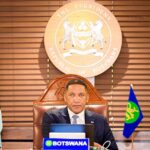

The Acting Minister of Finance of Botswana, Honourable Wynter Boipuso Mmolotsi, has called for stronger regional coordination to fight illicit financial flows, money laundering and terrorist financing across Southern Africa. His remarks were delivered at the opening of the 5th SADC Anti-Money Laundering and Counter Financing of Terrorism Committee Meeting held in Gaborone. He stressed that financial crimes weaken economic systems and reduce the ability of governments to fund development priorities. He also linked these threats to broader challenges facing the region, including limited diversification and exposure to external shocks. His message placed financial integrity at the centre of long term regional stability. The address set a clear tone for deeper cooperation among member states.
The Minister highlighted that countries within the Southern African Development Community continue to face structural economic weaknesses that make them vulnerable to illicit financial activity. He noted that constrained fiscal space limits investment in infrastructure, education and health systems. He also warned that geopolitical shifts are increasing pressure on already fragile economies. According to him, addressing these challenges requires coordinated policy action and stronger enforcement mechanisms across borders. He urged member states to treat financial crime not as isolated incidents but as a shared regional threat. His remarks reinforced the need for collective responsibility in safeguarding economic systems.
A key focus of his speech was Botswana’s domestic progress in strengthening anti money laundering systems. He pointed to the establishment of the Institute for Combating Illicit Financial Flows in partnership with the University of Botswana in 2024. The institute is designed to support research, training and capacity building in financial crime prevention. It also aims to serve as a regional knowledge hub for best practices and technical support. The Minister explained that the initiative reflects Botswana’s commitment to building stronger institutional frameworks. He added that the model can support other countries facing similar challenges in financial oversight.
The Acting Minister also welcomed recent progress within SADC following the approval of amendments to Annex 12 of the SADC Protocol on Finance and Investment. He confirmed that Botswana was among the first member states to sign the amended framework on 31 March 2026. He encouraged other countries to follow suit in order to accelerate regional harmonisation of financial regulations. He further acknowledged the role of the SADC Secretariat in coordinating policy alignment and technical support. Contributions from the Eastern and Southern Africa Anti-Money Laundering Group ESAAMLG were also recognised for strengthening regional capacity. These efforts were described as essential for improving compliance and enforcement across jurisdictions.
The meeting brought together representatives from across the SADC region to develop strategies for improving financial integrity and addressing emerging risks. Discussions focused on strengthening monitoring systems, improving information sharing and closing loopholes that enable illicit flows. Delegates also examined ways to enhance cooperation between regulatory bodies and law enforcement agencies. The Minister urged participants to engage constructively and prioritise long term regional stability over short term national interests. He emphasised that stronger financial systems are necessary for inclusive growth and sustainable development. The collaborative nature of the meeting was presented as a key step toward deeper regional integration.
The address concluded with a strong call for unity and sustained action against financial crime in the region. The Acting Minister reaffirmed that economic resilience depends on transparent systems and effective enforcement of financial regulations. He stressed that regional prosperity cannot be achieved without trust in financial institutions and accountability in governance. The outcomes of the meeting are expected to guide future policy direction within SADC. As discussions continue, member states are being encouraged to align their legal and institutional frameworks more closely. The overall message reinforced a shared commitment to building stronger and more secure financial systems across Southern African Development Community.