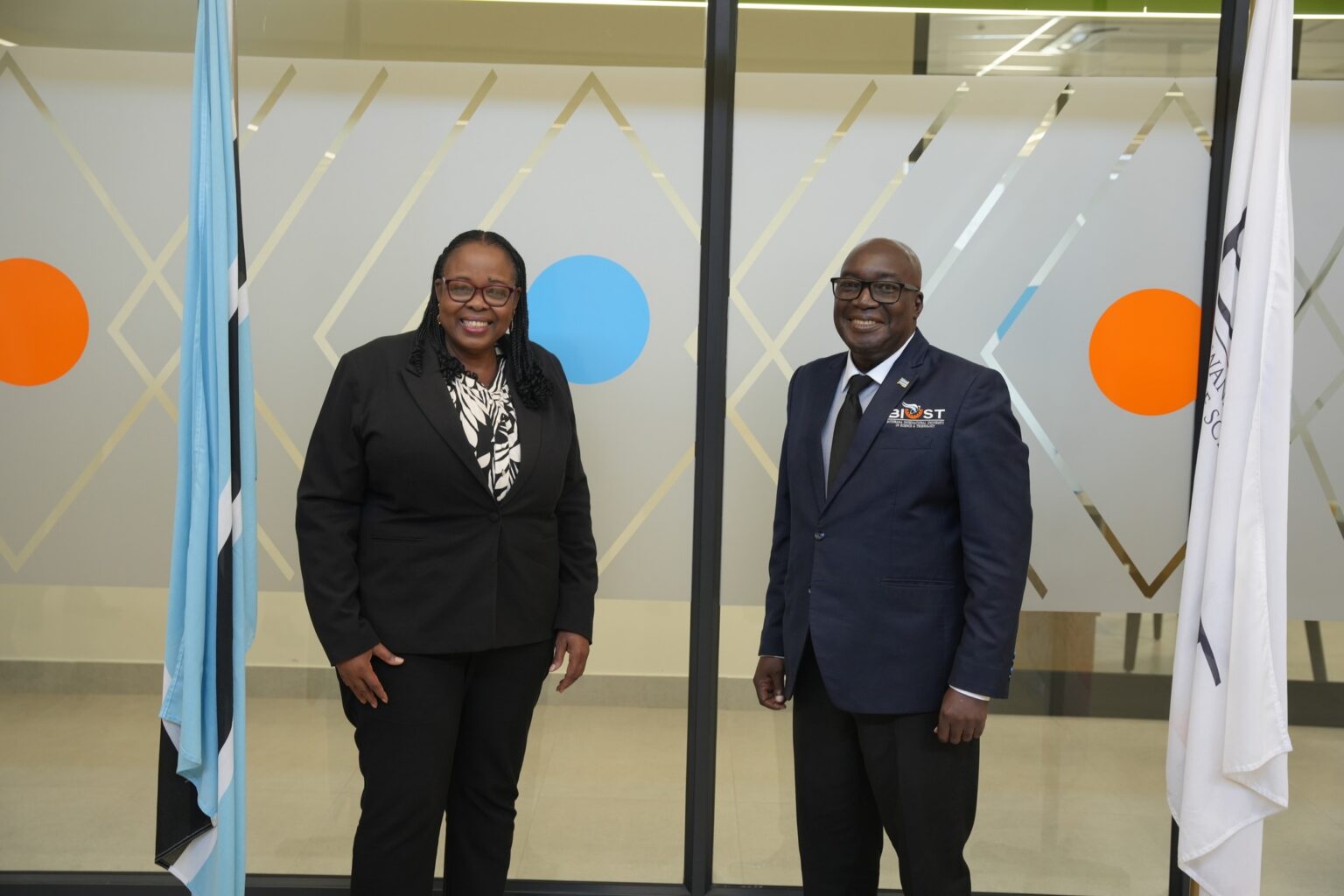
The Minister of Child Welfare and Basic Education, Nono Kgafela-Mokoka, has reinforced government commitment to education reform following a courtesy visit to the Botswana International University of Science and Technology. The engagement focused on strengthening collaboration between the ministry and the university in preparation for the rollout of Botswana’s upcoming STEAM-driven curriculum. The visit comes at a time when the country is intensifying efforts to modernize its education system and align it with global skills demands. Discussions highlighted the importance of linking classroom learning with real-world application. The engagement also underscored the role of higher education institutions in shaping national development priorities.
During the visit, Acting Vice-Chancellor Prof. Elisha Shemang outlined BIUST’s commitment to producing graduates who are ready for industry and innovation-driven environments. He explained that the university uses problem-based learning methods that challenge students to identify real-life problems and develop practical solutions. This approach is designed to move learning beyond theory and into applied knowledge that can address national and regional challenges. BIUST also focuses on building students’ ability to think critically and work independently in complex environments. The institution’s teaching model is structured to support Botswana’s broader shift toward a skills-based economy.
Prof. Shemang further highlighted BIUST’s efforts to develop well-rounded graduates by integrating soft skills into academic programmes. These include project planning, business communication, report writing, and foreign language proficiency. The university believes these skills are essential for preparing students to compete in both local and global job markets. He also showcased several outreach programmes that connect BIUST with schools and communities across Botswana. Initiatives such as National Science Week, the GEMS Programme, teacher training workshops, and the STEAM Power Lab are designed to strengthen interest in science, technology, engineering, arts, and mathematics from an early stage.
Minister Nono Kgafela-Mokoka praised BIUST for its forward-looking approach and its commitment to innovation in education. She emphasized that the proposed STEAM curriculum must go beyond technical knowledge to include creativity, critical thinking, and social awareness. According to the minister, this balanced approach is essential for preparing learners for the demands of the modern workforce. She noted that collaboration between the ministry and BIUST will play a key role in ensuring successful curriculum implementation. The partnership is also expected to strengthen teacher development programmes and improve learner exposure to practical STEAM experiences.
The minister’s remarks reflected a broader government vision of transforming education to support national development goals. She highlighted the importance of equipping teachers with the tools and training needed to deliver the new curriculum effectively. She also stressed the need to expose learners to hands-on learning environments that encourage innovation and problem-solving. The engagement between the ministry and BIUST is seen as a step toward building stronger institutional partnerships in education. These efforts are aligned with Botswana’s long-term goal of developing a competitive and knowledge-driven economy.
The visit reaffirmed a shared commitment between the Ministry of Child Welfare and Basic Education and BIUST to advancing education, innovation, and human capital development. Both parties expressed support for strengthening collaboration in curriculum design, teacher training, and research initiatives. The focus on STEAM education is expected to play a central role in preparing Botswana’s future workforce for emerging industries. The discussions also highlighted the importance of aligning academic programmes with national development priorities. This alignment is intended to ensure that education outcomes contribute directly to economic growth and social progress.
As Botswana moves toward implementing its STEAM-driven curriculum, partnerships like the one between the ministry and BIUST will remain critical. The collaboration is expected to support a more practical, inclusive, and future-focused education system. It also reinforces the role of universities in shaping national skills development strategies. The engagement marks another step in strengthening Botswana’s education sector and building a strong foundation for innovation-led growth.