
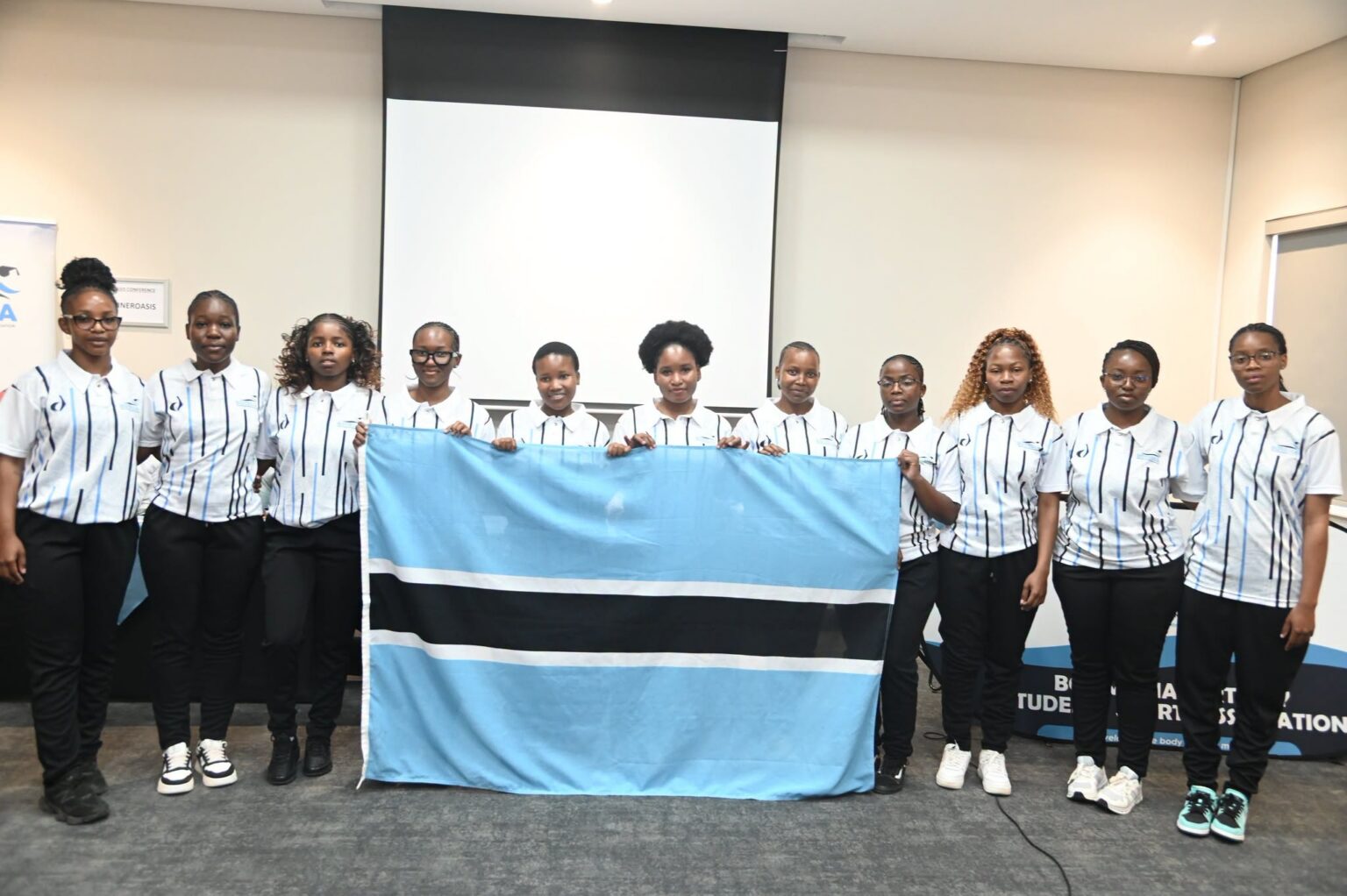
Botswana’s women’s Rugby Sevens team is preparing to make history as it takes the national flag to the FISU World University Rugby Sevens Championship in Stellenbosch, South Africa, from September 4 to 6, 2026. The 12-member squad received a special send-off from the Botswana Tertiary Student Sports Association (BOTESSA) ahead of its departure for the international tournament. The occasion marked an important moment for Botswana’s university sport as the team prepares to compete against some of the strongest university rugby nations in the world. More importantly, the tournament represents the first time a Botswana team sport will compete at an international World University Championship of this scale. The players now have an opportunity to showcase their talent, determination and national pride on a major international stage.
The special send-off ceremony brought together representatives from BOTESSA and the Botswana Rugby Union as they encouraged the players to embrace the significance of their participation. The 12 athletes will carry the expectations of their universities, sporting communities and country when they travel to Stellenbosch. Their participation reflects growing opportunities for Botswana’s tertiary students to compete beyond domestic competitions and gain valuable international experience. It also demonstrates the potential of university sport to create pathways for athletes who want to develop their careers while pursuing their education. With the tournament bringing together teams from different parts of the world, the Botswana squad will have the chance to measure its abilities against a much broader level of competition.
BOTESSA Vice President for Finance, Mr Bogha Maposa, described the tournament as an opportunity of a lifetime for the players. His message focused on the responsibility that comes with representing Botswana beyond its borders. He urged the squad to conduct themselves as proud ambassadors of the country while also showcasing Botswana’s culture and values. Such international competitions provide athletes with opportunities to represent more than themselves because their conduct can influence how audiences view their country. For the players, the experience will therefore involve competing at the highest level while also embracing the responsibility that comes with wearing Botswana’s colours.
The milestone is equally important for Botswana’s sporting development because this is the first time a Botswana team sport will represent the country at an international World University Championship of this magnitude. Individual athletes from Botswana have competed internationally across various sporting disciplines, but a team representing the country at this level creates a different opportunity for national visibility. Team sports require coordination, communication and collective discipline, making the achievement particularly significant for tertiary sport. The players will need to rely on one another throughout the competition as they face opponents with different playing styles and levels of international experience. Their participation could also encourage more university students to view sport as an important part of their academic and personal development.
The Botswana Rugby Union has also emphasised the wider role that rugby can play in developing young people. Secretary General Mr Damelin Motlogelwa highlighted the importance of sport, particularly team sport, in building discipline, character and well-rounded students. Rugby Sevens demands quick decision-making, physical commitment and strong communication between teammates, making it a useful environment for developing these qualities. The Botswana Rugby Union’s commitment to increasing the participation of women in rugby also gives the team’s appearance in Stellenbosch added importance. Greater exposure for women’s rugby can help inspire more girls and young women to participate in the sport and pursue opportunities at university and higher levels.
The team’s preparations have included three months of intensive training, giving the players time to develop their fitness, skills and understanding of the demands of Rugby Sevens. Coach and BOTESSA Rugby Technical Coordinator Mr Zibo Molefe has expressed confidence in the squad’s ability to compete for honours. His message makes it clear that the team is not travelling simply to gain experience or fill a place in the tournament. The players intend to compete seriously and challenge their opponents throughout the championship. That approach could prove important as they enter a tournament featuring university teams with strong rugby programmes and considerable experience in high-level competition.
Coach Molefe believes the characteristics of Rugby Sevens could work in Botswana’s favour. While Botswana’s players may have a comparatively smaller physical build than athletes traditionally associated with the 15-a-side version of rugby, Sevens places a particularly strong emphasis on speed, agility, fitness and rapid decision-making. Matches are played with fewer players on the field, creating more space and requiring athletes to cover large areas at high intensity. Players must quickly transition between attack and defence while maintaining concentration throughout the match. Botswana’s squad will therefore need to use its speed, movement and teamwork effectively if it wants to challenge physically imposing opponents.
The tournament will also expose the Botswana players to a range of international playing styles. They are expected to face university rugby powerhouses including Japan, Australia and Argentina, providing a demanding test from the opening stages of their international campaign. Matches against teams from established rugby nations can offer valuable lessons in tactical awareness, game management and physical preparation. Botswana will need to adapt quickly because every opponent could present different strengths in terms of pace, ball movement, defensive organisation and attacking structures. The experience gained from these matches could benefit the players long after the tournament ends.
Competing in Stellenbosch also gives the team an opportunity to build relationships within the wider international university sporting community. FISU competitions bring together student-athletes who combine academic studies with competitive sport, creating an environment where players can learn from one another both on and off the field. For Botswana’s representatives, participating in such a setting can broaden their understanding of international university sport. It can also provide valuable exposure to different approaches to training, competition and athlete development. The experience could contribute to the continued growth of university rugby in Botswana and help establish stronger pathways for future teams.
The historic nature of the trip has placed a clear responsibility on the players, but it has also created an opportunity for them to enjoy the moment. The squad has spent three months preparing for this competition and will now have the chance to put that work into practice against some of the world’s university rugby talent. Their performance will depend on more than individual ability, as communication, discipline and teamwork will be essential throughout the championship. Every possession, tackle, pass and defensive decision could contribute to how Botswana performs against its international opponents. The team will therefore need to remain focused while embracing the significance of becoming the first Botswana team sport to compete at this level.
As Botswana’s women’s Rugby Sevens team prepares to depart for Stellenbosch, the squad carries both sporting ambitions and historic significance. Its participation in the FISU World University Rugby Sevens Championship from September 4 to 6 represents a major step for BOTESSA, the Botswana Rugby Union and university sport in the country. The players will face formidable opposition from nations including Japan, Australia and Argentina, but their three months of preparation have given them a foundation from which to compete with confidence. Their speed, agility, discipline and teamwork will be central to their campaign as they attempt to challenge established university rugby programmes. Whatever the final results, the team has already achieved a landmark by taking Botswana into a new chapter of international university team sport, and its performance in Stellenbosch could help open even more opportunities for women’s rugby and student-athletes in the years ahead.