
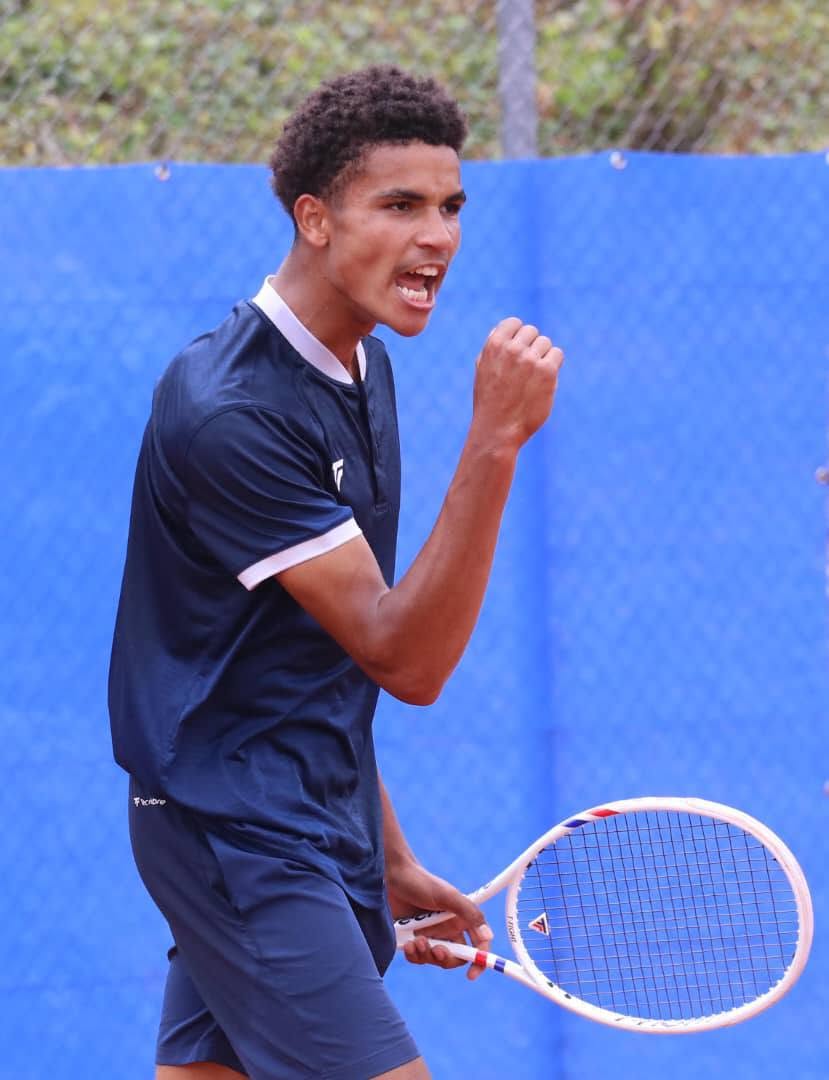
Botswana’s rising tennis talent Ntungamili Raguin has responded strongly to a difficult singles result at the World Tennis J300 in Washington by producing an impressive doubles victory. Raguin, who suffered a third-round singles defeat against Israel’s Dan Brand, quickly put the setback behind him and returned to the court with renewed focus. Partnering Nigerian player Peter Ogunsakin, the Botswana youngster delivered a convincing performance to secure a straight-sets victory in the doubles competition. The pair defeated American Carter Jauffret and Canadian Loic Massote 6-2, 6-2 to move into the quarter-finals. Their latest result keeps Raguin’s campaign alive and gives him another opportunity to compete for success at an important international junior tennis event.
Raguin’s singles campaign came to an end in a challenging third-round encounter against Dan Brand of Israel. The Botswana player lost the opening set 6-1 as Brand established control early in the match. Raguin showed greater resistance in the second set and pushed the contest into a tie-break, but Brand eventually secured the set 7-6(5). Despite the defeat, reaching the third round of a World Tennis J300 tournament represents valuable competitive experience for a young player competing at a high international level. The match also provides Raguin with lessons that can help him continue developing his game as he faces increasingly experienced opponents on the international junior circuit.
Rather than allowing the singles disappointment to affect his tournament, Raguin quickly shifted his attention to the doubles competition. He joined forces with Peter Ogunsakin of Nigeria and the partnership produced a dominant result in their latest match. The duo defeated Carter Jauffret of the United States and Loic Massote of Canada 6-2, 6-2 in a performance that demonstrated their ability to remain composed and effective after a demanding singles outing. Winning both sets by the same scoreline gave the pair a clear indication of their control throughout the contest. For Raguin, the victory also demonstrated the importance of mental resilience and the ability to reset quickly during a busy tournament schedule.
The doubles result was particularly encouraging because Raguin had little time to dwell on his singles defeat before returning to competitive action. Junior tournaments often require players to manage multiple matches and events while maintaining physical and mental energy. The ability to recover from a disappointing result and immediately produce a strong performance can become an important part of a player’s development. Raguin and Ogunsakin appeared to find an effective rhythm against their opponents, controlling the match and preventing Jauffret and Massote from establishing sustained momentum. Their 6-2, 6-2 victory has now placed them among the teams competing for a place in the latter stages of the tournament.
The partnership between Raguin and Ogunsakin has also added an interesting dimension to the Botswana player’s Washington campaign. Doubles requires players to communicate effectively, understand each other’s movement and make quick decisions during points. A strong partnership can create opportunities that are difficult to achieve individually because players can use different strengths and styles to complement one another. The straight-sets victory suggests that Raguin and Ogunsakin were able to work effectively together in their latest match. Their progress into the quarter-finals gives them another chance to strengthen their partnership while competing against another international pairing.
The next challenge will be a quarter-final clash against Brazilian players Pedro Henrique Chabalguity Francisco and Fontes Damorim. The match is scheduled to take place today and will provide Raguin and Ogunsakin with another demanding test at the World Tennis J300 in Washington. Brazilian junior tennis has produced a strong pool of competitive players, making the quarter-final a significant opportunity for the Botswana-Nigeria partnership. Raguin and Ogunsakin will need to maintain the concentration and consistency that helped them secure their previous victory. A place in the semi-finals will be at stake, adding further importance to the upcoming encounter.
For Raguin, the doubles competition provides an opportunity to build on the experience gained from his singles campaign. Every match at this level can contribute to a young player’s understanding of international competition, particularly when facing opponents from different countries and tennis systems. Competing alongside players from other nations can also expose athletes to different approaches to preparation, strategy and match management. These experiences can prove valuable as Raguin continues to develop his game and compete in higher-level tournaments. His ability to respond positively after a singles defeat is already a sign of the competitive mindset required to progress in international tennis.
The result is also encouraging for Botswana tennis, as Raguin continues to represent the country on an international junior stage. Players competing at tournaments such as the World Tennis J300 gain exposure to a wider competitive environment and have opportunities to test themselves against some of the world’s promising young players. Strong performances can help raise the profile of Botswana’s junior tennis programme while inspiring other young athletes to pursue the sport seriously. Raguin’s progress therefore carries significance beyond the individual results recorded on the court. His participation contributes to the growing visibility of Botswana in international junior tennis.
The World Tennis J300 tournament in Washington provides a valuable platform for young players seeking to gain ranking points, experience and international exposure. Events at this level bring together competitors from different countries and challenge them to adapt to unfamiliar opponents and conditions. For Raguin, the tournament has already included the highs and lows that form part of competitive sport, from a difficult singles defeat to a convincing doubles victory. His response to the singles setback has been one of the most positive aspects of his campaign so far. By quickly returning to winning form in doubles, he has kept his tournament hopes alive and created another opportunity to make progress.
Raguin and Ogunsakin will now turn their attention to the quarter-final, where they will look to continue the momentum generated by their 6-2, 6-2 victory. They will need to approach the Brazilian challenge with the same discipline and focus that helped them overcome Jauffret and Massote. Strong communication, consistent serving and effective positioning will be important as the pair attempt to reach the semi-finals. Raguin will also be hoping to carry the confidence gained from the doubles win into his next match. The quarter-final represents another opportunity for the Botswana player to demonstrate his ability to compete and adapt on the international stage.
Ntungamili Raguin’s journey at the World Tennis J300 in Washington has already shown both the challenges and opportunities that come with international junior tennis. His 6-1, 7-6(5) singles loss to Dan Brand was a difficult result, but he responded immediately by helping Peter Ogunsakin secure a commanding 6-2, 6-2 doubles victory. That response highlights the value of resilience, focus and the ability to move forward after a setback. With a quarter-final against Brazil’s Pedro Henrique Chabalguity Francisco and Fontes Damorim ahead, Raguin and Ogunsakin have another chance to make a deep run in the tournament. Botswana will be watching with pride as Raguin continues to push himself against international opposition, and his latest performance provides plenty of reason for optimism as he targets further success in Washington.