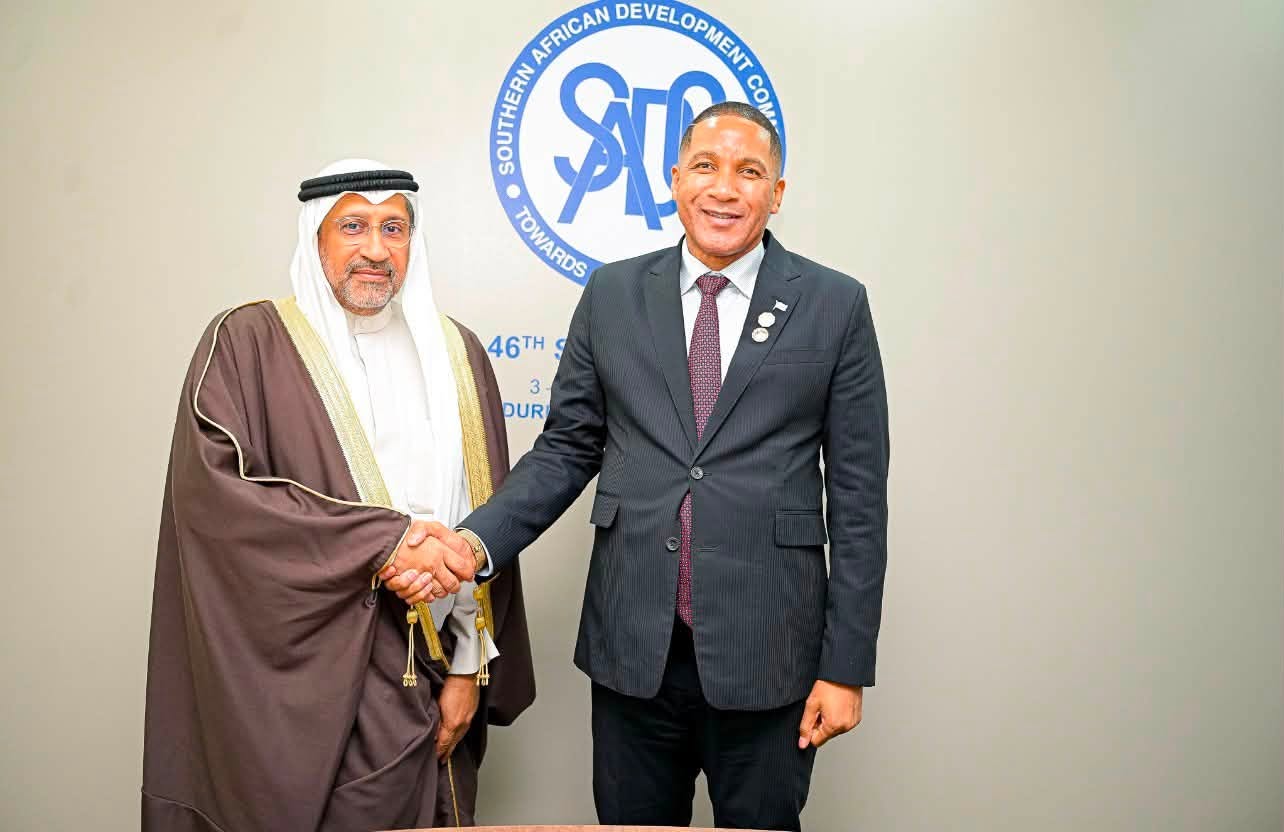
President Duma Boko has held high-level talks with the Arab Bank for Economic Development in Africa (BADEA) on the sidelines of the 46th Ordinary SADC Summit in Durban, with both sides seeking to accelerate the funding and implementation of development projects in Botswana. The discussions focused on a key challenge facing the country, the gap between available financing and projects that are ready for investment. While Botswana has access to potential funding opportunities, several proposed initiatives have stalled because they do not yet have completed feasibility studies. The government and BADEA have now agreed to work together to finance these preliminary studies, creating a clearer pathway for projects to move from planning into implementation. The agreement signals a stronger focus on turning development plans into projects that can deliver measurable economic and social benefits for Botswana.
During the discussions, President Boko highlighted the need to make better use of the funding capacity already available to Botswana. He explained that financing opportunities exist, but the country needs a stronger pipeline of investment-ready projects to take advantage of them. Many major development initiatives require detailed feasibility assessments before financiers can commit substantial resources, making these studies an important early step in the project development process. Without completed studies, projects can remain in the planning phase despite having potential economic value and access to possible funding. By working with BADEA to support feasibility studies, the government aims to remove one of the major obstacles delaying the implementation of development projects.
President Boko captured the urgency of the situation when he stated, “The headroom is fairly expensive. We need to populate it with projects.” His comments underline the government’s intention to move quickly from identifying development needs to preparing viable projects that can attract financing. The focus is therefore shifting towards practical project preparation, stronger coordination and faster decision-making. This approach could help Botswana make more effective use of development finance while reducing the time between project conception and execution. It also reflects the government’s broader objective of ensuring that financing commitments translate into visible economic activity and improved public services.
BADEA confirmed that it already has an extensive pipeline of 31 projects in Botswana, providing a significant foundation for deeper cooperation between the development bank and the government. The bank indicated that its support can extend beyond conventional public sector infrastructure financing. Its areas of assistance include private sector projects, public sector initiatives, trade finance, capacity building and study grants. This broad range of financing and technical support could give Botswana greater flexibility in developing projects across different parts of the economy. Strengthening this pipeline could also create opportunities for increased private sector participation, business growth and investment in projects that support national development priorities.
The agreement to support feasibility studies is particularly important because project preparation often determines whether a development proposal can successfully attract financing. A feasibility study can assess the technical requirements, financial viability, environmental considerations, potential risks and expected economic returns of a project. These assessments give governments, development institutions and private investors the information they need to make informed funding decisions. By helping finance these studies, BADEA can support Botswana in building a stronger portfolio of projects that meet the requirements of potential financiers. The move could therefore help convert a number of stalled initiatives into projects that are sufficiently developed to proceed to the investment stage.
President Boko also announced plans to strengthen the Project Delivery Unit within the Office of the President as part of efforts to improve project coordination. The unit will become the central point of contact between the Botswana government and BADEA, helping to identify suitable projects and guide them through the development cycle. A dedicated coordination structure can help reduce delays caused by fragmented responsibilities across government departments and agencies. It can also improve communication with financing institutions by ensuring that project information, feasibility requirements and implementation timelines are managed more efficiently. The strengthened unit is expected to play an important role in ensuring that projects remain focused on delivery rather than becoming delayed by administrative challenges.
The partnership between Botswana and BADEA also has implications for economic transformation, particularly if the cooperation results in a steady pipeline of investment-ready projects. Development projects can support economic activity through infrastructure investment, job creation, business opportunities and improved access to essential services. Private sector participation could further expand the impact by creating opportunities for companies to invest alongside public institutions and development financiers. Trade finance and capacity-building support could also strengthen businesses and institutions that contribute to long-term economic growth. However, the success of the partnership will depend on how quickly projects are prepared, approved, financed and implemented.
The discussions in Durban demonstrate the importance of stronger cooperation between governments and development finance institutions when countries seek to accelerate national development. Botswana has identified the need to improve the quality and readiness of its project pipeline, while BADEA has indicated its willingness to support that process through financing and technical assistance. The planned strengthening of the Project Delivery Unit provides an additional mechanism for keeping the partnership focused and coordinated. By addressing feasibility studies at an early stage, the two sides can reduce barriers that have previously prevented projects from reaching implementation. This could help Botswana build a more consistent flow of projects capable of attracting investment and delivering economic value.
The meeting concluded with a shared commitment to elevate the Botswana-BADEA partnership and speed up implementation. President Boko’s call for rapid action reflects the government’s focus on achieving tangible economic transformation rather than allowing development plans to remain on paper. The combination of feasibility study funding, an established pipeline of 31 projects and a strengthened Project Delivery Unit could provide a stronger framework for turning development priorities into operational projects. Continued coordination between Botswana and BADEA will be essential to ensure that identified projects move through preparation and financing without unnecessary delays. Fighting delays in development requires clear priorities, strong institutions and effective partnerships, and the latest engagement shows that Botswana is working to put these elements in place.