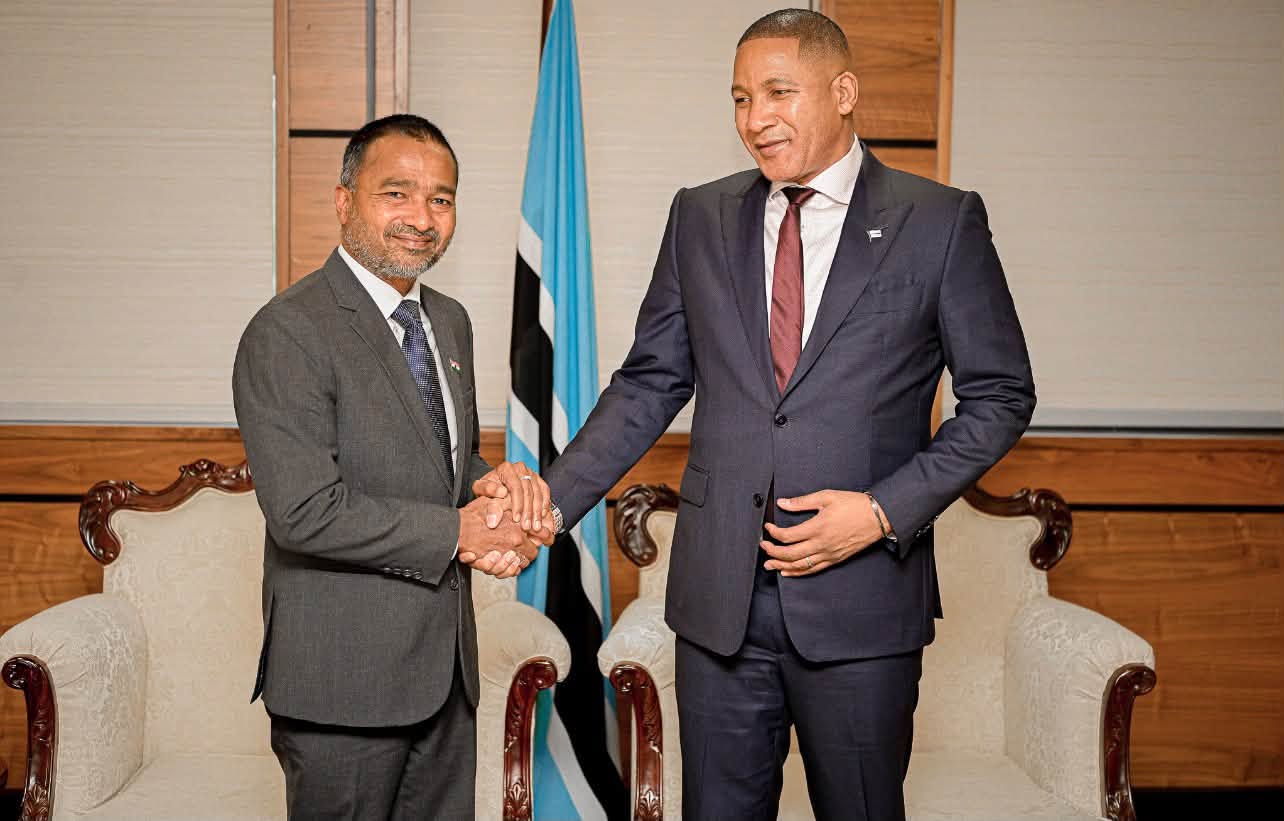
President Advocate Duma Boko yesterday morning received India’s High Commissioner to Botswana, His Excellency Mr. Bharath Kumar Kuthati, for a farewell courtesy call as the diplomat concludes his three-year-and-three-month tour of duty in Botswana. The meeting provided an opportunity to reflect on the strong relationship between Botswana and India and the cooperation developed during Mr. Kuthati’s tenure. President Boko expressed appreciation for the longstanding bonds of friendship between the two countries, with particular emphasis on education, defence, conservation and health. The farewell meeting also highlighted areas where Botswana and India can build on their existing partnership. As Mr. Kuthati prepares for his next diplomatic assignment, both sides reaffirmed the value of maintaining close relations between the two countries.
President Boko thanked Mr. Kuthati for his service in Botswana and recognised the contribution he made to strengthening bilateral relations. He also expressed appreciation to the Government of India for its continued support to Botswana in several important sectors. Among the areas highlighted were education, defence, conservation and health, all of which have provided opportunities for practical cooperation between the two countries. These areas reflect a relationship that extends beyond diplomatic engagement and includes programmes and initiatives with direct relevance to Botswana’s development priorities. The President’s remarks also acknowledged the importance of maintaining this cooperation as Botswana and India look towards deeper engagement in the future.
Health cooperation featured prominently during the discussions, particularly following India’s recent donation of antiretroviral medicines to Botswana. The ARVs arrived in Botswana in September and represented another example of India’s support in the health sector. Access to essential medicines remains an important component of public health systems, making cooperation in this area significant for both governments. President Boko used the farewell meeting to express his gratitude to the Indian Government for the assistance. The donation also reinforced the broader health partnership that has been identified as an important part of Botswana-India relations.
President Boko also welcomed the recent visit by the President of India and indicated his intention to reciprocate the visit. He explained that health concerns related to the Ebola outbreak had prevented him from attending the scheduled summit. His intention to visit India demonstrates the importance Botswana places on maintaining high-level engagement with its international partners. A reciprocal presidential visit would provide another opportunity to discuss bilateral cooperation and identify areas where the relationship can be expanded. It would also build on the diplomatic engagement already taking place between the two countries.
Mr. Kuthati expressed his gratitude to President Boko and the Botswana Government for the support and hospitality he received during his three years and three months in the country. He described the cooperation between Botswana and India as successful and highlighted several areas where the two countries have worked together. Among the initiatives he identified was the translocation of cheetahs, which has become a notable example of cooperation in wildlife conservation. The initiative connects Botswana’s experience in wildlife conservation with India’s efforts involving the species. It also demonstrates how bilateral relations can support cooperation on environmental and conservation matters.
Conservation has become an important area of Botswana-India cooperation, particularly through work involving cheetahs. Botswana is known for its wildlife and conservation landscapes, while India has developed a national programme focused on reintroducing cheetahs. Cooperation between the two countries in this field has created a distinctive link between their environmental and wildlife priorities. Mr. Kuthati’s reference to the successful translocation of cheetahs highlighted the practical nature of this relationship. It also showed how diplomatic partnerships can extend into specialised areas involving wildlife management and conservation.
While describing bilateral relations as strong, Mr. Kuthati also pointed to significant potential for expanding economic cooperation between Botswana and India. Economic engagement provides an important opportunity for the two countries to build on the foundation created through existing diplomatic and development partnerships. Strong political relations can create an environment for greater interaction between businesses, investors and institutions in both countries. Identifying opportunities for increased economic cooperation could therefore add another dimension to the Botswana-India relationship. Mr. Kuthati’s comments suggest that economic ties remain an area with considerable room for further development.
The Indian diaspora in Botswana was another important part of the discussion. Mr. Kuthati recognised the community as a bridge between Botswana and India, reflecting the role that people and communities can play in strengthening relations between countries. Diaspora communities can contribute to cultural understanding, business connections and people-to-people relationships. Their presence can also help sustain links between countries beyond official diplomatic channels. Recognising the Indian diaspora therefore adds an important social dimension to the broader Botswana-India partnership.
As Mr. Kuthati prepares to leave Botswana for his next assignment in Trinidad and Tobago, he reflected on his experience in the country with appreciation. He said Botswana would remain in his heart and pledged to continue advocating for the country wherever his diplomatic career takes him. His remarks reflected the personal dimension often associated with diplomatic service, where officials develop relationships and experiences that continue beyond their formal assignments. He also spoke fondly of his travels across Botswana and recalled visiting the Okavango Delta. Those experiences, he said, had left him with cherished personal and professional memories.
President Boko wished Mr. Kuthati well as he begins his new assignment in Trinidad and Tobago. He also encouraged the outgoing High Commissioner to continue visiting Botswana, reflecting the cordial relationship established during his time in the country. The farewell courtesy call provided an opportunity for both sides to acknowledge the achievements of the past three years and three months while looking ahead to future cooperation. The discussion showed that Botswana and India maintain broad relations covering health, education, defence, conservation and other areas of mutual interest. It also highlighted the importance of economic cooperation as a potential area for further growth.
The farewell meeting between President Duma Boko and High Commissioner Bharath Kumar Kuthati comes at a time when Botswana and India continue to build on established areas of cooperation while considering new opportunities. India’s support through the recent ARV donation, cooperation on cheetah conservation and engagement across other sectors demonstrate the practical nature of the relationship. At the same time, the emphasis on economic cooperation points to the potential for the partnership to expand further. Mr. Kuthati’s departure marks the end of his diplomatic assignment in Botswana, but his pledge to continue advocating for the country reflects the lasting relationships developed during his tenure. As Botswana and India maintain their strong friendship, continued government engagement, economic links, conservation initiatives, health cooperation and people-to-people connections can provide a solid foundation for the next phase of bilateral relations.