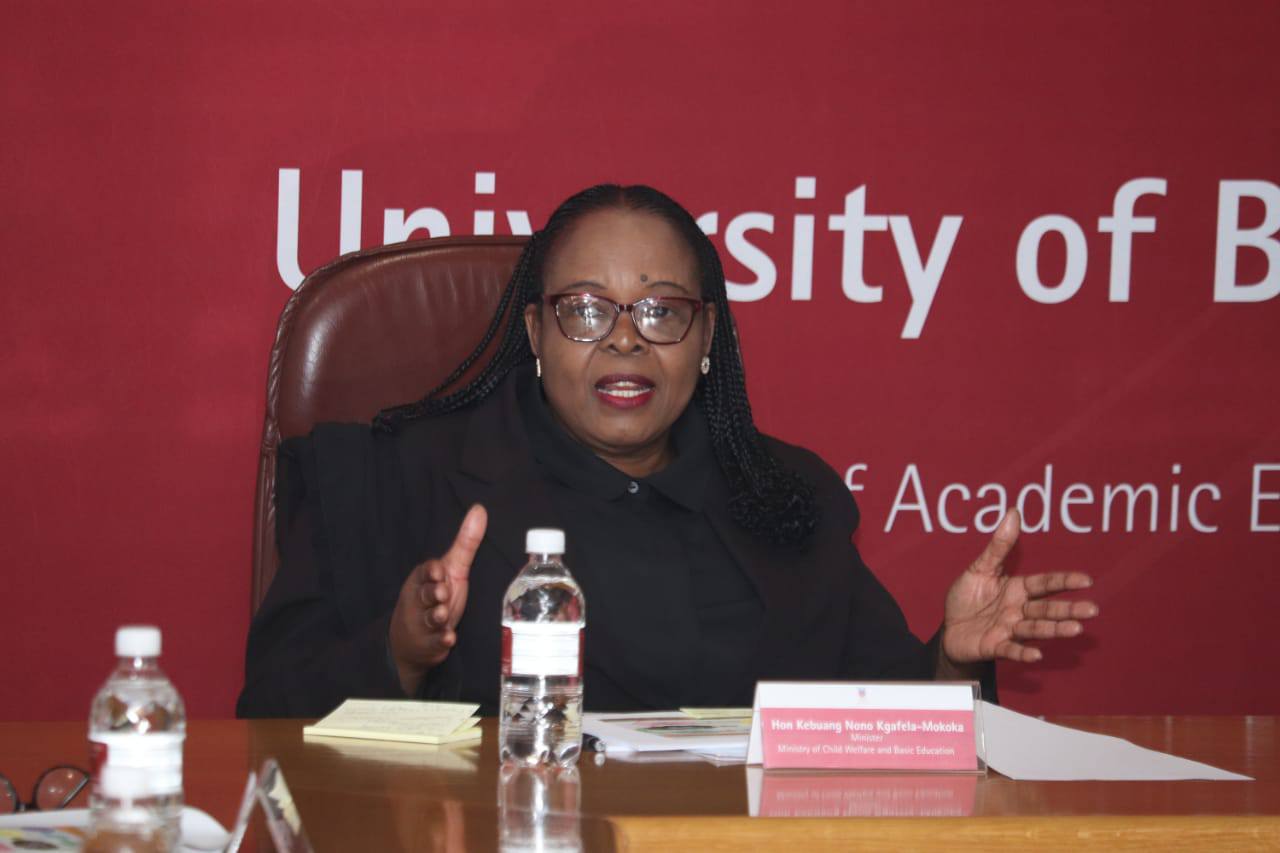
The Minister of Child Welfare and Basic Education, Honourable Nono Kgafela-Mokoka, recently paid a courtesy call to the Vice Chancellor of the University of Botswana, Professor David Norris, in a strategic engagement aimed at strengthening collaboration between government and higher education. The meeting focused on advancing innovation in education systems and preparing learners for the demands of the 21st century. It reflected a growing national priority to align academic programmes with the evolving needs of the economy and global workforce. The discussion also highlighted the importance of building stronger partnerships between policymakers and academic institutions. This engagement forms part of broader efforts to ensure that Botswana develops a knowledge-driven society supported by relevant skills and innovation.
Central to the discussions was the role of STEAM education, which integrates Science, Technology, Engineering, Arts, and Mathematics into a unified learning approach. Both parties emphasized that STEAM is essential in developing graduates who are not only technically skilled but also creative, adaptable, and capable of solving complex problems. The approach is seen as a key driver in preparing learners for a rapidly changing, technology-driven world where innovation plays a critical role in economic growth. The meeting underscored the need to strengthen curriculum design, teaching methods, and research outputs to reflect these priorities. By focusing on STEAM, Botswana aims to equip students with the competencies needed to remain competitive in regional and global job markets.
Honourable Nono Kgafela-Mokoka stressed that higher education institutions must play a direct and measurable role in national development. She emphasized that universities should go beyond traditional academic instruction and actively contribute to solving real-world challenges faced by communities. According to her, graduates must possess critical thinking skills, problem-solving abilities, and practical knowledge that aligns with the needs of the economy. She highlighted the importance of ensuring that education systems remain responsive to the changing demands of the world of work. Her remarks reinforced the government’s commitment to strengthening the link between education, innovation, and national development priorities.
In response, Professor David Norris reaffirmed the University of Botswana’s commitment to supporting the Ministry in achieving its strategic education goals. He noted that the institution is equipped with a highly qualified executive management team and a wide range of academic expertise across multiple disciplines. This expertise, he explained, can be leveraged to support government initiatives through research, innovation, policy development, and skills training programmes. He also emphasized the University’s readiness to collaborate on initiatives that enhance the quality and relevance of education in Botswana. His response highlighted the institution’s role as a key partner in shaping the country’s human capital development agenda.
The meeting also emphasized the importance of research and innovation in driving sustainable development. Both the Ministry and the University recognized that strong research systems are essential for informing education policy and improving learning outcomes. Collaboration in this area is expected to support the development of evidence-based strategies that address current and future educational challenges. The discussions pointed to the need for continuous knowledge sharing between academic institutions and government departments. This approach is intended to ensure that policies remain grounded in practical insights and global best practices.
The engagement between the Ministry of Child Welfare and Basic Education and the University of Botswana demonstrated a shared commitment to developing future-ready graduates. These graduates are expected to possess the skills, knowledge, and innovative capacity needed to contribute meaningfully to Botswana’s sustainable development. The focus on STEAM education, research collaboration, and skills development reflects a forward-looking approach to education reform. It also highlights the importance of building strong institutional partnerships to achieve long-term national goals. As Botswana continues to invest in education transformation, collaborations such as this are expected to play a vital role in shaping a more skilled, adaptable, and competitive workforce.