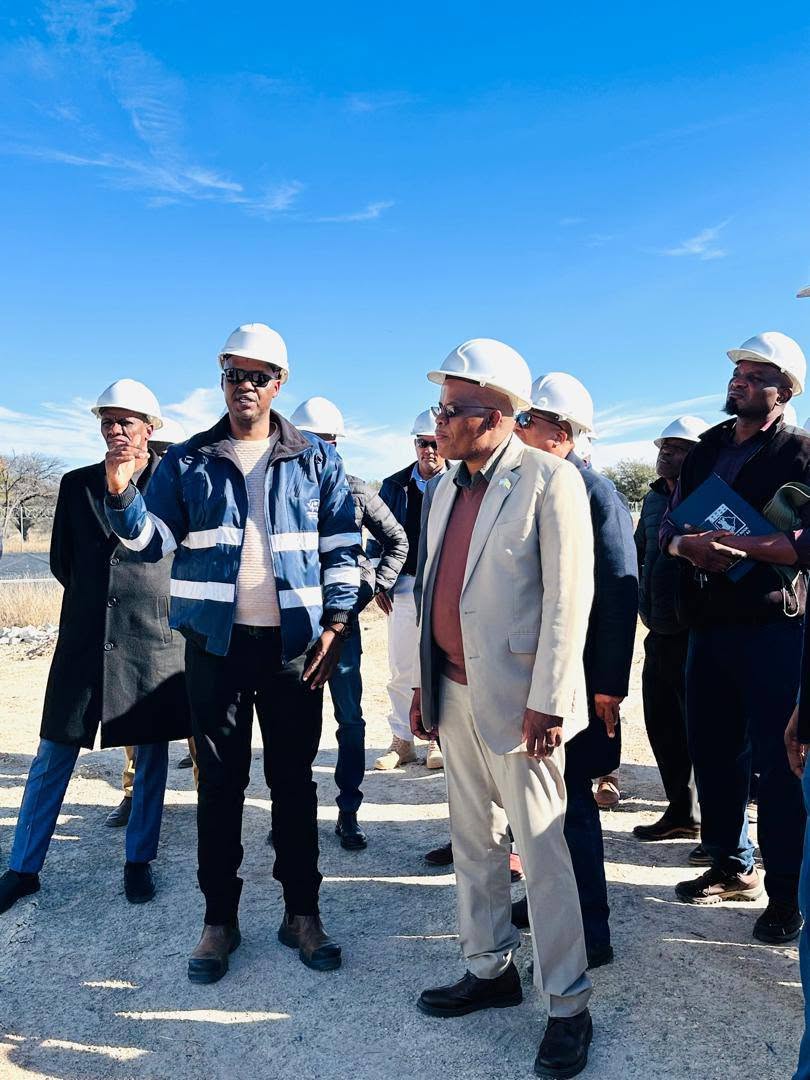
Assistant Minister of Lands and Agriculture, Mr Motsamai Motsamai, conducted an official tour of the Tsabong Multi-Species Abattoir yesterday to assess its readiness and overall infrastructure condition ahead of full operations. The visit formed part of Government’s broader drive to strengthen agricultural value chains and ensure that key facilities are fully functional. During the inspection, the Assistant Minister reviewed the state of equipment, processing areas and operational systems to determine how soon the facility can begin serving farmers. He emphasized that the project carries significant strategic importance for the agricultural sector and the wider national economy. The tour also highlighted Government’s focus on ensuring that public investments in agriculture deliver tangible results. The inspection reinforced the urgency placed on activating infrastructure that can directly support rural livelihoods.
Mr Motsamai commended the project management team for the progress made in developing the abattoir and maintaining its standards. He stated that the ministry’s top priority is to see the facility become fully operational in the shortest possible time. According to him, delays in commissioning such infrastructure limit the potential benefits for farmers who depend on reliable market access. He noted that the abattoir is not only a physical facility but a key economic instrument designed to transform livestock production in the region. The Assistant Minister stressed that efficient coordination between stakeholders will be essential to achieving full operational readiness. His remarks reflected Government’s expectation that the project must deliver practical benefits without unnecessary delays.
The Tsabong Multi-Species Abattoir is expected to play a major role in strengthening Botswana’s livestock sector once fully operational. The facility is designed to process multiple types of livestock, creating a structured and formal market for farmers in the region and beyond. Mr Motsamai highlighted that this will allow farmers to move away from informal selling channels and access more stable and profitable markets. He explained that such infrastructure is critical for commercialising livestock farming and improving productivity across rural communities. The abattoir is also expected to improve quality standards by ensuring that livestock processing meets regulated health and safety requirements. This will ultimately enhance the competitiveness of Botswana’s livestock products in both domestic and potential export markets.
A major expected outcome of the project is its contribution to job creation within the local economy. The Assistant Minister noted that once the abattoir becomes fully operational, it will generate employment opportunities for residents of Tsabong and surrounding areas. These jobs will range from technical and operational roles to logistics, administration and support services. The development is therefore positioned as both an economic and social intervention aimed at reducing unemployment in rural communities. Mr Motsamai emphasized that empowering local people through employment is a key priority of the Ministry of Lands and Agriculture. He added that sustainable job creation remains one of the most effective ways to strengthen rural economies.
The abattoir is also expected to significantly improve income generation for livestock farmers in Botswana. By providing a reliable and structured market, the facility will enable farmers to sell their cattle, goats and other livestock at more competitive and predictable prices. This will reduce reliance on middlemen and informal trading systems that often limit farmers’ earnings. Mr Motsamai explained that access to formal markets is essential for encouraging investment in livestock production. When farmers are assured of stable demand, they are more likely to expand herds and improve production practices. The abattoir therefore plays a direct role in strengthening food security and rural economic stability.
Beyond its immediate economic benefits, the Tsabong Multi-Species Abattoir represents a long-term investment in agricultural transformation. It forms part of Government’s broader strategy to modernise the livestock sector and integrate it into value-added production systems. The Assistant Minister noted that infrastructure of this nature helps shift agriculture from subsistence-based activities to commercial enterprises. This transformation is essential for diversifying Botswana’s economy and reducing dependence on traditional revenue sources. The facility is also expected to encourage private sector participation in livestock processing and distribution. Such partnerships can further enhance efficiency and innovation within the sector.
Mr Motsamai reiterated that the success of the project depends on effective coordination between all stakeholders involved in its implementation and operation. He emphasized the importance of maintaining high operational standards to ensure the facility functions efficiently from the start. He also highlighted the need for continued monitoring and support from the Ministry to address any challenges that may arise. According to him, infrastructure alone is not enough without proper management systems and skilled personnel. The Assistant Minister encouraged all parties involved to remain focused on the goal of delivering a fully functional and sustainable facility. His message underscored the importance of accountability in public infrastructure projects.
The Tsabong Multi-Species Abattoir stands as a critical development in Botswana’s efforts to empower pastoral communities and strengthen the agricultural economy. Its completion and activation are expected to unlock new opportunities for farmers, create employment and improve market access for livestock products. The Assistant Minister’s visit reaffirmed Government’s commitment to ensuring that strategic projects are implemented efficiently and deliver meaningful impact. As Botswana continues to invest in agricultural infrastructure, facilities like the Tsabong abattoir will play a key role in driving rural development and economic diversification. The project represents a clear step toward building a more competitive and inclusive livestock industry that benefits farmers and communities across the country.