
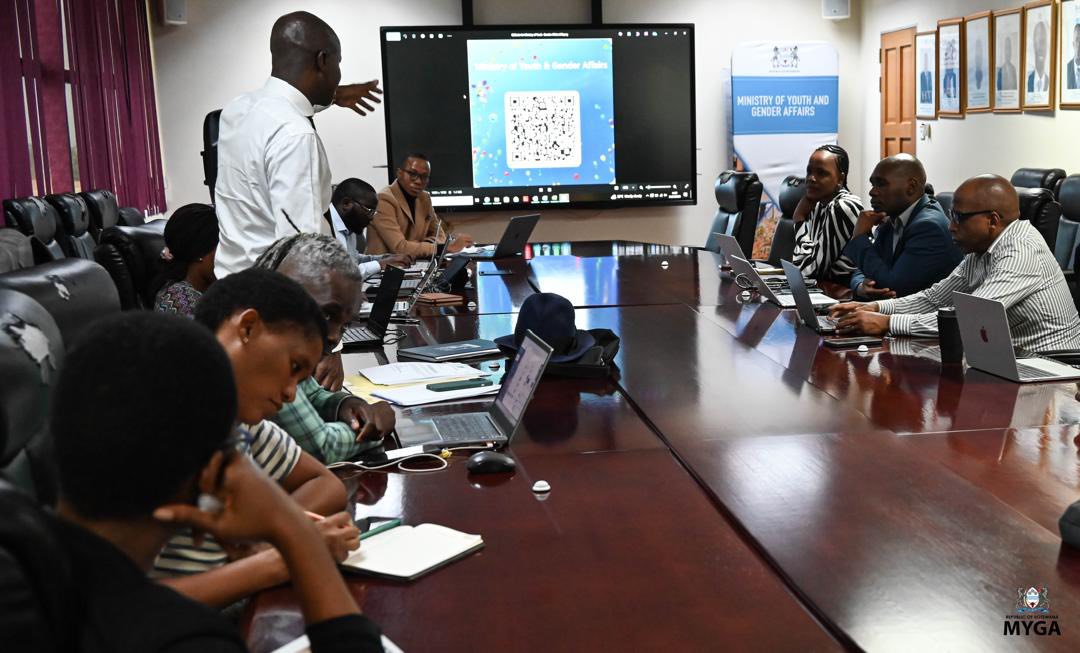
The Ministry of Youth and Gender Affairs has taken a decisive step toward modernising public service delivery through its recent meeting on Youth Online Services. The session brought together key stakeholders from government and the private sector to assess progress and refine the direction of the initiative. Officials from the Ministry of Communication and Innovation joined representatives from Innovateium Pty Ltd, a youth-led digitalisation company, to contribute technical and strategic input. This collaboration reflects a clear shift toward inclusive and technology-driven governance. The meeting focused on practical ways to improve how services reach young people and other underserved groups.
Mr Emmanuel Otukile, Acting Coordinator of the Transformation Office, set the tone with a strong focus on accessibility and efficiency. He highlighted the barriers that many citizens still face when accessing government services, including long queues and limited physical access points. He pointed out that digital platforms can remove these obstacles by allowing users to access services remotely. This approach can reduce waiting times and improve overall service delivery. His remarks made it clear that digital transformation is not optional but necessary for equitable access.
The initiative aims to serve a broad group that includes young people, women, persons with disabilities, and other marginalised communities. Mr Otukile stressed that digital tools can create a more inclusive system that operates across different locations and time zones. This ensures that services remain available even outside standard working hours. He also clarified that the goal is not just to convert paper forms into digital versions. The focus is on building systems that respond directly to the needs of users and improve their experience when engaging with government services.
Mr Tsumake from the Ministry of Communication and Innovation reinforced the importance of digital platforms in today’s environment. He explained that online services have become central to communication, business, and daily life. Governments now face growing expectations to deliver services through digital channels that are fast and reliable. He noted that countries that adopt digital systems early tend to improve efficiency and citizen satisfaction. His contribution highlighted the need for continuous investment in digital infrastructure and innovation.
The role of Innovateium Pty Ltd added a practical dimension to the discussions, as the company represents youth-driven innovation in action. Their involvement ensures that solutions are designed with direct input from the people who will use them most. This approach increases the likelihood of adoption and long-term success. It also creates opportunities for young professionals to contribute to national development through technology. The partnership demonstrates how public and private sectors can work together to solve real challenges.
Ambassador Nkoloi Nkoloi, Director of Youth, closed the meeting with a focus on impact and implementation. He stated that young people need solutions that address real challenges in their daily lives. He emphasized that digital systems can scale faster than physical infrastructure, making them more responsive to growing demand. This speed of expansion is critical in a rapidly changing environment where needs evolve quickly. His remarks pointed to a future where digital services play a central role in youth development.
He also provided an update on the ongoing review of the Youth Development Fund. The Ministry has proposed three new models aimed at improving how the fund supports young people. These models focus on increasing access, improving efficiency, and ensuring that funds reach intended beneficiaries more effectively. This review aligns with the broader digital strategy by seeking to modernise financial support systems. It shows a commitment to aligning policy with practical outcomes.
The meeting concluded with a clear message about the importance of digital transformation in governance. Online services are becoming essential tools for engagement, service delivery, and economic participation. The Youth Online Services initiative stands as a key step toward a more inclusive and efficient system. It reflects a broader vision of using technology to bridge gaps and expand opportunities. As the initiative moves forward, its success will depend on execution, collaboration, and continuous improvement.