
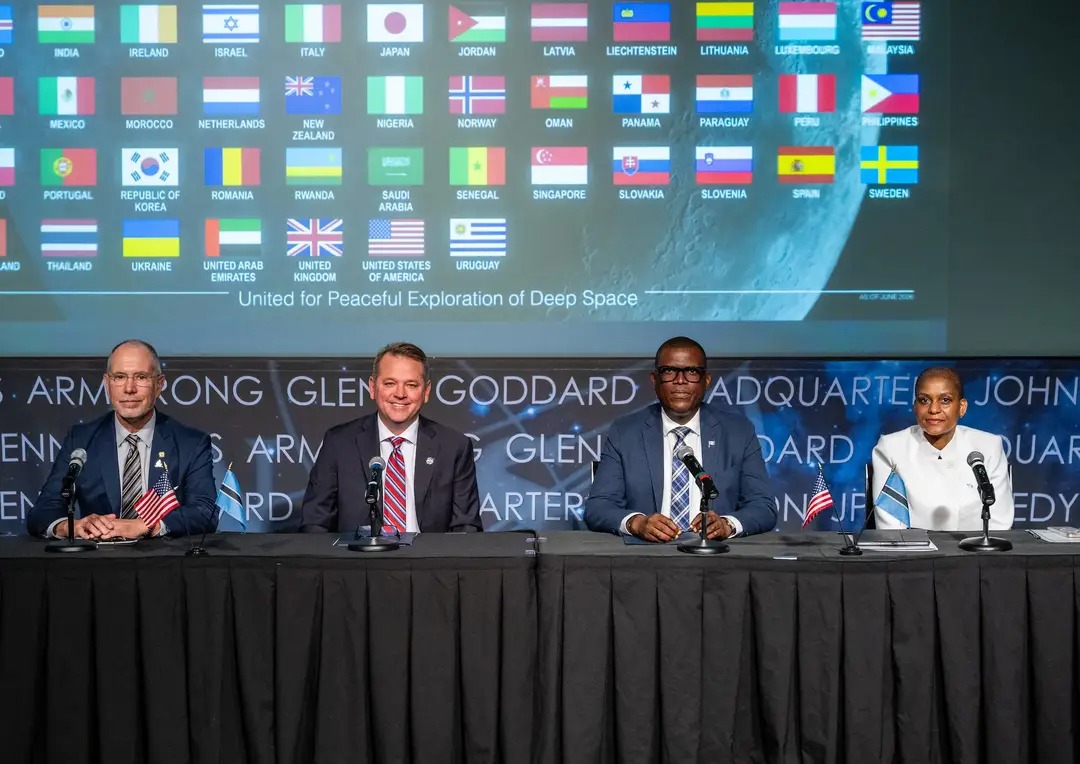
Botswana has officially signed the Artemis Accords at a ceremony hosted by NASA in Washington on Thursday, marking a significant milestone in the country’s entry into global space governance. This move places Botswana as the sixth African nation to join the growing group of countries committed to peaceful, transparent and responsible exploration of outer space. The signing reflects a clear shift in Botswana’s long-term development strategy as it positions itself within emerging space science and technology frameworks. It also signals stronger engagement with international partners in advanced scientific fields. The decision highlights Botswana’s intent to expand its role beyond traditional sectors and participate in global innovation systems.
By joining the Artemis Accords, Botswana becomes an active contributor to a shared set of principles that guide civil space exploration. The framework promotes peaceful use of space, transparency in activities, and cooperation among nations working on lunar exploration and related missions. Botswana’s endorsement confirms its commitment to safe and sustainable practices as human activity in space continues to grow. The agreement also opens pathways for collaboration in scientific research, data sharing, and technological development. These opportunities can support local institutions and researchers by connecting them with global space agencies and research networks. It also strengthens Botswana’s visibility in international scientific discussions.
The partnership with NASA and other signatory nations creates opportunities for Botswana to participate in future space missions, including lunar exploration initiatives under the Artemis program. It also provides potential access to shared scientific data that can support research in areas such as Earth observation, climate monitoring and satellite technology. Botswana has also indicated interest in strengthening its own space capabilities through initiatives such as future BOTSAT missions, including the anticipated BOTSAT 2 project. These developments can support innovation in communication systems, environmental monitoring and resource management. The collaboration creates a foundation for skills development in science, technology, engineering and mathematics fields within the country. It also encourages the growth of a new generation of scientists and engineers.
Botswana’s participation in the Artemis Accords aligns closely with its national strategy to transition toward a knowledge-based economy. By engaging in space-related cooperation, the country aims to diversify its economy beyond traditional sectors such as mining and agriculture. Access to advanced space technologies can support national development goals in infrastructure planning, disaster monitoring and environmental protection. The agreement also positions Botswana to benefit from international best practices in space science governance and innovation management. This strategic move reflects a broader effort to integrate technology-driven solutions into long-term economic planning. It strengthens Botswana’s ambition to become a regional leader in science and innovation.
The signing of the Artemis Accords represents a forward-looking step that connects Botswana to a global network shaping the future of space exploration. Through this partnership, the country is expected to deepen collaboration with NASA and other international space agencies in research and innovation projects. It also provides a platform for Botswana to contribute to the development of international standards that will guide future missions to the Moon and beyond. The agreement supports national efforts to build scientific capacity and expand participation in high-technology sectors. As global interest in space exploration continues to grow, Botswana’s involvement positions it to take part in shaping the next era of discovery while advancing its own development priorities.