
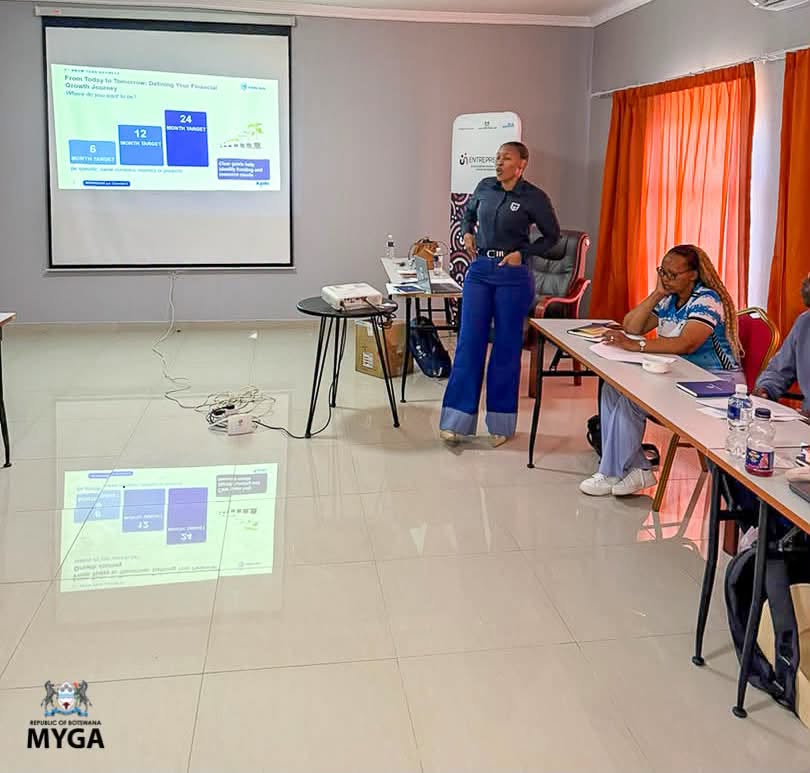
The success of a business depends on more than the money it earns. It also depends on how well the owner manages expenses, tracks income, controls debt and plans for future growth. This important lesson shaped Day 3 of the EntreprenHER training in Bobonong, where women entrepreneurs explored financial literacy, responsible money management and sustainable business development. The session opened with a thought-provoking question, “If your money had a voice, what would it say to you?” The question encouraged participants to examine their financial habits and consider whether their decisions were helping their businesses grow or holding them back.
Ms. Dinah Ntebele, Incubator Specialist at Stanbic Bank Botswana, led the financial literacy session as part of the bank’s partnership with the EntreprenHER programme. She invited participants to reflect honestly on their relationships with money and how they handle their business finances. Their responses varied, with one participant suggesting that their money would say, “Leave me alone,” while another imagined it saying, “Think before you use me.” Although the answers brought laughter to the room, they also highlighted a common challenge among entrepreneurs, the need to make deliberate financial decisions rather than spend without a clear plan. The discussion showed that building a sustainable business requires financial discipline, consistent planning and a clear understanding of where money comes from and where it goes.
The session built on the previous two days of training, which focused on business resilience and the ability to respond to challenges. Participants were encouraged to set realistic financial targets that reflected their current business performance, available resources and long-term ambitions. Ms. Ntebele emphasised the importance of understanding the true position of a business before deciding how to grow it. Entrepreneurs need to know whether their businesses are generating enough revenue, controlling costs and producing sustainable profits. By identifying their strengths and weaknesses, business owners can develop practical plans to improve performance and prepare for future opportunities.
Financial discipline emerged as one of the key principles of effective business management. Entrepreneurs need to establish clear rules for spending, avoid unnecessary purchases and ensure that business money supports agreed priorities. Without these controls, even a business with regular sales can struggle to meet its obligations. Financial discipline also involves planning for expenses before they arise and resisting the temptation to use available cash simply because it is in the account. Developing these habits helps business owners protect their working capital, manage uncertainty and make better decisions about investments.
Record keeping was another important pillar of financial health discussed during the EntreprenHER training. Accurate financial records help entrepreneurs track sales, monitor expenses, calculate profits and understand whether their businesses are performing as expected. Records should capture money received, payments made, outstanding debts and other transactions that affect the business. Keeping this information organised makes it easier to prepare budgets, assess performance and identify financial problems before they become serious. Reliable records can also help entrepreneurs demonstrate their business performance when applying for funding, seeking partnerships or preparing to expand their operations.
Cash management was highlighted as a further priority for entrepreneurs who want to maintain stable businesses. Cash flow refers to the movement of money into and out of a business, and it can determine whether a company has enough funds to pay suppliers, cover operating costs and meet other obligations. A business may record strong sales but still experience financial difficulties if customers pay late or expenses become due before revenue arrives. Entrepreneurs therefore need to monitor their available cash, plan payment dates and avoid unnecessary expenditure that weakens their ability to operate. Careful cash management helps business owners maintain daily operations while setting aside resources for unexpected expenses and future growth.
Debt management also formed part of the discussion on financial health. Borrowing can help a business purchase equipment, increase production or finance expansion, but loans create obligations that must be repaid according to agreed terms. Entrepreneurs need to understand interest charges, repayment schedules and the effect of debt on their cash flow before taking on new financial commitments. They should also assess whether the expected benefits of borrowing justify the cost and whether the business can afford repayments under realistic trading conditions. Responsible borrowing allows business owners to use credit strategically without placing unnecessary pressure on their operations.
The fifth pillar, growth readiness, focused on preparing businesses to expand in a sustainable and organised way. Growth can create new opportunities, but it can also increase costs, introduce operational challenges and place greater demands on the owner’s time and resources. Entrepreneurs need suitable financial systems, reliable records and a clear understanding of their profit margins before making major expansion decisions. They should also assess whether they have enough working capital to support increased production, additional staff or new markets. Preparing for growth helps business owners make decisions based on evidence rather than relying solely on optimism or rising sales.
A particularly important lesson from the session was the need to separate personal finances from business finances. Ms. Ntebele explained that personal spending habits can directly affect business discipline and financial stability. When entrepreneurs regularly withdraw business funds to cover household expenses or personal emergencies without a clear repayment plan, they risk weakening the business’s ability to meet its obligations. Mixing personal and business transactions can also make it difficult to determine actual profits and understand how much money the business needs to operate. Maintaining separate accounts and keeping clear records of withdrawals can help entrepreneurs protect their businesses and make more informed financial decisions.
Participants were also encouraged to think carefully about how they distribute the money their businesses earn. After meeting essential operating costs and other obligations, entrepreneurs need to balance reinvestment, savings and personal income. Reinvesting part of the profit can help a business purchase equipment, improve products, increase stock or reach new customers. Building savings can provide a financial cushion during slow periods or unexpected emergencies. At the same time, business owners need a reasonable and planned salary for their own work, rather than relying on irregular withdrawals that make it difficult to assess business performance.
The training placed particular emphasis on understanding profit and pricing before pursuing business expansion. Entrepreneurs were encouraged to ask whether every sale generates money, whether their profit margins are sufficient to cover operating costs and whether any profit remains for the business owner. These questions are essential because high sales volumes do not automatically translate into a profitable business. If prices fail to account for the full cost of producing or delivering a product, a business can lose money even when customers continue to buy. Business owners need to understand expenses such as materials, transport, packaging, labour and other operating costs when setting prices and evaluating profitability.
Understanding profit margins can also help entrepreneurs decide which products or services deserve more attention. Some products may generate strong sales but deliver little profit after costs, while others may sell less frequently but contribute more to the business’s financial health. Reviewing costs and pricing regularly allows business owners to respond to changes in supplier prices, customer demand and operating expenses. Before expanding, entrepreneurs should assess whether increased sales will generate enough additional profit to justify the extra resources required. Making these calculations can reduce financial risk and help businesses grow at a manageable pace.
Grant readiness and financial accountability were also important parts of the EntreprenHER training. Participants learned that securing funding requires more than having a promising business idea or a strong desire to expand. Entrepreneurs need to meet relevant compliance requirements, maintain proper documentation and show how their businesses use financial resources. Accurate records of grants received and how the money is spent help demonstrate responsible management and build confidence among funding organisations. These practices can also help business owners track whether financial support is achieving its intended purpose and identify areas where further investment may be needed.
Grant funding can provide valuable support for entrepreneurs who need capital to develop products, purchase equipment or strengthen their operations. However, receiving a grant also brings responsibilities that require careful planning and transparent reporting. Business owners must understand the conditions attached to funding and ensure that spending follows the agreed requirements. Poor documentation or unexplained expenditure can create difficulties when organisations assess compliance or consider future funding opportunities. By developing strong financial systems before applying for grants, entrepreneurs can improve their readiness to access support and manage it responsibly.
The participation of Stanbic Bank Botswana reflects the role that financial institutions can play in strengthening entrepreneurship through practical business education. Access to banking services and funding can help businesses operate and expand, but entrepreneurs also need the knowledge to manage financial resources effectively. Training in budgeting, record keeping, cash flow, debt and profitability can help business owners make better use of the opportunities available to them. These skills are particularly useful for small businesses, where financial decisions often rest with the owner and limited resources leave little room for costly mistakes. Combining financial knowledge with consistent business practices can help entrepreneurs build stronger operations and improve their prospects for long-term sustainability.
As the three-day EntreprenHER training concluded, Ms. Lydia Mafhoko-Ditsa thanked Stanbic Bank Botswana for equipping participants with practical financial knowledge. She also expressed appreciation to UN Women and De Beers Group for supporting the programme. Mafhoko-Ditsa recognised the commitment shown by participants who stepped away from their daily business activities to invest time in their learning and development. Their participation reflected an understanding that business growth requires owners to strengthen their skills as well as their products and services. The training provided an opportunity for entrepreneurs to reflect on their current practices and consider practical changes that could improve their financial management.
The lessons from the Bobonong session extend beyond the training room because financial literacy is an ongoing part of running a successful business. Entrepreneurs must regularly review their records, assess their cash flow, check their pricing and adjust their plans as circumstances change. They also need to distinguish between revenue and profit, manage borrowing carefully and prepare their businesses before committing to expansion. Small improvements, such as recording transactions consistently or planning withdrawals in advance, can help prevent larger financial problems. Applying these practices can support stronger decision-making and help business owners build businesses that are better prepared to withstand uncertainty.
The EntreprenHER training reinforced a central message for women entrepreneurs in Botswana: sustainable business growth depends on how wisely money is managed, not simply on how much revenue a business generates. Through the financial literacy session led by Stanbic Bank Botswana’s Dinah Ntebele, participants explored the importance of discipline, accurate records, effective cash management, responsible borrowing and preparation for growth. They also examined the need to separate personal and business finances, establish appropriate pricing and maintain accountability when receiving grants or other funding. These practical skills can help entrepreneurs protect their resources, improve profitability and make informed decisions about their futures. Ultimately, a stronger relationship with money can help women-owned businesses become more resilient, financially secure and ready to pursue new opportunities.