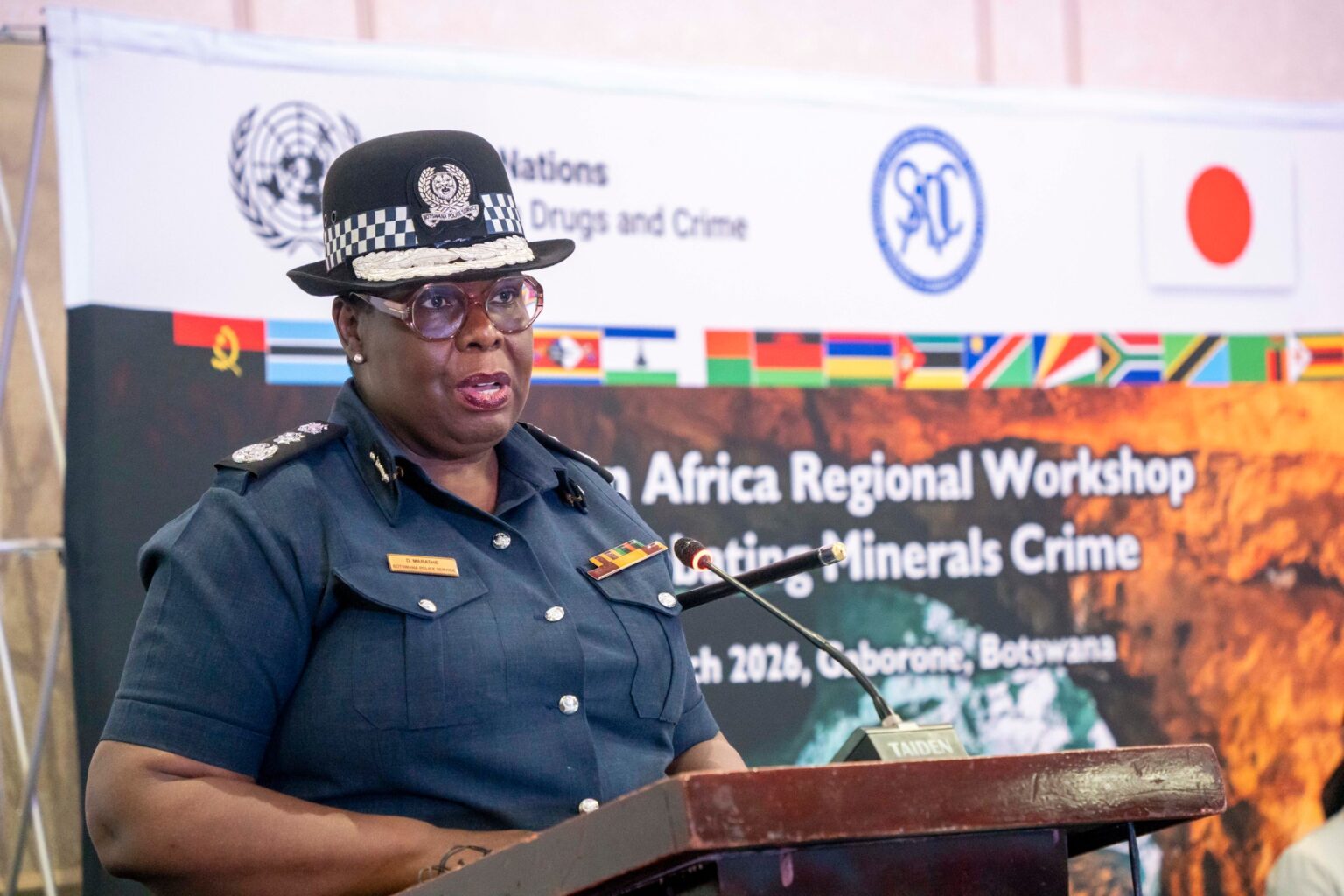
The Commissioner of Police in Botswana, Dinah Marathe, has called for stronger regional cooperation to address the growing threat of mineral related crimes across Southern Africa. She made the remarks in Gaborone while officially opening the Southern Africa Regional Workshop on Combating Mineral Crime. The workshop was facilitated by the Southern African Development Community and brought together law enforcement agencies, regulators, and security experts from across the region. Commissioner Marathe emphasized that organized criminal networks are increasingly targeting mineral supply chains connected to the global clean energy transition. Her remarks highlighted the urgency of coordinated action as demand for valuable minerals continues to increase worldwide.
During her address, Commissioner Marathe warned that the rising global demand for minerals such as lithium, cobalt, diamonds, and gold has intensified the risk of illegal mining, smuggling, corruption, and money laundering. These activities threaten economic stability and undermine the legal mineral trade that supports national development. She explained that mineral related crime is no longer limited to local operations but is rapidly evolving into transnational organized crime. Criminal networks often operate across borders, using complex supply chains and financial systems to move illicit minerals and profits. This situation makes regional collaboration critical for monitoring and controlling the movement of valuable resources.
Commissioner Marathe also stressed the need for law enforcement organizations to identify regulatory and coordination gaps that criminals could exploit. Weak oversight and inconsistent regulations across countries can create opportunities for illegal mining operations and mineral trafficking. She encouraged authorities to review policies and strengthen enforcement mechanisms to ensure criminals cannot manipulate legal systems. Intelligence sharing among countries was identified as a key strategy for identifying criminal networks and disrupting their operations. According to the Commissioner, effective responses require coordinated investigations, information exchange, and stronger partnerships between police services and regulatory institutions.
The Commissioner further highlighted the importance of collaboration between law enforcement agencies, customs authorities, and financial intelligence units throughout the region. These institutions play different roles in detecting suspicious transactions, monitoring mineral exports, and tracking financial flows linked to illegal activities. Joint investigations and cross border operations can help dismantle criminal networks that operate across multiple jurisdictions. She urged participants attending the workshop to transform discussions into practical strategies that can be implemented in their respective countries. Protecting mineral resources requires consistent enforcement and a unified regional response.
Representing the Southern African Development Community Secretariat, Senior Officer for Public Security Ms Kealeboga Moruti also emphasized the importance of cooperation among member states. She noted that criminal activities connected to mineral resources rarely remain confined to one country. According to Moruti, the region’s strength lies in unity because criminal networks operate without regard for national borders. Sustained collaboration among police services, regulators, and policy makers is essential for building effective countermeasures. Regional partnerships allow countries to share expertise, improve intelligence networks, and coordinate enforcement actions.
The three day workshop is supported by the United Nations Office on Drugs and Crime and the Government of Japan. It brings together regional law enforcement agencies and regulators to strengthen strategies aimed at preventing and combating mineral related crimes. Participants are expected to exchange experiences, review current challenges, and develop coordinated approaches to safeguard mineral resources. The discussions will also focus on improving policy frameworks and enhancing investigative capabilities across the region. Such initiatives help strengthen the capacity of Southern African countries to protect natural resources from exploitation by criminal networks.
The workshop reflects the growing recognition that mineral resources are both an economic opportunity and a potential security risk if not properly managed. As the global demand for minerals used in renewable energy technologies continues to rise, the pressure on mineral rich regions will increase. Strong governance, effective law enforcement, and regional cooperation will play a critical role in protecting these resources. Commissioner Marathe’s call for collaboration highlights the importance of collective action in addressing cross border mineral crimes. By working together and implementing coordinated strategies, Southern African countries can protect their natural wealth and ensure that mineral resources contribute to sustainable economic growth.